|
Dan
Martinets used to walk along the railroad
tracks running through the heart of his hometown, Granger,
and dream of getting on one of those trains and never coming back.
That was in the 1920s, when both Granger
and Martinets
were young and in their prime. Now Granger would seem to be yet another
small town with a great future behind it and Martinets has passed
on; he died two days before Christmas last year. |
Abandoned tracks
west of Granger
TE Photo 2004 |
| Dan
Martinets knew Granger
in its heyday. He knew photographer John
Trlica and he knew King Cotton and the Katy railroad. He saw the
town rise and fall and grew to love it after a decades-long absence.
He became the town’s unofficial historian and goodwill ambassador.
For anyone who cares about how we got where we are today or who has
a soft-spot for kind-hearted old gentlemen, he will be missed. |
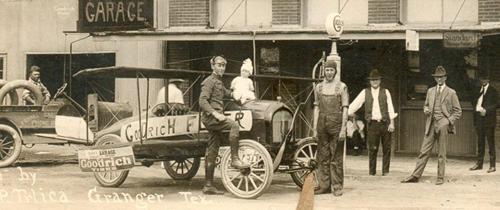
| Baby Dan Martinets
(on hood) was already absorbing Granger history in the late 1920s |
| Granger
basically emerged full-blown from the Blackland Prairie in eastern
Williamson
County when the Houston and San Antonio branches of the Missouri-Kansas-Texas
Railroad – commonly referred to as the Katy – intersected where Granger
sits today. The main street of the new town was named Davilla, for
a nearby community. The town’s first unofficial mayor was H. B Wright,
who sold lots for Captain A.S. Fischer and proclaimed, “Granger is
sure to be a town.” |
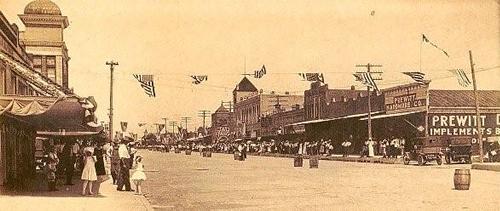
| Davilla Street
awaiting a parade (Looking west - city hall building on right.) |
| The men who laid
out the city had a grand vision of what the town could become. They
made Davilla Street 100-feet wide, eventually stretching the town
west of the railroad tracks. Because the Blackland dirt that was such
a blessing for farmers was such a liability in town when it rained,
the city took on the task of bricking Davilla Street in 1912. The
wide brick street set the town apart from others in the area. The
Granger News declared: “Granger is said to boast the distinction of
being the only city in the state, of less than 5,000 inhabitants,
that has paved streets or is in the process of paving them.” |
Granger's (now)
historic bricks on the west side of town.
TE photo, 2004 |
Granger’s brick
streets were recognized on May 7, 2005 with a Texas Historical Marker.
Martinets was there and spoke at the ceremony, but the driving force
behind the effort to have the streets officially recognized was the
late Loretta Mikulencak, an astute and dedicated local historian
who passed away in 2003, two years before the official designation.
She provided all the documentation for the marker to the Texas Historical
Commission.
Many of the original bricks were gone by the time the historical marker
was unveiled. Water lines destroyed some and the Texas Department
of Transportation tarred and paved part of the street when it became
part of FM 971. About a block-and-a-half of West Davilla is still
bricked.
Mikulencak, in pushing for the designation, wrote the historical commission
that bestowing historical status on 600 feet of brick would in itself
be insignificant.
She wrote: “The true value of such a designation lies in the recognition
and affirmation of the efforts of those early pioneers and the township
they created; validifying the most basic fact: that they once lived
and built a great community. Without such recognition, their era would
be lost to history, as if they and the town they founded had never
been.”
One of the people who helped make true the founders’ grand vision
for the town was A.W. Storrs, who constructed the Storrs
Opera House at the corner of Davilla and Granger Streets just
after the turn-of-the-century. An elaborate, two-story brick structure,
the Storrs Opera House became a cultural center on the prairie, drawing
the Chicago Opera Company and other top-flight entertainment to the
Blacklands. Ella Storrs, A.W.’s wife, founded the “Eat, Drink and
Be Merry Club” and started the drive for Granger’s city clock. She
donated many hours caring for the city cemetery, where she, A.W. Storrs
and their four children are buried.
In later years, the Storrs Opera House was utilized as a stage for
school activities and later housed a weekly newspaper and various
repair shops. The building was eventually torn down to make room for
a parking lot, a fact that Dan Martinets never quite got over.
“My God, you can put a parking lot anywhere,” he groused. “Why tear
down one of the town’s most beautiful buildings for anything, much
less a parking lot?”
By 1909 Granger had
a modern electric power and light plant and was at the center of one
of the top cotton-producing areas in the state. Williamson County
produced 89,237 bales of cotton
during the 1899-1900 ginning season, more than any other county in
the state.
But farmers asked too much of the rich Blackland dirt and planted
too much cotton. After the boll
weevil hit Williamson
County in 1923, King Cotton was on its way to being a pauper.
By the late 1930s, the county had become the top corn-producing county
in the state. |
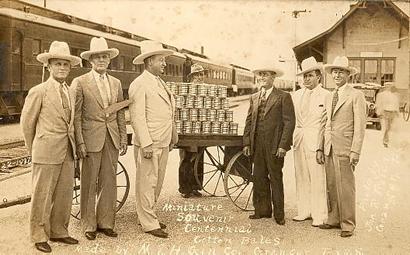 |
| Granger Officials
in 1936 sending miniature bales of cotton to the Texas
Centennial |
| In 1938, leaders
of the Texas Grange, the East Texas Chamber of Commerce and Texas
A&M agencies joined forces to stage the Corn Carnival, the first one
ever held south of the Mason-Dixon Line. About 20,000 people showed
up, most of them by automobile; the railroad was still the preferred
method of shipping, but the car had replaced the train as America’s
favored means of travel. |
| Granger photographer
John Trlica chronicled the Corn
Carnival, along with nearly every major event that took place in Granger
from 1924, when he opened his photography studio, until it closed
in the mid-50s. |
A
collection of Trlica’s pictures are
collected in Barbara McCandless’ excellent book “Equal before the
Lens: Jno. Trlica’s Photographs of Granger, Texas.”
Martinets, whose grandfather first employed Trlica
on the farm when he arrived in Granger,
said he was stunned to see the book’s cover with a picture of a young
Hispanic boy with long thick black hair holding an ear of corn.
"The boy's name was Louis
Escobedo,” Martinets said. He was quite the little rascal. You’d
hear a big whoop and it would be Louis chasing one of his brothers
down the street.”
(See Update
- Editor)
|
|
|
The ear
of corn was deemed worthy of inclusion in the photo because
it bore a sign of the cross, which Louis’s father, Jose
Escobedo, believed foretold of a great war. This was nine years
before the Japanese bombed Pearl
Harbor, but about the same time Hitler was coming to power in
Germany.
“The Martinets family was to become very important in Trlica’s
growth, influencing his life in the church, in retail business,
and, most importantly, in photography,” McCandless wrote. “Trlica’s
belief in photography as something that should be available to everyone,
not just the upper class, set him apart in his day.”
Martinets agreed with assessment. “For his time, I guess you would
have to say he was avante garde,” he said. “He photographed Black
folks, Hispanic folks. He might not have known it but he probably
took pictures of the Ku Klux Klan too.”
|
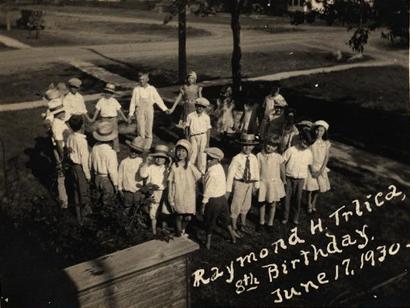
Raymond Trlica's
8th Birthday
TE Archives |
Trlica
kept his prices low to make sure the people of his little town could
afford his services. The foundation of his business was portraits
made from four-by-five inch glass plate negatives with a postcard
layout on the other side. These could be sent through the mail, like
a postcard. He sold half a dozen of these portraits for a dollar.
Granger’s town and
social scenes provided the subject matter for most of Trlica’s
postcards and functioned as advertising for local businesses, including
his own. His influence didn’t extend far beyond Granger’s city limits
but because of that he was able to chronicle in photographs an almost
complete history of the town.
Trlica saved more than 15,000 film and
glass plate negatives, several hundred prints and bits and pieces
of studio equipment. Even more remarkable, he saved his original studio
ledgers, which helped identify and date the images. |
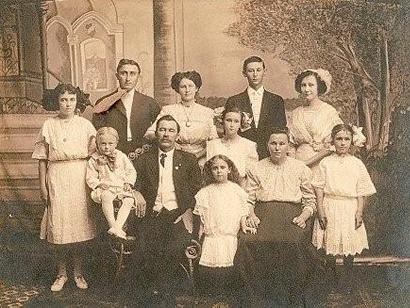
| The J.F. Martinets
Family |
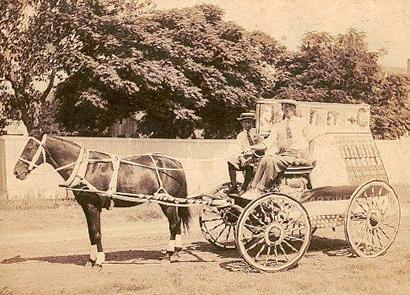
| The Martinet's
Store Delivery Hack |
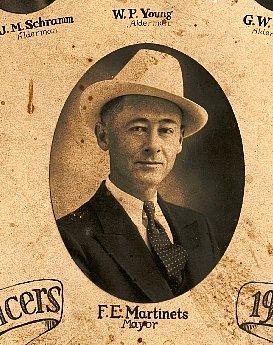
| Mayor F. E. Martinets
in 1934 |
Dan
Martinets’ father appears in several of the book’s photographs. One
man in a picture with Martinets’ father was a man that he remembered
becoming a lobbyist in Washington, D.C.
“He represented Granger
in Washington,” Martinets recalled. “One day you would see him driving
to market with a couple of filthy, squealing pigs in his car. The
next thing you know, he’s riding a limousine in Washington.” With
Martinets gone, there’s no one left in Granger with those kinds of
memories, and Granger
is poorer for it. |
Dan
eventually bought that one-way ticket out of town and spent most of
his adult life working in the production end of the advertising department
at Neiman-Marcus in Dallas.
“It was an interesting life,” he said of his Dallas years. “You got
to see how the wealthy people lived.”
When he retired, he headed toward Padre Island because, after careful
consideration, he had decided to spend his retirement years as a beach
bum. He stopped at his mother’s house on his way to the coast, but
she slipped and broke her hip while he was there, and Martinets stayed
on to look after her. She died in 1998, at the age of 104. |
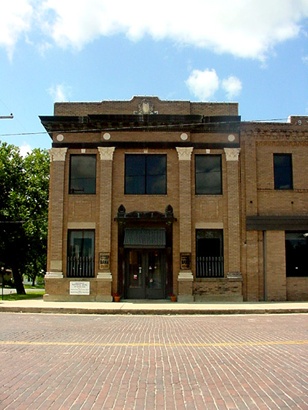
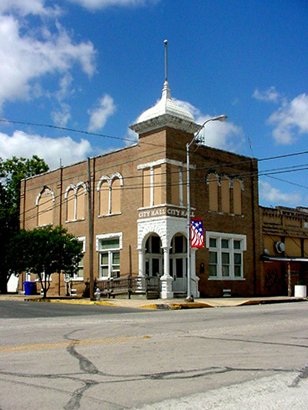
Granger's Moorish
City Hall
TE Photo, July 2002 |
Journalist Dick
Reavis, who lived in Granger for a number of years knew Martinets
and when the Troessers of Texas Escapes Online
Magazine inquired about Granger's distinctive city hall, the staff
called Dan directly. Somewhere along the line, Dan, as unofficial
historian, was given the (equally unofficial) sobriquet "The
Lone Granger" - a name that Dan sometimes used on his correspondence.
Not long after the Troessers’ visit, I dropped by Martinets’ place
to visit. He talked about John Trlica,
about a firebug who set fire to many of the town’s old wooden buildings
and a double-murder
and a runaway
bride. He shared his memories of Hollywood actors Rip
Torn and Sissy Spacek, native Texans who spent a good part
of their respective childhoods visiting Mary Spacek’s house across
the street from where Martinets lived.
“It was the first two-story house in Granger,”
Martinets said. “That was very exciting to a kid.”
Martinets remembered Rip
Torn as a little boy who would occasionally challenge Mary Spacek’s
patience. “He had a little yellow scooter he drove like mad. His grandmother
(Mary Spacek) would yell out, ‘Slow down, Skippy! Slow down!”
As might be imagined, Skippy rarely heeded the warning.
Torn presided over Granger’s Lakefest in 1986, not long after he received
an Academy Award nomination for his portrayal of the farmer Marsh
Turner in “Cross Creek.”
Though Torn doesn’t make it back to Granger
as often as he used to, Martinets remembered when he flew back to
Texas from Spain, where he was playing Judas in “King of Kings,” to
attend Mary Spacek’s funeral.
“I remember him going up and kissing the casket,” he said. “I remember
that because it was such a touching, human moment. It was genuine.
He wasn’t acting.” |
 |
|
The Spacek family
headstone
TE Photo
|
Sissy
Spacek appeared at Lakefest the year before Torn, her cousin,
had the honor. She had just won an Academy Award for her performance
as Loretta Lynn in “Coal Miner’s Daughter.” Like Torn, she served
as Grand Marshal and received a proclamation from the state declaring
May 11, 1985 as “Sissy Spacek Day.”
Spacek’s father, A.E. Spacek, was with his daughter at the 1985 Lake
Fest and spoke to a reporter with mixed emotions about his old hometown.
“It’s the same story to be found in all small towns which used to
be agriculturally important,” he said. “Now they’re dependent on industry
and they’re in trouble…This is the friendliest, most wholesome town
I know. This is a great little community. These people never give
up – no way – and I’m proud to call it my hometown.” |
|
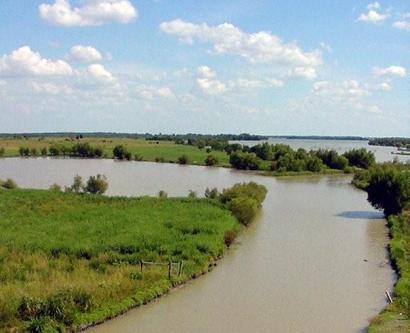
Where the San
Gabriel River meets Granger Lake
TE Photo
|
A
lot happened in Granger
during Martinets’ absence. Perhaps the most significant thing to happen
was the construction of a dam on the San Gabriel River
that created Granger Lake. The river has always had a tendency
to flood, especially when low-pressure systems park themselves west
of the Balcones Escarpment. A monumental 1921 flood made a dam on
the San Gabriel a priority in Williamson
County.
In September of ’21 a hurricane made landfall at Tampico, Mexico,
roared through South Texas
and stalled over Central Texas, dumping 38.21 inches of rain on the
town of Thrall
in 24 hours; to put it in perspective, Central Texas averages about
32 inches of rainfall in a year. More than 200 Texans drowned in that
flood, including 92 in Williamson
County. Livestock, bridges, houses, churches, stores, barns and
people – all washed away.
That the building of the dams would turn into one of the most contentious
issues to ever shake Williamson
County could hardly have been imagined at the time. Over the next
few decades, the controversy would erupt into something of a Williamson
County Civil War that literally pitted brother against brother and
neighbor against neighbor.
In those early days of talk about damming the river, most people assumed
the dam or dams would be built in the western part of the county because
the eastern end, around Granger,
had some of the state’s most productive farmland. That’s why it came
as such a shock in 1948 when the U.S. Army Corps of Engineers announced
that it had decided to build one big dam, at Laneport, near Granger.
|
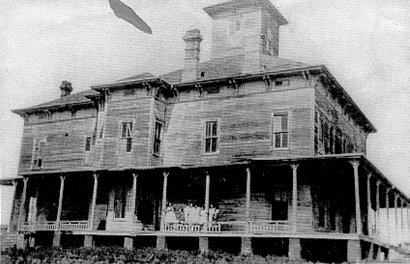 |
| A local landmark,
the Hoxie House burned in the 1930s |
Ultimately, two
dams were built, one in the western end of the county that created
Lake Georgetown, and one in the eastern end that formed Granger
Lake. Granger Dam and Lake was dedicated in 1978, more than
five decades after the 1921 flood and 21 years after a similar flood
in 1957. It began operating in 1980. More than 200 Blackland farms,
along with whole communities like Friendship,
disappeared under the waters of the new lake.
The long and ultimately decisive battle over the dams is detailed
in Linda Scarbrough’s outstanding 2005 book, “Road, River, And
Ol’ Boy Politics: A Texas County’s Path from Farm to Suburb.”
One of the people Scarbrough talked to for her book was Loretta
Mikulencak. Aside from being an outstanding local historian, Mikulencak
served as Granger’s
school tax assessor and collector for many years; she saw the impacts
of the lake from several perspectives. |
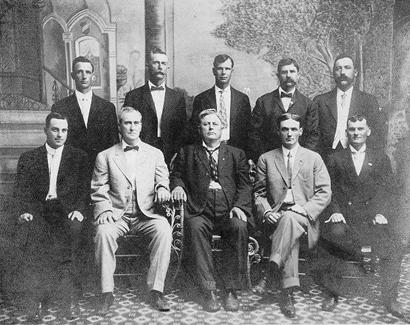
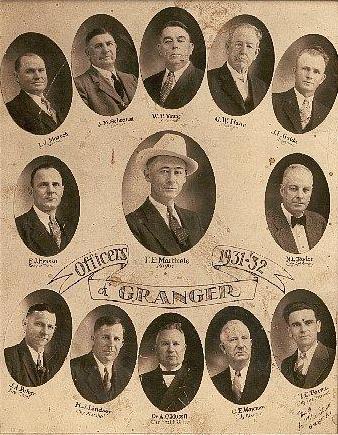
| Granger City
Council (Date Unknown) |
| Granger City
Officers 1931-32 |
| “The Corps offered
certain people high dollar for their land, but everyone was at their
mercy,” she told Scarbrough. “The chief damage to Granger
was getting those (Czech) families out of there; they were stable
farm families who had inherited their land and they were not going
to leave. They never recovered… They just died, one by one. And the
worst of it was that it made us bitter; it made us what we weren’t.
It made us different people.” |
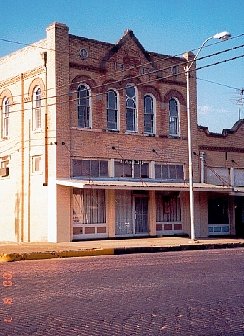
| The Martinets
Store in 2000 |
These
days, Granger keeps
getting referred to by big-city types as one of the state’s “best
kept secrets.” The Cotton Club in downtown Granger has been called
that, but its hard to think of it as too big a secret on certain Saturday
nights when the place is packed with people dining, dancing and drinking.
Even on certain weekdays Granger
can be just this side of bustling. Though I don’t live in Granger,
I have a Granger address and some of the affairs of daily living often
take me there. I can say without fear or favor that the people I know
and encounter in Granger are among the friendliest and most down-to-earth
people you are going to find in Central Texas.
In recent years, Granger
has served as the setting for several movies, including a documentary
on the Newton Boys, the Hollywood productions of “When Zachary Beaver
Came To Town,” “The Return” and parts of the Spike Lee movie, “25th
Hour.” |
|
“We may be poor
but at least we’re picturesque,” Martinets once remarked.
The battle over the dams is but a distant memory to even the old-timers;
now people in the Blacklands see the proposed Trans-Texas Corridor
as the biggest threat to Granger
and the other little towns on Highway 95 like Bartlett,
Holland
and Little
River-Academy.
The exact route of TTC-35, the first segment of a proposed series
of six-lane highways cris-crossing the state, has not yet been finalized
but one proposal shows TTC-35 running through, or at least very
close to, Granger.
While Granger has
accepted Granger Lake, as its annual Granger Lake Fest shows, it’s
hard to imagine any future celebrations over the corridor, especially
if it wipes out the town. The scope and time frame of the corridor
are so immense as to make the very idea seem almost abstract, but
Granger knows better
than most towns how imaginary lines on a map can turn into the next
life-altering reality.
Whatever happens to Granger
in the future, good or ill, there are some of us who can’t help
but think what a shame it is that people like Loretta Mikulencak
and Dan Martinets won’t be around to tell future generations about
it.
© Clay Coppedge
"Letters from Central Texas"
October
3, 2008 Column
See Letter
of Correction on the book Equal before the Lens
|
|
|
 HOME
HOME