|
There are two
turpentine stories worth telling in East
Texas -- one a forgotten town; the second, a forgotten way of
life.
First, the town -- a settlement established in 1907 by the Western
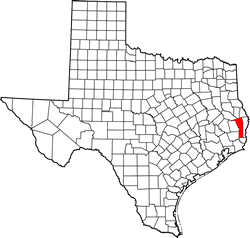
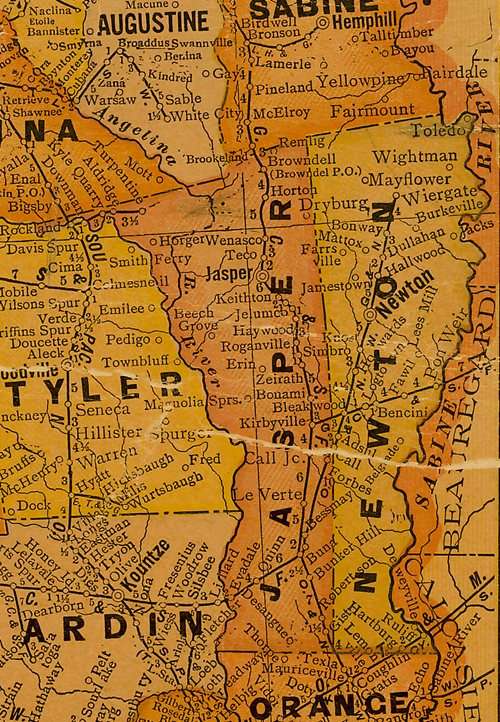
Naval Stores Industry in the virgin longleaf pinelands of Jasper
County as a turpentine camp and distillery.
Actually a "mother camp" for the company in Southeast Texas, Turpentine
employed about 80 men and had a population of l25 at its peak in 1910.
By 19l5, the company had 16 subsidiary camps in Jasper,
Sabine, Newton
and San
Augustine counties. In 1918-19, at the peak of the turpentine
industry in the South, Texas and two other Southern states -- Louisiana
and Mississippi -- produced some 21 percent of the nation's gum output
before the industry started to fade. |
Turpentine --
as well as its offspring camps -- generated a lawless breed of men
and a way of life that led loggers to look down upon "turpentiners."
Chester Norris of Broaddus, who in 1973 shared his memories as a turpentine
camp boss with a writer, said turpentiners "were the meanest people
who ever lived."
"They'd kill each other...one or two every Saturday night. If they
didn't have gambling and a barrel house to get drunk in, they'd move
on to camps where they did have 'em."
Norris, whose father was also a turpentiner, remembered that he and
others "had to patrol the camps on Saturday nights, breaking up fights,
trying to keep them from killing each other."
Norris said the outside law "didn't pay us any mind...it was turpentine
law and we took care of our own camps."
Norris remembered a camp incident when a worker who kept his money
tied around his leg got drunk and fell asleep in a house used to store
wooden barrels). "A fellow came in with a razer-sharp apron knife.
He chopped off the man's leg at the knee, grabbed the leg and left."
Another incident occurred, according to Norris, when a worker named
Molasses was shooting craps with several other turpentiners. "A man
came in with a gun to shoot another fellow in the game, but Molasses
was between the two. The fellow with the gun hollered at Molasses
to duck, but he didn't. The bullet went in Molasses' forehead and
slid around under the skin and came out behind his ear. Molasses wrapped
his head in a red handkerchief and went right on shooting craps."
Turpentine workers collected sap from the pines by "notching" or gouging
holes into the sides of the trees to let the sap run down the sides.
Cups were then attached to the notches and once a week the turpentiners
would empty the cups into barrels scattered throughout the woods.
A barrel wagon regularly made rounds to pick up the full barrels.
The sap was then taken to stills -- which operated somewhat like a
whiskey still -- to generate turpentine. The stills were able to handle
about l5 barrels at a time.
The turpentine industry in East
Texas was usually referred to as "the naval stores business,"
a term originated when tree gum was used to tar the rigging and caulk
the hulls of sailing vessels more than a century ago.
Early turpentine workers in East
Texas seldom made much money. But there were benefits other than
the pay. Norris said turpentiners seldom got sick in the camps.
"How could they get sick? They breathed in enough turpentine fumes
to kill all the flu and pneumonia bugs in the world."
All Things Historical
July 15,
2001 column
Published by permission.
(Bob Bowman is a former president of the East Texas Historical Society
and the author of 24 books on East Texas history and folklore.) |
 |
|
|
 HOME
HOME