|
|
Aldridge
is perhaps the most isolated and desolate of East
Texas’ ghost towns--a somnolent cluster of weathered concrete
and brick ruins wrapped in the growth of a Neches River forest.
Nearly a century ago, the old ruins were the backbone of a sawmill
town whose fortunes rose and fell with the vast virgin pinelands of
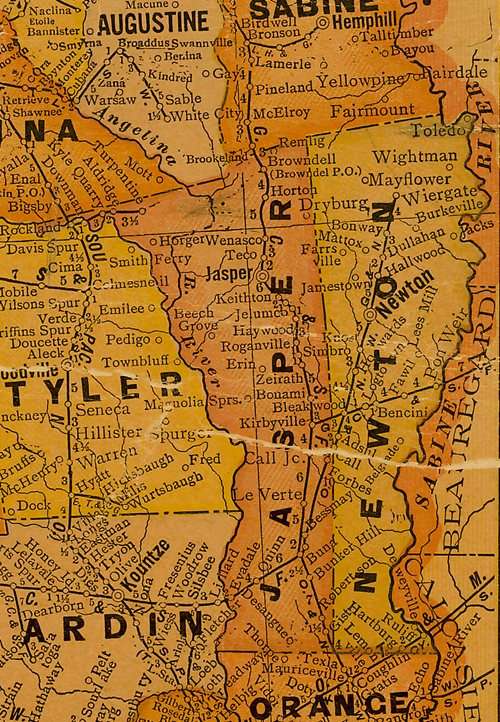
Jasper and Angelina
counties.
The town lasted less than 20 years, but the sawmill’s sturdy buildings
that were abandoned on the river’s bank have kept Aldridge’s legends
alive.
Unfortunately, the buildings have been tarnished by graffiti, chipped
by inconsiderate campers, and trashed by wanderers. It has been a
sad ending for one of the few remaining early sawmill complexes in
East Texas.
Today, however, the U.S. Forest Service is riding to Aldridge’s rescue.
The federal agency, which administers the Angelina National Forest
where Aldridge stands, has closed the buildings to public access because
of deterioration, vandalism, and structural problems.
The buildings will remain closed until a team of archeologists and
engineers can assess the site and develop plans to make it safe and
accessible for the public.
Lumberman
W.H. Aldridge came to this corner of East
Texas around 1900. Impressed with the thick pine forests he found
along the Neches River, he established a mill site in 1903, guiding
hundreds of men and tons of machinery--some by river barge, some by
ox cart--to a sweeping bend on the river near Burr’s Ferry Crossing.
Pouring concrete by hand, Aldridge’s men built two massive dry kilns
and a powerhouse with floors four feet thick. They also built a two-story
wooden building to house the giant saws that ripped through the pines,
a concrete engine room, and other massive concrete structures.
While the work was time-consuming and laborious, Aldridge’s crews
put into the buildings ornate roof lines, archways and an architectural
sophistication seldom seen in sawmills. It seemed as if they expected
the mill to last for centuries.
The town of Aldridge began to shape itself around the mill--including
a large commissary store, a hundred or so houses for sawmill families,
a school, and a church--all made from Neches River pine. A railroad
line--the Burr’s Ferry, Browndell and Chester Railroad--soon connected
the town with a main line at Rockland.
Aldridge’s mill was soon producing 100,000 board feet lumber a day
and shipping it to booming Texas cities like Dallas,
Houston, and Beaumont.
When W.H. Aldridge decided to sell the mill and move to El
Paso, the mill was sold to a man named Trevathan, but in a year
he sold the company to Keith Lumber Company. In another year, it was
owned by Kirby Lumber Company, which operated a sister mill at nearby
Browndell.
Aldridge reached the peak of its prosperity around 1912, but three
years later a fire burned down the sawmill and parts of the town.
The mill’s owner decided not to rebuild the mill, and in the 1920s
workmen began to smash holes in the concrete buildings to remove the
mill’s machinery. The railroad tracks were taken up in 1925.
The U.S. Forest Service acquired the town site and much of the cutover
forests in the l930s, incorporating the holdings into the Angelina
National Forest.
Today, the ruins of Aldridge loom like forgotten monuments deep in
the forest, waiting for someone to remember their rich history in
the lumber industry.
© Bob
Bowman September 12, 2011 Column
|
 |
| Texas
Escapes, in its purpose to preserve historic, endangered and vanishing
Texas, asks that anyone wishing to share their local history and recent
or vintage/historic photos, please contact
us. |
|
|
 HOME
HOME

 Texas
Gulf Coast
Texas
Gulf Coast East
Texas
East
Texas Central
Texas North
Central
Texas North Central
Texas South
Central
Texas South Texas
Panhandle
Texas
Panhandle South
Texas
South
Texas Texas
Hill Country
Texas
Hill Country West
Texas
West
Texas Texas
Ghost Towns
Texas
Ghost Towns Texas
Counties
Texas
Counties