|
 |
History in
a Pecan Shell
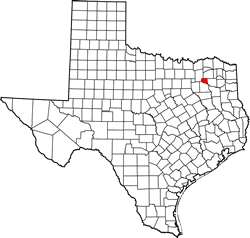
Originally
known as Springville, it was changed to honor early settler
Emory Rains, when Rains
County was organized in 1870. Emory became the county seat and
the first courthouse was a log building. A second courthouse was built
(1872) but soon burned (1879). A third (brick) courthouse, constructed
in 1884, burned in 1890.
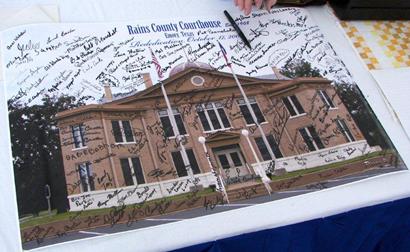
[See Rains County
Courthouse]
The Denison and Southeastern Railway arrived about 1880, establishing
Emory as a shipping point for lumber. In 1885 the town's population
was 600.
By the end of 1929 the population reached 1,000 but two years later
it had declined to 750, and by 1936 it had dwindled further to 447.
After the construction of Lake Tawakoni in the late 1950s,
a number of retirees began settling in the area boosting the population
back to the 1929 population of 1,000. |
Emory,
Texas Landmarks / Attractions
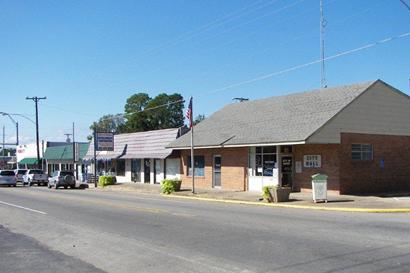
The Courthouse
Square, Emory City Cemetery
and Emory Rains, the town's namesake |
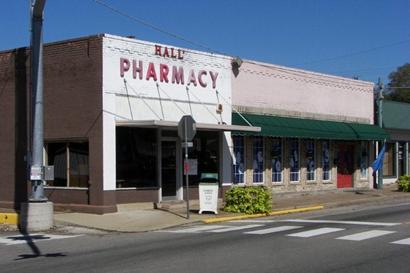
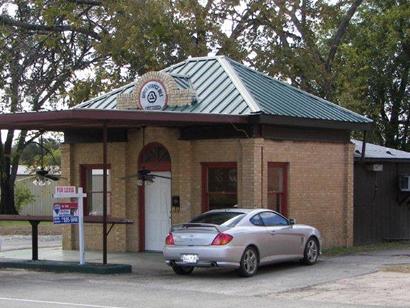
"Hall's
Pharmacy on N. Texas St. The red doors are the entrance to the local
newspaper, the Rains County Leader."
- Terry
Jeanson |
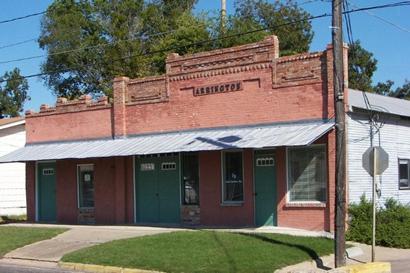
"The Arrington
Building on the north side of the square. Businesses failed to develop
on the north side of the courthouse square due to the lack of a north
side entrance on the courthouse."
- Terry
Jeanson, October 2009 |
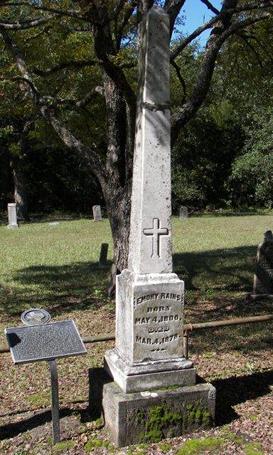
Gravesite of
county and county seat namesake Emory Rains at the Emory City Cemetery.
- Terry
Jeanson, October 2009 |
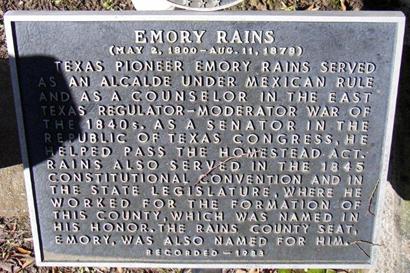
Emory Rains
Grave Marker
(May 2, 1800 -
Aug. 11, 1878)
Texas pioneer Emory Rains served as an alcalde under Mexican rule
and as a counselor in the East
Texas Regulator-Moderator
War of the 1840s. As a senator in the Republic of Texas Congress,
he helped pass the Homestead Act. Rains also served in the 1845 Constitutional
Convention and in the State Legislature, where he worked for the formation
of this county, which was named in his honor. The Rains County Seat,
Emory, was also named for him. |
 |
Emory Texas
Chronicles:
News
Bits by Mike Cox ("Texas
Tales" column)
... Those whirling funnels of high wind Texans keep an eye out for
each spring used to be known as cyclones, not tornadoes.
Whatever they are called, they are capable not only of wreaking terrible
destruction, but doing things than can only be called weird. Take,
for example, what happened to John Zimmerman’s mule.
A farmer who lived near Emory, in Rains County, told the Rains County
Leader that a cycle had hit his place, picking up one of his mules
and carrying it whirling through the air for a hundred yards.
After the tornado set the animal down, the May 30, 1913 article continued,
it “stood bewildered for a few minutes, then ran to a wooden pasture
nearby, braying loudly. Since then the animal has not been seen.”
|
| Texas
Escapes, in its purpose to preserve historic, endangered and vanishing
Texas, asks that anyone wishing to share their local history, stories,
landmarks and recent or vintage photos, please contact
us. |
|
|
 HOME
HOME