|
|
The only visible
reminders of Old Fairmount, an early East
Texas community in southern Sabine
County, are a well-kept graveyard and a church founded in 1887.
The community was settled in the early 1850s around the swift, clear
waters of South Prong Creek, which was used by pioneers as a source
of fresh water and to power a grist mill and sawmill.
The community, supposedly named for an attractive mound in the area,
received a post office in 1854 and had a population estimated at
seventy in 1884. In addition to its grist mill and sawmill, the
community also had a cotton gin, a school, a blacksmith shop and
a general store. By 1896, the community’s one-teacher, one-room
school had thirty-one students.
One of the earliest roads in the Fairmount area led from Sabinetown
Ferry, a crossing on the Sabine River. A fork in the road led
to another river crossing, Hadden’s Ferry.
|
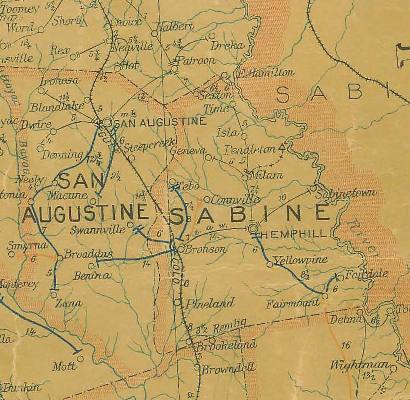 |
1907 Sabine
County postal map showing Fairmont
(Below "E" in "S-A-B-I-N-E", S of Hemphill
)
From Texas state map #2090
Courtesy
Texas General Land Office |
|
Edward
Smith
One Fairmount resident, Edward Smith, deserves his own place in
history. When he reached eighteen, he enlisted in the Confederate
Army to fight in the Civil War. When federal naval forces approached
the Texas coast, Smith and others in his company pushed through
the East Texas swamps
to reinforce Lieutenant Dick
Dowling and his Texas forces at Sabine
Pass.
The battle, the only Civil War conflict fought in East
Texas, saw Smith, Dowling
and about 40 other soldiers outnumbered 100 to one. But the Texans
had no deaths or injuries while the federal force of 27 ships had
about 400 men injured, captured or killed. The Texans were so fierce
that the battle lasted only forty-five minutes. Following the end
of the war, Smith came home to Fairmount, served as its postmaster
25 years, and became a Baptist preacher. The bravery he showed at
Sabine Pass
is also evident in a story told by his descendants.
Smith was walking with his dogs in the woods when a bear started
chasing him. Smith scrambled up a tree and when the bear started
climbing after him, Edward whipped out his pocketknife and slashed
the bear’s head and paws while his dogs nipped at the bear’s heels.
The bear retreated, started chasing the dogs, but returned to climb
the tree again. Again the dogs nipped at the bear, who started chasing
them a second time. The distraction enabled Edward to climb down
and run home.
Fairmount
Cemetery has about 240 marked graves and about 15 unmarked graves.
One of the best known graves is that of Thomas B. Anthony, who in
the l880s volunteered to travel to Austin
to collect a reward for the killers of Texas Ranger Jim Moore, who
was shot down when he and other Rangers tried to capture outlaw
Willis Conner and his sons.
It took considerable bravery on Anthony’s part to make the long
trip, especially during a time when some of the Conners were still
on the loose.
By the 1920’s, Fairmount had begun to decline, largely because of
the development of new highways which gave Fairmount’s people easier
access to other communities.
The great timber boom also lured many Fairmount men to sawmill communities,
and World War I came
along, pulling away more men. Fairmount’s post office closed in
1937.
Today, because of Toledo
Bend Reservoir, the Fairmount area is attracting new residents,
but most of them are dispersed around the lake.
© Bob
Bowman
"All
Things Historical" August,
2007
Published with permission
|
| Texas
Escapes, in its purpose to preserve historic, endangered and vanishing
Texas, asks that anyone wishing to share their local history, stories,
landmarks and recent or vintage photos, please contact
us. |
|
|
 HOME
HOME