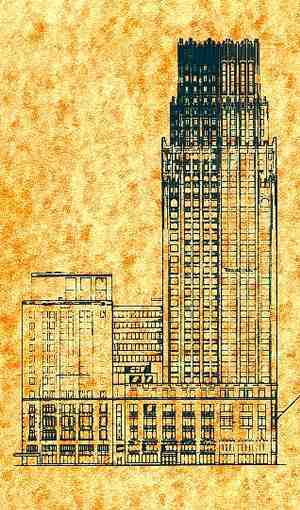
|
|
Location:
Main Street and Rusk Avenue, Houston,
Texas
Construction: 1927 to 1929
Architects: Alfred C. Finn, Principal Architect
with Kenneth Franzheim and J.E.R. Carpenter
Estimated Cost: $3,500,000 - $6,000.000
Height: 430 ft.
Style: Characteristic of 1920s American skyscrapers in Northern
cities, the Gulf Building is described in the 1990 AIA Houston Architectural
Guide as having a "crypto-Gothic" tower profile with Art
Deco ornamentation. |
|
|
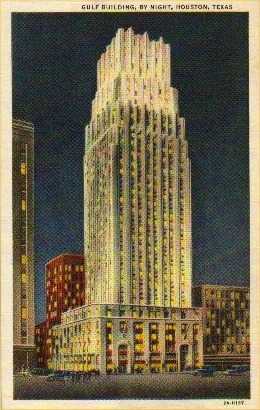
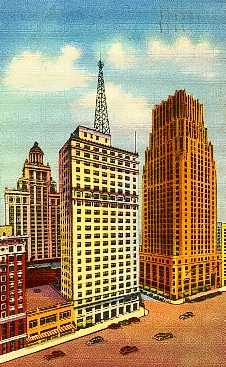
"Gulf
Building by Night"
Postcard
courtesy www.rootsweb.com/
%7Etxpstcrd/
|
|
Ten Things
You Might Not Know About the Gulf Building
- The house
of Charlotte Baldwin Allen, wife of one of the founders of Houston,
had originally been located on the site. By the time of Mrs. Allen's
death, in 1895, the neighborhood was already in transition from
residential to commercial use.
- Two annexes,
one of 13 stories and the other of 16, were added after World
War II but are freestanding structures and not attached to the
building proper.
- Atop the
37th level was a viewing platform which housed the Jesse H. Jones
Aeronautical Beacon. This beacon was described as two searchlights,
one pointed in a vertical position emitting 15,000 candlepower
and another pointed in a horizontal position emitting 8,000 candlepower.
It was touted as an aid to government mail planes.
- Also mounted
on the roof of the building was an observation deck equipped with
a telescope. It was said that on a clear day Galveston
was easily visible.
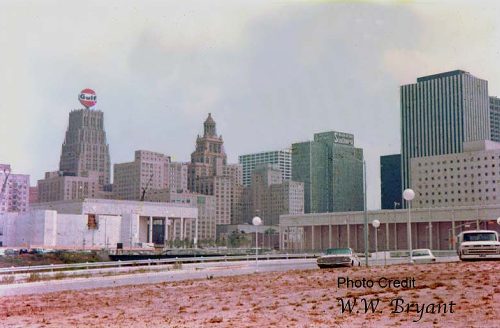
- From 1965
to 1974 a 53 foot high rotating sign with the name GULF was mounted
atop the building with 4,700 square feet of display area and 7,350
lineal feet of neon tubing.
- Pneumatic
tubes, like those found in old department stores or in drive-up
bank windows were installed in the building. Leather pouches from
this system are said to be on display on the 17th and 19th floors.
- The great
window above the Travis Street entrance, with its stained-glass
depiction of the Battle
of San Jacinto, was installed in 1960.
- It was the
tallest building west of the Mississippi River until 1931 (surpassed
by a Kansas City building), and the tallest building in Houston
until 1963 when it was surpassed by the Humble Building.
- The three
original tenants were to be the National Bank of Commerce, the
Gulf Oil companies, and the Sakowitz Brothers store.
- The Gulf
Building was one of only two Art Deco skyscrapers erected in Houston.
|
 |
|
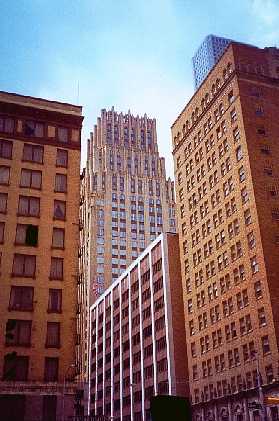
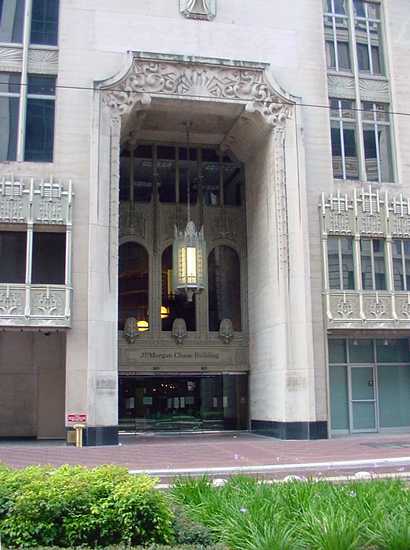
The Gulf
Building / JP Morgan / Chase Building
Main Street Entrance
|
|
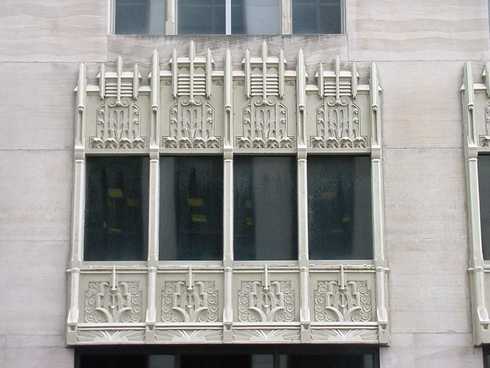
Window Detail
TE Photo 2005
|
|
|
Brick Canyon
TE Photo
2001
|
|
|
|
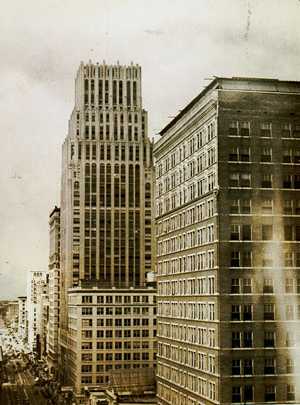
The Gulf
Building c. 1930s
Photo Courtesy
TxDoT
|
|
|
|
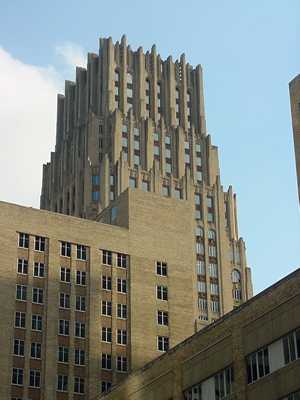
The building
as photographed by Lauren Meyers, 2006
|
|
|
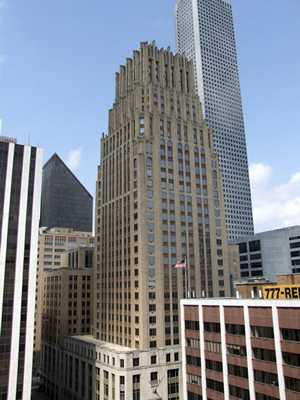
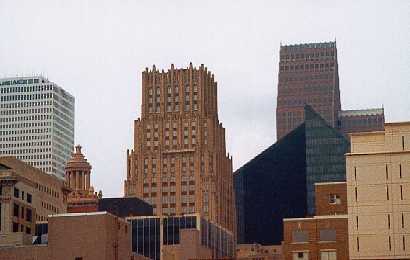
Gulf Building
with neighbors - seen from the SW
TE Photo 2006
|
"The
Gulf Building and the nearby Niels
Esperson Building remain two of Houston's most prestigious office
buildings. The lower six stories of the structure are faced with limestone,
there are three principal entrances to the Gulf Building, two from
Main Street and one from Travis Street. Along the crosswalks of the
lobby are eight frescoes illustrating historic Texas scenes. A central
air-conditioning system was installed around 1939." - from The
Texas Historic Sites Atlas
In 1987 Texas Commerce Bank (the present owner) spent 50 million dollars
on rehabilitation.
Sources: The Texas Historic Sites Atlas, The Handbook of Texas
and the AIA Houston Architectural Guide - Text by Stephen Fox |
|
|
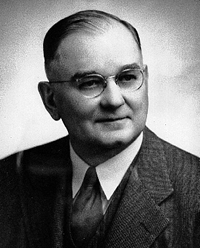
Architect
Alfred C. Finn c. 1950
"The
man who built Houston"
Photo courtesy Austin County Historical Society
|
|
Alfred
C. Finn
Alfred C. Finn,
principal architect was originally from Bellville,
Texas. Sent to work in the Houston office of Sanguinet and Staats
in 1913 he opened his own office two years later and commenced upon
a long career, becoming known as "The Man who Built Houston."
Other Finn projects included the Houston Light Guard Armory, the Lamar
Hotel, the Metropolitan and State theaters in Houston (both demolished),
the second Jefferson Davis Hospital (razed in 1989), the Federal Building
in Galveston,
the San
Jacinto Monument, the Brenham Country Club, the Simon Theater
in Brenham (undergoing
restoration in 2006), a high-rise bank in Tyler,
Texas and the former San Jacinto High School in Houston (now an Houston
Community College campus). |
|
|
The
architect's drawing.
Courtesy Austin County Historical Society |
|
Forum:
Subject: Gulf Oil building Houston Texas
Thank you so much
for Texas Esapes. My family and I have
planned many day trips from there.
Gulf Oil Building photo was taken by my Grandfather W.W. Bryant sometime
in the early 1970's. I found the picture in a box full of photos he
and my Grandmother had left to us. Unfortunately gulf air wreaked
havoc on it. I restored it to this condition using photoshop. Best
regards. - Walter S. Fuller, Conroe, Texas, August 13, 2010
See Houston, Texas
Book Hotel Here Houston
Hotels |
|
|