|
Books by
Jeffery Robenalt
|
|
| The
first president of the Republic of Texas, Sam
Houston, spent much of his term of office promoting the annexation
of Texas by the United States and striving
to maintain peaceful relations with Mexico.
The Republic’s second President, Mirabeau Lamar, had a much bolder
vision for the Republic; one that was in direct conflict with the
views of Sam Houston.
|
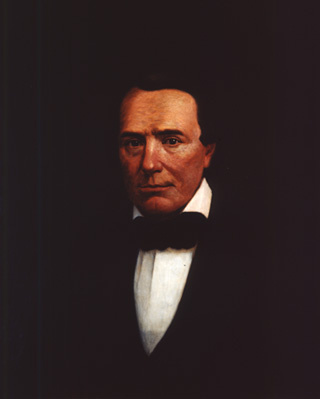 |
President Lamar
sought freedom from United States influence and, more importantly,
eventual expansion of the Republic of Texas all the way to
the Pacific Ocean. Lamar also refused to shy away from conflict with
Mexico in order
to achieve his goals. In his 1838 inaugural address the second president
of the Republic made it clear where he stood as far as relations with
Mexico were
concerned when he warned, “If peace can be obtained only by the
sword, let the sword do its work.”
The Treaties
of Velasco, one open to public scrutiny and the other kept secret,
were signed by Santa Anna after the Battle
of San Jacinto. In the public treaty the Mexican dictator recognized
Texas independence, but in the secret treaty, which he later denied,
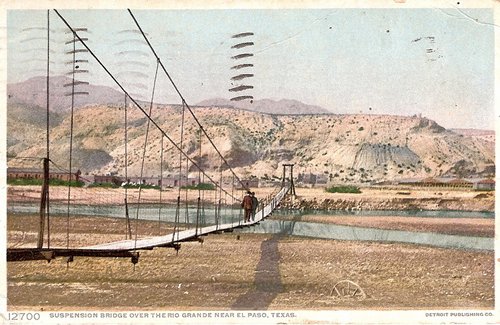
Santa Anna agreed to accept the Rio Grande River as the boundary
between Texas and Mexico;
not the Nueces River as Mexico
had long claimed. Lamar interpreted this controversial treaty provision
to include the entire length of the Rio Grande; from the Gulf
of Mexico to the river’s headwaters in the far northern foothills
of the Rocky Mountains. |
 |
Under this view,
the long established town of Santa Fe and half the province of New
Mexico would fall within the boundary of Texas.
Establishing sovereignty over New Mexico would promote Lamar’s goal
of westward expansion, but even more important, it would give the
Republic of Texas a new source of revenue. A thriving system of trade
had developed between the United States and Mexico ever since the
Santa Fe Trail opened in 1821, after Mexico gained its independence
from Spain. President Lamar, desperate for a new source of income
for the nearly destitute Republic, wanted Texas
to take control of this profitable enterprise.
In
1841, President Lamar sought Congressional approval to send an expedition
to New Mexico. However, when the Texas Congress wisely refused his
request, Lamar proposed to send the expedition on his own initiative;
ostensibly to establish a trade route across northern Texas to Santa
Fe, and to offer the citizens of New Mexico an opportunity to voluntarily
join the Republic. Of course it was rumored that should the Mexicans
refuse such a generous offer, force could always be applied if and
when the opportunity presented itself.
A call for volunteers was issued, and men gathered from all parts
of the Republic, eager to harvest the gold and silver that was said
to be lying in the streets of Santa Fe for the taking. In addition,
any merchant who was willing to ship his goods to Santa Fe was promised
both transportation and protection for his merchandise.
The 270 volunteers designated to protect the trade caravan, and perhaps
act as an invasion force if the situation called for it, were commanded
by General Hugh McCleod and organized into five infantry companies
and an artillery company. The captain of one of the companies was
well-known Indian fighter Matthew “Old Paint” Caldwell. Supplies for
the expedition and the merchants’ trade goods were carried in twenty-one
ox-drawn wagons.
The expedition, or what Andrew Jackson referred to as "the wild goose
campaign to Santa Fe," set out on June 19, 1841, from a site on Brushy
Creek fifteen miles north of Austin.
Slowly rolling north, the Texans took nearly a month to ford the Brazos
River and enter the Cross Timbers in the area of present-day
Parker County, and that was only the beginning of the agony.
Cutting their way through the thickets and underbrush of the Cross
Timbers and hauling the wagons across numerous gullies and dry
washes was backbreaking labor, and the men constantly suffered from
the intense heat and lack of water.
The wagons headed northwest when they finally cleared the timber and
soon reached the present day site of Wichita
Falls. Receiving little help from their Mexican guides, the Texans
mistakenly believed they had reached the Red River and followed the
course of the Wichita for nearly two weeks before finally taking note
of their error. By then the practically useless Mexican guides had
deserted the expedition, and McCleod was forced to send a company
of men north to search for the Red River. They returned to lead the
wagons there on August 20. |
 |
Constantly harassed
by the hit and run raids of small parties of Comanche and Kiowa warriors
and suffering from a lack of adequate provisions and a scarcity of
water, the expedition plodded slowly to the northwest until finally
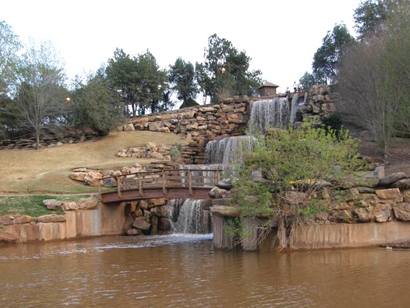
reaching the Cap Rock, a tall abrupt escarpment rising nearly
two hundred feet from the rolling plains of north central Texas. Above
the escarpment stretched the dreaded Llano Estacado, the infamous
“Staked Plains”, so named nearly three hundred years before
during Francisco Coronado’s search for the fabled “Seven Cities of
Gold.”
Unable to locate a route by which the wagons could ascend the Cap
Rock, McCleod sent a mounted party out to seek the settlements
of New Mexico while he and the remainder of the expedition waited
below the escarpment. After suffering numerous hardships, the advance
party finally met up with some Mexican traders on September 12, and
sent a guide back to lead the wagons to the top of the Cap Rock
and across the desolate high plains. The brutal journey, however,
was far from over. |
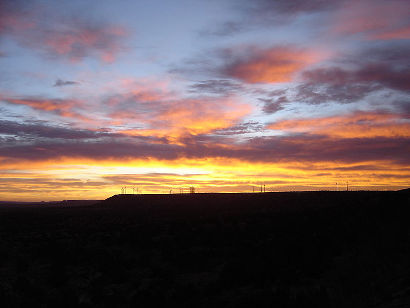 |
Llano Estacado
Caprock at Sunrise
Wikimedia Commons |
Cut by hundreds
of deep arroyos and bone dry washes, the rugged terrain of the Staked
Plains slowed the movement of the expedition’s wagons to a crawl.
Water was so scarce along the route that the Texans were constantly
thirsty, and the expedition repeatedly wandered off course because
not one man in the entire outfit was familiar enough with the vast
treeless plains to realize when the Mexican guide was making a mistake.
Finally
after suffering for nearly thirteen hundred miles since their departure
from Austin, the Texans
staggered into New Mexico; their spirits broken, their bodies lean
from hunger, and practically dying of thirst. The volunteers had naively
expected to be welcomed with open arms by the citizens of New Mexico,
but instead the ill-fated expedition was met at the border by a force
of 1500 Mexican dragoons under the command of the governor of New
Mexico, Manuel Armijo, a Santa Anna appointee. |
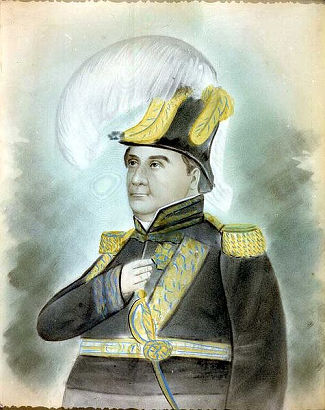
Governor Manuel
Armijo, portrait by Alfred S. Waugh ca 1840
wikipedia.com |
|
The Governor
offered the Texans fair treatment and clemency if they would agree
to surrender their weapons. After the arduous journey from Austin,
the volunteers were in no condition to fight a force that outnumbered
them so heavily, so with little choice, they surrendered. Of course,
once he had possession of the Texans’ weapons, Armijo promptly reneged
on his promise, and the Texans were immediately bound hand and foot.
That evening Governor Armijo called for a conference of the Mexican
officers to determine whether the prisoners would be executed immediately
or sent to Mexico City. After a long discussion with much heated
debate on both sides of the issue, a vote was taken. The volunteers'
lives were spared by a scant majority of one vote. The expedition’s
wagons and trade goods were confiscated, and the Governor ordered
the Texans marched in chains the entire 2000 miles to Mexico City.
During the brutal and tortuous journey, many of the men, already
weakened from their terrible ordeal, died of thirst, hunger, and
exhaustion, or the occasional musket or pistol ball to the back
of the head. Those who were fortunate enough to survive the death
march arrived in Mexico City on December 26, and were immediately
put to work repairing roads. Like most Texans taken prisoner by
the Mexicans, the unlucky members of Lamar's "Wild Goose Campaign"
eventually found their way into the dank dungeons of Perote Prison
in Vera Cruz.
When word of the debacle reached Texas,
people were furious, and most of them rightfully put the blame squarely
on the shoulders of Lamar. A letter in an Austin newspaper in January
1842, most likely written by Anson
Jones, an enemy of Lamar and a future President of the Republic,
proposed that President Lamar be exchanged for the prisoners. Of
course, Lamar avoided this fate, and the prisoners continued to
languish in Perote prison until diplomatic efforts of the United
States secured their release in April 1842.
The Santa Fe debacle was the political Waterloo for President Lamar.
Hope for continued peace with Mexico
had practically vanished, the currency had fallen to three cents
on the dollar, and public debt had risen to more than six million
dollars. Sam Houston
soon returned to the Presidency of the Republic with a plethora
of problems to solve, not the least of which was a series of incursions
across the Rio Grande by Mexican soldiers in retaliation for Lamar’s
ill-fated Santa Fe expedition.
©Jeffery
Robenalt
"'A Glimpse of Texas Past"'
February 9, 2011 Column
jeffrobenalt@yahoo.com
|
|
|
 HOME
HOME