| Little
did Annie suspect that bank employees were on the lookout for notes stolen in
the Great Northern Train Robbery the previous July. The alert McHenry, who found
loyalty to his employer to be more in his character than succumbing to the charms
of a beautiful woman, reported his findings to J.T. Howell, the head cashier.
Mr. Howell called the police and bank president, Samuel J. Keith. Howell and Keith
invited Annie Rogers to accompany them into an office, whereupon they told her
the bills were stolen.
Faster than a 911 response, detectives Jack Dwyer and Austin Dickens arrived at
the bank to question Annie, who denied signing the bills. She insisted that, if
the bills had been stolen, she surely didn't know a thing about it. Pressured
by the detectives, Annie finally said a "little blonde man named Charley had given
[the bills] to her" in Louisiana. The pair had traveled together for about two
weeks from Omaha to Louisiana where Charley continued on to New Orleans and Annie
to Shreveport. Annie insisted that the $500 was hers, that she had earned it.
Dwyer and Dickens would have none of that, and took her off to police headquarters
to be further questioned by their Lieutenant Marshall.
Annie didn't even
give name, rank and serial number. She gave only one of her names, neglecting
to tell the dicks that she was also known as Delia Moore or Maude Williams. Other
than that, she uttered only the same words about the fictional Charley, and repeating
that she didn't know the bills were stolen. This "non-denial denial" caught the
attention of Justice Hiram Vaughn, who issued a warrant charging Annie with attempting
to pass forged National Bank notes.
Annie's arrest was called "one of
the most important captures in recent years..." by the Nashville American, which
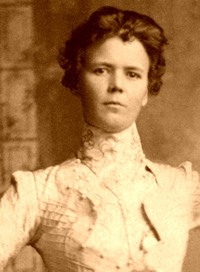
described her as "somewhat good looking, not beautiful but not ugly." If they
printed something like that today, Annie would probably hire a celebrity lawyer
and sue their pants off for calling her "not beautiful." The American went on
to say "She was slender, with a heavy head of dark brown hair, a dark complexion,
and high cheek bones. Her most noticeable features were two gold teeth on the
left side and her piercing black eyes ... [which] fairly danced as she spoke."
The same day the American story came out, the Nashville Banner sent
a reporter to interview Annie, who cheerfully greeted him as he entered her cell,
led by Detective Dwyer. Annie called Dwyer "Happy Jack" and told the reporter
he was one of her favorites. It was reported that Annie laughed, smiled, and flirted
with her visitor throughout the interview. She regretted, she said, that she hadn't
brushed her hair properly.
Next day, Annie appeared before Justice Vaughn for a preliminary hearing, wearing
a black suit, and a black hat adorned with ostrich feathers. The Banner reported
that "a deep frown gathered her brow and her piercing black eyes danced defiantly
in answer to the stares of the onlookers."
According
to Wayne Kindred's article in a 1995 issue of Old West, the following conversation
occurred:
Justice Vaughn asked her if she had heard the warrant read.
"I heard one read yesterday. I don't know whether it is the same one
or not," she answered.
He told her that it was the same warrant and asked
if she wished to plead guilty or not guilty.
"Guilty of what?" she angrily
replied. "Of taking those bills to the bank" I took them bills to the bank. Yes,
I did that."
After Justice Vaughn explained the charges again, Annie entered a plea of not
guilty. Vaughn then set her bail at $10,000, and asked her if she wanted to make
a statement.
"Nothing, but that I came by those bills honestly, and I don't see why I should
be treated this way. I had used some of the bills before, and I thought they were
all right."
The
hearing must have seriously scared Annie because, by the next day, she was closer
to telling the truth, or so it seemed: her real name was Delia Moore, she was
26, and she was born in Tarrant County, Texas. She left home in 1893 and worked
as a prostitute in Mena, Arkansas, Fort
Worth, and San Antonio (at
the bawdy house of Fannie Porter).
Between Ft. Worth and San
Antonio, she had married a farmer named Lewis Walker, but left him because
"he was just a poor farmer" and their life on the farm was altogether "too tame"
for her.
She left Fannie
Porter's house for Colorado, Idaho and Montana in late 1900 with Bob Nevils,
Will Casey, and Lillie Davis (another graduate of Fannie
Porter's "college of soft knocks"). Annie claimed not to have asked either
Nevils or Casey what they did for a living. "They were just good fellows," she
said. Nevils gave her five $20 gold pieces on their return to Ft.
Worth where they separated.
Annie split her time between her mother's
Ft. Worth home and Fannie
Porter's house of ill repute in San
Antonio. She then left for Mena, Arkansas where she remained until September
1901. Fannie Porter got word to
her that Nevils had come back to San
Antonio and wanted Annie to take another trip. Annie responded to the message
with a telegram: "Will wait till parties come." Nevils shortly thereafter came
to Arkansas to get her.
According to the Kindred article, their first
stop was Shreveport, Louisiana where they remained for nearly a week, playing
cards and patronizing saloons. Nevils had plenty of money and gave Annie a bunch
of $10 bills before they left Shreveport for Jackson, Mississippi where they did
"nothing but having a good time."
They took the day coach to Memphis,
Tennessee and let the good times continue to roll. Annie guessed they spent around
$400 having fun and she especially enjoyed Nevils buying expensive dresses and
hats for her. By the time they left Memphis for Nashville on October 10th where
they headed straight for Linck's Hotel, Annie had Bank of Montana notes for about
$400. She must have been a very good companion, because Nevils gave her at least
another hundred. Perhaps Annie was Mae West's inspiration when she said "When
I'm good I'm very, very good, but when I'm bad, I'm better."
As Annie's
story unfolded, she admitted spending most of her time at the Lincke Hotel in
their room, while Nevils preferred hanging around saloons until the wee hours.
Then, Annie said, she began to have misgivings. The more money Nevils gave her,
the more suspicious she got. She was also afraid he might take the money back
and dump her. A shrewd move by Annie was that she changed the money he had given
her into larger bills so they could be more easily hidden from him, and repaired
to the Fourth National Bank to accomplish this, where she was arrested.
At the completion of this second statement, cops ran to the Linck and found that
Nevils, registered under the name R.J. Whalen, had escaped due to the length of
time it took Annie to tell her (false) story. She had given him enough time to
make his escape. He had checked out the day before taking the train to Birmingham,
Alabama, thence on to Mobile, where the cops lost his trail.
An incarcerated
Annie Rogers might have been daydreaming of her boring days back on Lewis Walker's
farm. Even that dull life would be better than a dreary jail. On April 21, 1902,
she appeared before Judge W.M. Hart asking for a bail reduction. Her former employer,
madame Fannie Porter, who well
deserved her kind-though-soiled reputation, offered to put up the money.
As reported in Kindred's article, Annie was dressed in a black suit and hat.
"Wearing a black glove on one hand and carrying a white handkerchief in the other,
she took a seat beside her attorney, Richard West." Attorney General Robert Vaughn
prosecuted, his first witness express messenger C.H. Smith who had been brought
from Montana to describe the train robbery and link Annie to one of the robbers.
He described the robbery ($40,000 in unsigned bank notes on July 3, 1901) near
Wagner Montana, and identified a man in a torn photograph shown him by General
Vaughn as one of the train robbers. So ended the first day of Annie's bail hearing.
Next
morning, a smiling and laughing Annie with the dancing eyes sat in court carrying
on a "lively conversation" with a deputy sheriff. She quit laughing as soon as
she saw Pinkerton dick Lowell Spence take the stand. General Vaughn showed him
the same photograph identified the day before by messenger Smith, and Spence also
identified the man as the train robber, one Harvey Logan, member of the Wild Bunch,
also called "Kid Curry," and said he was in the Knoxville, Tennessee, jail. (Note:
After he got into a saloon brawl in Pueblo, Harvey and his brothers headed for
Hole in the Wall, Wyoming , where they met up with George Curry. Having been known
as the "Kid" in Texas, Harvey took George's last name and began to go by "Kid
Curry.") Logan had been arrested December 1901 on a charge of felonious assault
against policemen. He had over $9,000 of the stolen Bank of Montana bills on him
at the time. |