|
If
even half the legends passed down through generations are true, the
Old West was a riotous and exciting place. Whether heroes or desperadoes,
these legendary people all seem to have either been born in, traveled
through, or fought for the great Republic
of Texas. Many books have been written, movies made, and cities
named after these men.
But they didn't fight, shoot, and rustle all the time. They needed
rest. They needed relaxation. They needed love. And Fannie Porter
of San Antonio supplied
these diversions. This is her story. |
FANNIE
The
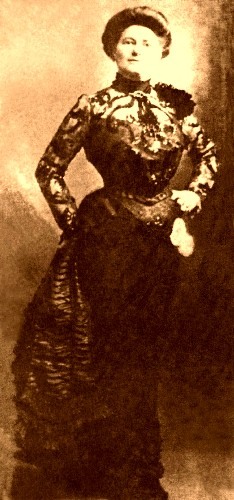
Fannie Porter who tantalized men was a voluptuous, pink-cheeked widow
with flashing brown eyes and a pile of burnished brown hair piled
high on her head. She stood straight, like a dancer, and wore beautiful
brocaded clothes that showed off the tiny waist she was so proud of.
She must have spent quite some time turning this way and that in front
of her looking glass to be sure everything was perfect before descending
the opulent staircase leading down to the front parlor of her, what
was it they called it? Oh yes, "boarding house." |
Portrait of Fannie
Porter
Photo courtesy Kathie Weiser, Legends of America |
Fannie
and her family had emigrated to Texas
from England in 1874 when she was only a year old. Just 14 years later,
she began her professional life as a fallen angel in San
Antonio and earned her later reputation as a formidable, shrewd
businesswoman before she was out of her teens. It was at the tender
age of 19, an age at which other young women found themselves teaching
school, nursing the sick, or married off, that Fannie utilized everything
she had learned and started her own brothel. One day, it would make
her a rich woman.
Fannie, whose appearance was always immaculate, supplied more than
just pretty girls with whom men desirous of companionship might choose
to wile away the hours in a pleasant diversion from hunting, shoot
outs, and Injun fighting. One of the niceties she supplied was rare
to sporting houses in those days for Fannie's girls were free of diseases.
This made her establishment as safe to visit as a convent, and a lot
more fun.
Fannie's brothel was visited by both outlaws and lawmen because of
her warm personality, the fact that she chose five to eight extremely
attractive young girls between the ages of 18 and 25, and her requirement
that the girls practice good hygiene. At the time of the 1900 U.S.
Census, there were five ladies of the night living full time in Fannie's
"boarding house." Fannie herself was mentioned off and on in various
San Antonio city
directories from 1880 until 1902.
By 1895, her house was one of the most popular in the Old West. By
that time, it had become a frequent stopover for outlaws evading capture
and Fannie was vastly admired for her discretion. She emphatically
refused to divulge the whereabouts of any wanted man to the authorities
no matter how much pressure was brought to bear. Fannie knew well
the meaning of the word "honor," unlike today's madams who will sell
names from their little black book to the highest bidder. Not Fannie.
She remained mum.
Other reasons patrons enjoyed Fannie's establishment were the elegant
imported brass cuspidors, classy upholstered furnishings and luxurious
appointments. For some "special customers," she reserved bottles of
chilled champagne. That included members of the Wild Bunch. |
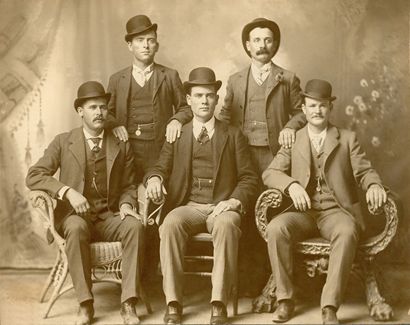 |
The Wild Bunch
Front row left to right: Harry A. Longbaugh, alias the Sundance Kid,
Ben
Kilpatrick, alias the Tall Texan, Robert Leroy Parker, alias Butch
Cassidy; Standing: Will Carver & Harvey Logan, alias Kid Curry; Fort
Worth, Texas, 1901.
Photo courtesy wikipedia.com |
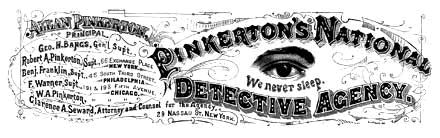
Pinkerton's National
Detective Agency
Photo courtesy Library of Congress |
Not
one to discriminate, Fannie's patrons also included certain lawmen
and she made sure that any lawman who entered received the best treatment.
As late as 1901, William Pinkerton visited Fanny. He was son of the
founder of Pinkerton ("We Never Sleep") National Detective Agency.
She was said to have been mighty partial to William Pinkerton because
he treated her like a lady.
Fannie was well-connected and ran her house generally without interference
from the law; however, she was arrested for “vagrancy” in the late
1880s, vagrancy being cop-speak for prostitution. The arrest may have
been occasioned by the fact that Fannie chased a police officer from
her establishment threatening to knock him senseless with a broom.
|
THE SPORTING
HOUSE
Built
in 1883, the two-storey building at 503 South San Saba* was advertised
as a boarding house, but everybody knew that it really was a bawdy
house. Primly standing about a block outside of the Red Light District
at the southwest corner of Durango and San Saba in San Antonio's Second
Ward, Number 503 remained a working witness to the wild and woolly
West until after the turn of the 20th Century.
Fannie's lavishly appointed sporting house served as hideout, rendezvous,
and sometime headquarters for the Wild Bunch and other outlaws for
several years. Fannie operated her house with the cooperation of city
officials (San Antonio
issued licenses to such facilities) and local lawmen.
Legend
has it that Butch Cassidy made his famous bicycle ride up and down
the unpaved street in front of Fannie's place. It is not known if
raindrops were falling on his head at the time.
Fannie Porter's brothel is often confused with the Fort
Worth brothel of a madam named Mary Porter. Despite their identical
last name and profession, there is no connection between the two women.
Misinformation and the transposition of these two madams' names and
cities turns up in some sources, giving rise to the incorrect notion
that the Wild Bunch frequented the other Ms. Porter's place in Fort
Worth.
*NOTE: In 1914, the building was purchased by the Carmelite Sisters
of Divine Charity and operated as a day care center. Today, 503 Urban
Loop (formerly known as San Saba) is the site of Girls & Boys Town
of San Antonio. The original building apparently still exists within
the newer structure, according to Sanborn Fire Insurance maps of 1904
and 1956. |
THE SPORTING-HOUSE
GIRLS
It
was always exciting to hear Fannie say, "There's company in the parlor,
girls" because it meant good times, fast living and cash on the dresser.
Fannie's bordello beauties loved her for insisting that any customer
who mistreated them would be forever barred from her house of good
repute, and patrons loved her for the gilded grandness with which
she surrounded them. Not only was Fannie's place laden with sparkling
candle-lit crystal chandeliers and plush red carpeting, the carved
four-poster beds were dressed in imported silk sheets (unlike the
girls who were dressed rather sparingly). It is probably safe to assume
Fannie insisted all clientele, including members of The Wild Bunch,
remove their sharp spurs before climbing into bed, rather than risk
snagging even one thread of such expensive silken coverings.
One could consider Fannie Porter's the eHarmony of its day, since
genuine matchmaking took place at her establishment with regularity,
creating quite a turnover of girls. Aside from operating as something
of a Wild Bunch dating service, the brothel offered the outlaws a
haven where they could relax, party down and unload some of their
ill-gotten gains.
It was at Fannie's that Harry Longbaugh (the Sundance Kid) met beautiful
young Etta Place, as wild and exciting a girl as ever worked at Fannie's.
Unless of course the other story is true -- that he met her much earlier
in Utah when she was dating Robert Leroy Parker (Butch Cassidy), about
which we will soon learn more. |
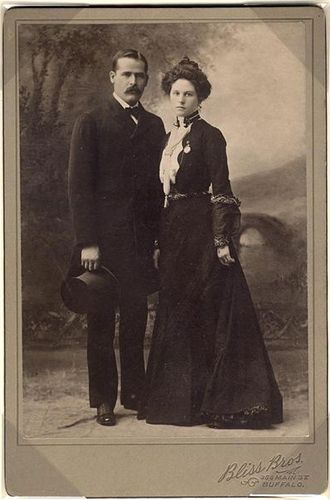 |
Sundance Kid
and Etta Place
(the only known photo of her)
Photo courtesy wikipedia.com |
|
Etta
Place is probably the most mysterious of all outlaw women. However,
Doris Karren Burton, of the Outlaw Trail History Center at the Uintah
County Library, ran a series of computer photograph analyses of
Etta Place that she published in 1992. The results linked Place
to another colorful figure: Ann Bassett, the so-called Queen of
the Cattle Rustlers, who dated Butch Cassidy back in Utah. Burton's
fascinating research uncovers parallels in their lives too numerous
to be coincidental. Based on Burton's findings, together with the
findings of Dr. Thomas G. Kyle of the Computer Research Group at
Los Alamos National Laboratory, there is no doubt that Etta Place
and Ann Bassett were one and the same.
Another
match made at Fannie's was that of Harvey (Kid Curry) Logan, considered
the most dangerous member of the Wild Bunch, and his girlfriend,
the slender Annie Rogers
with her high cheekbones and sassy ways. Annie was born Della Moore
in Texas, and also went by the alias
Maud Williams. It seems women in those days changed names as often
as they changed hats. Wild though Kid Curry's reputation was, he
was on his best behavior at Fannie's and it has been speculated
that he married Annie or at the very least, they posed as man and
wife.
And then there's Will "News" Carver and Laura Bullion. Will was
born in Coryell
County, Texas, briefly married to Laura Bullion's aunt, had
a romantic involvement with Ann Bassett/Etta Place, and also had
a fling with another of Fannie's girls, Lillie Davis, who later
claimed to have married him in Fort
Worth. But his heart belonged, more or less, to Laura. Laura
Bullion was born in Knickerbocker Texas around 1876 and was of German
and Native American descent. She used the alias of Della Rose when
she was a dance hall girl in Wyoming before working at Fannie's.
After Carver died of a posse-fired gunshot wound after a bank robbery,
Laura took up with his friend and fellow Wild Bunch member, Ben
("Tall Texan") Kilpatrick.
The last time that the Wild Bunch is known to have visited Fannie's
brothel was in February, 1901, when they were between robberies,
the First National Bank in Winnemucca, Nevada where they got $30,000,
and Great Northern Train in Wagner, Montana, which netted the gang
$65,000. With the law on their heels, the gang planned to split
up and head out in different directions. Before they left for the
last time, Fannie threw them a memorable going-away party that must've
given them plenty to talk about as they rode off.
It wasn't long after this that moral reform became popular and "openly
operating" brothels were frowned upon, causing Fanny to gradually
fade away together with the Red Light District. Some historians
believe that she retired a rich woman, while others believe she
married a wealthy man. Subsequent unconfirmed rumors indicated that
all went well with Fanny for many years -- until 1940, when she
perished in an El
Paso auto accident.
Life ended for Fanny Porter and she passed into legend like the
famous men she protected and accommodated in the house on Durango
in San Antonio.
© Maggie
Van Ostrand
"A Balloon In Cactus"
September 25, 2007 column
|
SOURCES:
Library of Congress, Prints and Photographs Division
San Antonio Historical Society Library
Legends of America, Kathy Weiser
Wikipedia Encyclopedia
tsha.utexas.edu/handbook/online/articles/PP/fpo51.html
James D. Horan, Desperate Men: Revelations from the Sealed Pinkerton
Files (New York: Putnam, 1949)
James D. Horan, The Wild Bunch (New York: Signet, 1958).
Richard F. Selcer, Hell's Half Acre: The Life and Legend of a Red
Light District (Fort Worth: Texas Christian University Press, 1991).
butchandsundance.com/players/fannie.htm historytogo.utah.gov/utah_chapters/pioneers_and_cowboys/
justwhowastheoutlawqueenettaplace.html
Mysterious San Antonio, by David Bowser 199
Sanborn Fire Insurance Maps 1904 V 1, p 32; 1956, Vol 1A, p. 49A
|
|
|
 HOME
HOME