|
|
I
don’t know anything about opera, and accidentally once proved it to
my date at a screening of Franco Zeffirelli’s film of La Traviata.
Halfway through the movie, I whispered, “What a rip off. All they
did was copy the plot of Garbo’s movie, Camille.” How did I know that
the Verdi opera, based on Dumas’ 1848 novel, was written long before
Garbo was even born? Like Lincoln said, “It is better to keep one's
mouth shut and be thought a fool than to open it and resolve all doubt.”
At least my date was enough of a gentleman not to laugh aloud; he
merely snickered behind his hand. When, on Christmas Eve, I was trapped
into seeing a new film of another opera, La Bohéme, I determined to
keep my big trap shut -- except for you, of course. I just have to
tell you about it.
Emilio Rolando Villazón Mauleón is the world’s next great tenor, at
least equal to Placido Domingo, but easier on the eyes and with far
more dramatic gifts. You don’t have to know anything about opera to
appreciate Villazón’s voice. When you hear him sing, your jaw drops,
your eyes glaze over, and the hairs on your arm stand to attention.
My goose bumps had goose bumps of their own. This, I thought, is a
voice for the ages. I felt like Al Capone must have felt the first
time he heard the voice of Enrico Caruso. |
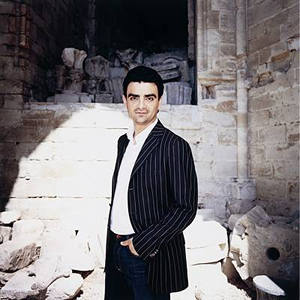 |
Villazón
was born in 1972 in the Mexico City suburb of Fuentes de Satellite.
At the age of 11, Villazón entered the Mexican Academy of Performing
Arts (where he later met his future wife, Lucia), studying acting,
music, modern dance and ballet. That would account for the graceful
perfection of his later onstage movements. He is to opera as Fred
Astaire was to dancing.
His father used to bring home records from his job at Columbia/Sony,
including Placido Domingo’s “Perhaps Love.” Villazón loved Domingo’s
voice and bought every record of his that he could, except opera.
Back then, he didn’t even like opera. In fact, he had decided to study
for the priesthood. Luckily for us, fiancée Lucia sent him on an intense
soul-searching mission, which ended with Villazón’s painful decision
to not become a priest.
When he was 18, Villazón sang in a school play, with baritone Arturo
Nieto in the audience. Nieto went backstage and invited Villazón to
take instruction from him to develop his “really big voice.” When
Villazón arrived at Nieto’s studio and saw a photograph on the wall
of Nieto with Villazón’s idol, Placido Domingo, he was so impressed
that he decided to take up Nieto on his offer.
Two years later, after singing before an audience of 1500, Villazón
met with his mentor, a Catholic priest, who assured him that his destiny
was opera, and persuaded him to try out for the conservatory at once.
Villazón auditioned next day, singing an aria from La Bohéme, and
using a pillow as his character’s lover, Mimi. In order to finance
his studies, Villazón taught history part-time, and nearly became
a full- time teacher. But Lucia, now a psychologist, threatened to
not marry him if he refused to pursue his dream. Smartly, he listened
to his Lucia and continued his studies, now under Enrique Jaso.
In Villazón’s case, it seems destiny was spelled L-U-C-I-A. He started
performing in small parts, easily winning two national opera competitions
in Mexico. Within only a few years, Villazón has graced the most famous
opera stages on earth, performing the lead male roles in the greatest
operas ever written. |
The
New York City Opera magazine, Music & Vision, wrote that he “sings
with such seeming ease that it is almost scary… There are no mistakes,
anywhere, no stifled tones, no sloppy phrasing. This is a great tenor
voice, a truly exceptional voice … It is a voice of rare beauty, with
a tender romantic touch, but capable of displaying fiery youth.”
After voice problems in April 2007 forced cancellation of performances
at Carnegie Hall and the Metropolitan Opera, today, Villazón’s voice
is back, as superb as ever. He has just released his 2010 schedule,
which includes performances in Mexico next June. |
|
|
Though Villazón
did not become a priest, God has gifted him with something else:
the voice of an angel.
If ever I have
another date to see a new version of La Traviata, this time starring
Rolando Villazón, I won’t even think about Garbo. I’ll be too busy
in the faraway place to which his soaring, celestial voice has transported
his adoring audience.
© Maggie
Van Ostrand
"A Balloon In Cactus"
January
2, 2010 column
Related Topics: People
| Mexico |
Columns | Texas
|
|
|
|
 HOME
HOME

 Gulf
Coast
Gulf
Coast East
Texas
East
Texas Central
North
Central
North Central
South
Central
South Panhandle
 South
Texas
South
Texas Hill
Country
Hill
Country West
Texas
West
Texas Ghost
Towns
Ghost
Towns COUNTIES