|
It
started over a duck.
Caleb Berg (Cape) Willingham, first sheriff of newly-organized Oldham
County, was in the Equity Bar, Tascosa’s
oldest saloon, when he heard a commotion outside. Suddenly one of
the town’s few ladies did something most ladies of the era would not
– she ran into the drinking establishment.
“He killed my duck!” she yelled, pointing to a man outside. “Shot
it just now.”
Willingham saw that the woman was referring to Fred Leigh, foreman
on the LS Ranch. Leigh was known for his drinking and had been warned
before about carrying a pistol in town.
“He did, did he?” the sheriff asked. “Well, now, don’t you worry.
I’ll see that the gentleman pays you for your duck.”
Armed with a double-barreled shotgun, the big sheriff walked out and
approached the cowboy to discuss the fair market value of domesticated
migratory waterfowl.
“You’re in debt to this woman for that duck you shot just now,” the
sheriff said. “You going to pay for it?”
“Hell, no, I ain’t going to pay for no duck,” the cowboy replied.
Willingham was in the process of reminding the cowboy that he was
sheriff when he saw the drover’s hand moving toward the six-shooter
on his hip. That ended the talking. The sheriff let loose with both
barrels of his scattergun. With 18 pieces of buckshot in his body,
the cowboy tumbled from his horse, as dead as the duck he’d blasted
a short time before.
Not only had Leigh been killed on account of a duck, he had the added
distinction of being the first person buried on a hill outside Tascosa
that soon bore one of the most famous names in the Old West. Leigh
having died with his boots on, saloon proprietor Jack Ryan thought
it fitting that the new graveyard be called Boothill.
(Dodge City also had a Boothill, but that was way off in Kansas.) |
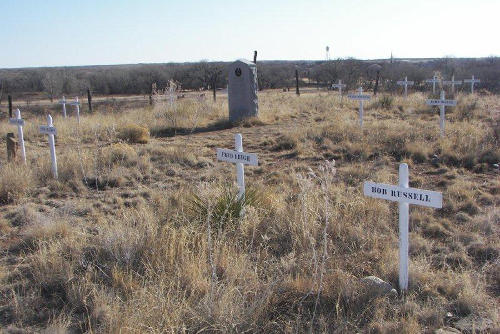 |
"Graves
on Boot
Hill. According to a map at the entrance to the cemetery, Bob
Russell (bottom right) was the first person buried here after being
killed in a showdown with Jules Howard in 1879. His widow selected
the site. Fred Leigh is buried beside him."
- Terry
Jeanson, March 2008 photo |
Willingham
went on to serve out his term as sheriff, but in 1882 he was defeated
in his bid for another two years in office. After losing the election,
Willingham moved east across the Panhandle to Wheeler County, where
he operated a saloon in Mobeetie.
Later, he became manager of the Turkey Track Ranch.
Without mentioning his sources, J. Marvin Hunter described Leigh’s
death in an article he wrote for his Frontier Times Magazine in 1943.
Three years later, Amarillo writer John McCarthy told the story a
little differently in his book “Maverick Town: The Story of Old Tascosa.”
In McCarthy’s version, the woman who owned the duck was pregnant.
She fainted after seeing Leigh shoot off the bird’s head. McCarthy
also listed Leigh as the second occupant of Boothill,
not the first. But both authors agreed that it all started over a
duck.
Hunter said the shooting happened in 1879, but Willingham had not
become sheriff until 1880. McCarthy did not offer a date in his book.
No matter exactly when Leigh died, or whether he was permanent guest
No. 1 or No. 2, Boothill
Cemetery went on to accommodate a total of 32 graves. Twenty-three
of the occupants were men who, like Leigh, died with their boots on. |
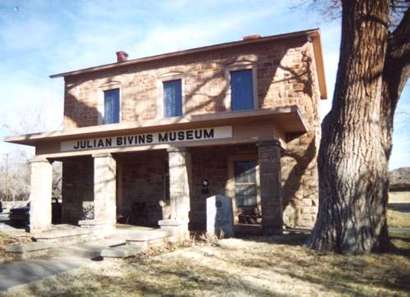 |
The rock courthouse
in Tascosa
Photo courtesy Barclay
Gibson, January 2003 |
Tascosa,
like most of the people in its cemetery, did not live to enjoy old
age. When the Fort Worth and Denver Railroad cut across the Panhandle,
the tracks did not come to Tascosa. The once lively – and deadly –
cowtown faded away as the nearby railroad town of Amarillo
grew.
In 1893, a flood on the Canadian
River destroyed the bridge leading into town as well as many buildings.
That was the last straw for Tascosa,
which soon lost its county seat status to Vega.
The same year, Willingham left the Panhandle
for New Mexico. He ran a ranch near Roswell, before continuing west
to Arizona. He died there in 1925 at the age of 72.
Today, all that remains of old Tascosa
– now the home of Cal
Farley’s Boys Ranch – is the rock building that once served as
courthouse and a hill-top collection of lonely graves.
© Mike Cox
"Texas Tales" Column
|
|
|
 HOME
HOME


