|
 |
History in
a Pecan Shell
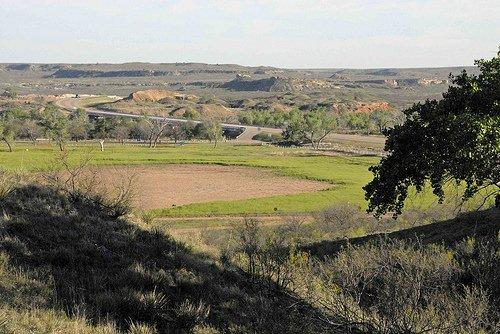
Originally settled by shepherds and freighters from New Mexico, the
area was named Atascosa (boggy) for the swamp-like area where
the Canadian River
meets the local creek (also named Atascosa). The abbreviated name
resulted in ‘Tascosa. The town found itself as a terminus of the Tascosa-Dodge
City Cattle Trail in the late 1870s as the large ranches that formed
in the region used the town as an assembling point. The activity drove
the original settlers back to the tranquility of New Mexico.
The town’s first business was a blacksmithing operation owned by Henry
Kimball, followed by a general store and a post office. In 1880 the
county was organized and Tascosa became the county seat. A stone
courthouse was constructed, even while dancehalls and saloons
were building at an alarming rate. In need of a cemetery, the town’s
first Sheriff (Caleb Willingham) shot the town’s first villain, who
then became the first cemetery occupant.
Tascosa was soon known as the “Cowboy Capital of the Plains,”
and with good reason. Lawmen and outlaws either became long-term residents
or quickly left. Those who tarried often became permanent residents
of Boot Hill.
The Fort Worth and Denver City Railway passed through this part of
Oldham County around
1887, necessitating a move of two miles across the river. In 1890
the residents of both Old and New Tascosa reached 350.
By 1915, the Panhandle
was adding new towns
which bled population from Tascosa. An election was held that year
to create a new county seat and Vega
won. Tascosa was left with a population of about 15 people. The last
to leave was Frency McCormick, the widow of Tascosa’s first saloon.
The woman held out until 1939, the year that opened the door for the
establishment of Boys Ranch. |
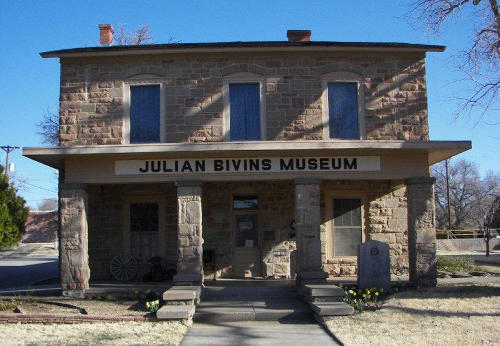
Former courthouse
in Tascosa , now the Julian Bivins Museum
Recorded Texas Historic Landmark
Photo courtesy Terry
Jeanson, March 2008 |
Photographer's
Note
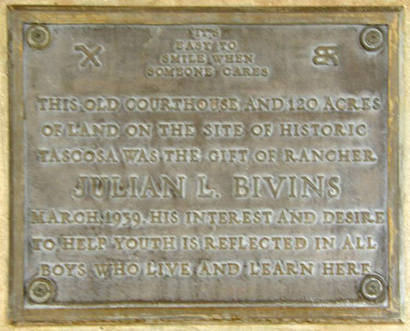
"The 1884 Oldham County courthouse is now the Julian Bivins museum,
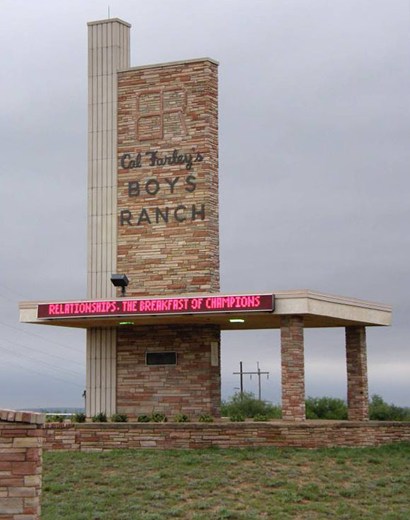
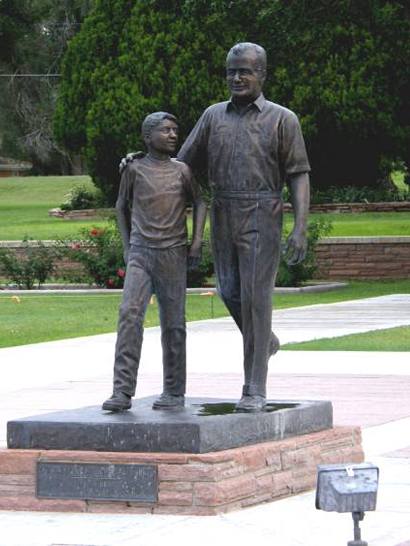
named for a local rancher who donated 120 acres of land to Cal Farley
for his Boys Ranch." - Terry
Jeanson |
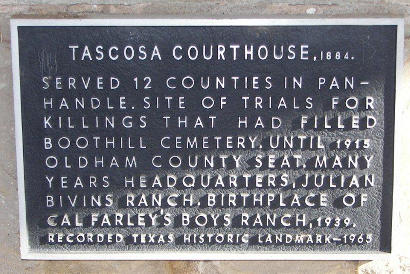
1884 Oldham County
Courthouse Historical Marker
Photo courtesy Terry
Jeanson, March 2008 |
Historical Marker:
Tascosa Courthouse, 1884
Served 12 counties in Panhandle.
Site of trials for killings that had filled Boothill
Cemetery. Until 1915 Oldham County seat. Many years headquarters,
Julian Bivins Ranch. Birthplace of Cal
Farley's Boys Ranch, 1939.
Recorded Texas Historic Landmark - 1965 |
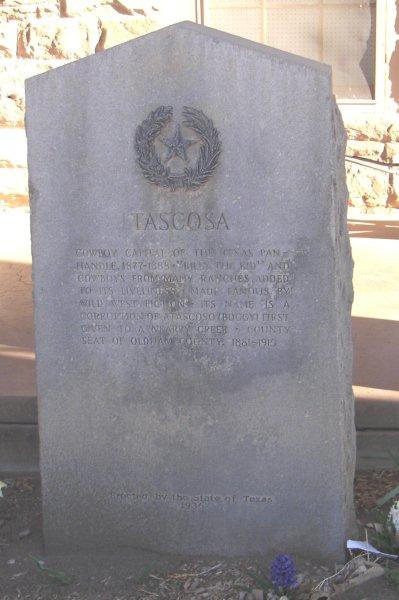
Texas Centennial
Marker:
TASCOSA
Cowboy capital of the Texas
Panhandle, 1877-1888. "Billy
the Kid" and cowboys from many ranches added to its liveliness.
Made famous by wild west fiction. Its name is a corruption of Atascoso
(boggy) first given to nearby creek. County seat of Oldham
County, 1881-1915. |
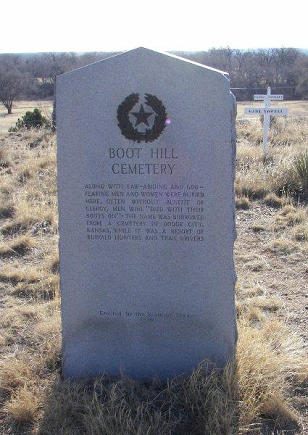
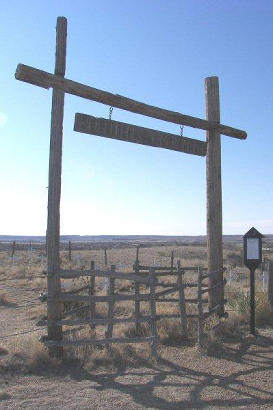
Boot Hill Cemetery
Centennial Marker
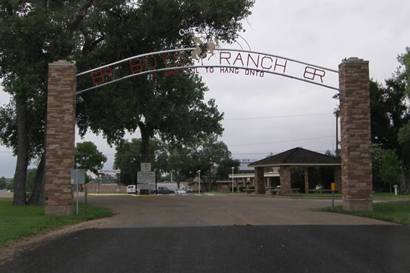
US 385 at Boy's Ranch
Photo courtesy Terry
Jeanson, March 2008 |
Texas Centennial
Marker:
Boot Hill Cemetery
Along with law-abiding and God-fearing men and women were buried here,
often without benefit of clergy, men who "died with their boots on".
The name was borrowed from a cemetery in Dodge City, Kansas, while
it was a resort of buffalo
hunters and trail drivers. |
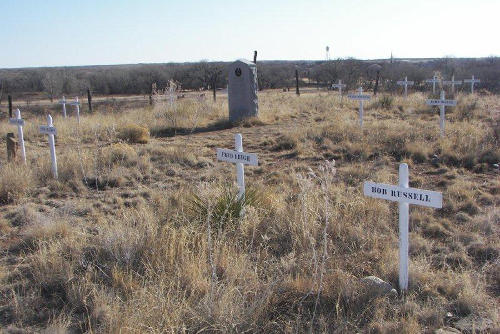
Photographer's
Note:
According to a map at the entrance to the cemetery, Bob Russell (bottom
right) was the first person buried here after being killed in a showdown
with Jules Howard in 1879. His widow selected the site. Fred Leigh
(See "The
Duck Fight" by Mike Cox) is buried beside him. - Terry
Jeanson, March 2008 |
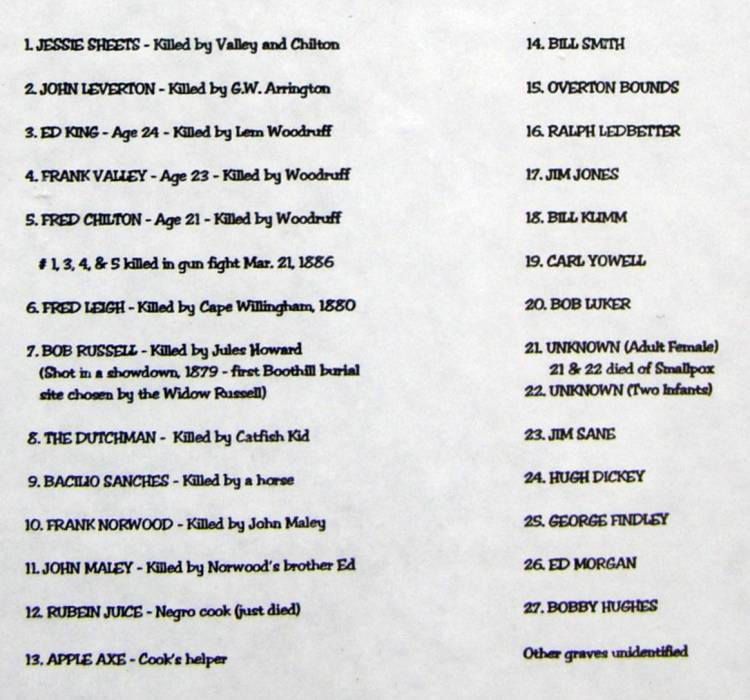
Boot Hill Cemetery
Directory
Click on image to enlarge
Photo courtesy Barclay
Gibson, July 2009 |
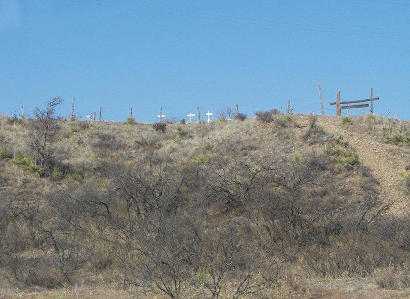
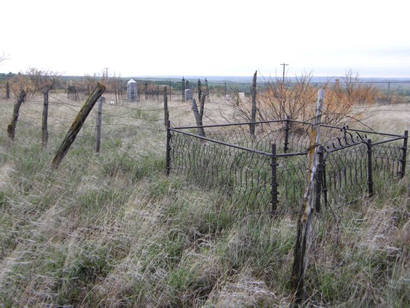
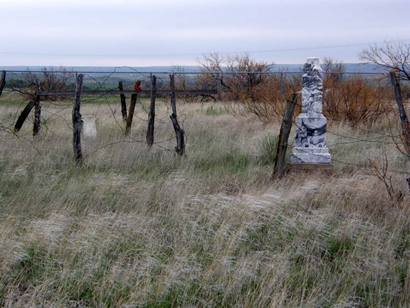
Boot Hill Cemetery
seen from below.
Photo courtesy Terry
Jeanson, March 2008 |
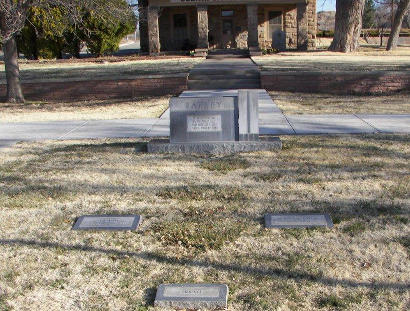
"The graves
of Boys Ranch founder Cal Farley, his wife Mimi and their beloved
dog Cricket in front of the old
courthouse."
- Terry
Jeanson, March 2008 photo |
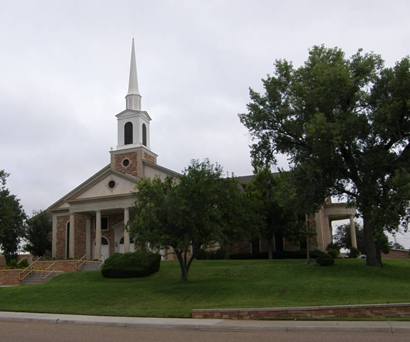
Cal Farley's
Boys Ranch Chapel
Photo courtesy Barclay
Gibson, July 2009 |
|
Tascosa
and Boothill
by Mike Cox ( "Texas
Tales" Column)
"Tascosa, like most of the people in its cemetery, did not
live to enjoy old age. When the Fort Worth and Denver Railroad cut
across the Panhandle,
the tracks did not come to Tascosa. The once lively – and deadly
– cowtown faded away as the nearby railroad town of Amarillo
grew.
In 1893, a flood on the Canadian
River destroyed the bridge leading into town as well as many
buildings. That was the last straw for Tascosa, which soon lost
its county seat status to Vega.
Today, all that remains of old Tascosa – now the home of Cal Farley’s
Boys Ranch – is the rock building that once served as courthouse
and a hill-top collection of lonely graves." more
How
Tascosa Got Boot Hill
by Mike Cox
|
|
Billy
the Kid's Texas vacation
by Clay
Coppedge
"A lot of what we know about Billy the Kid is dead wrong, and
that includes stories and information about the time he spent in
Texas. Tascosa must have had a population of several thousand if
we are to account for all the first-hand stories people of the day
(and not of the day) later told about what amounted to a working
vacation in Texas for The Kid.
Here are a few true facts, untrue facts, distortions, fictions and
outright lies about Billy the Kid in Texas, sorted out as best we
can...." more
|
Sam
Houston Medley
by Mike Cox ("Texas
Tales" Column)
Tascosa, now the site of Cal Farley’s Boys Ranch northwest of Amarillo,
had the reputation of being one of the toughest towns in Texas during
its heyday in the early 1880s.
Bonham poet and all-round character Macphelan Reese told this story
in 2000:
A dusty cowboy (so bow-legged they’d have to bury him in a base fiddle
case) rides into Tascosa, already high enough to have a nose bleed,
and ties his horse in front of one of the town’s numerous saloons.
Tromping inside, the drover orders a beer and drinks about half of
it before noticing that the floor is covered in sawdust. He observes
to the bartender: “I’ve been in saloons all over this country and
I ain’t never seen one with sawdust on the floor.”
The bartender replies: “That ain’t sawdust, that’s last night’s furniture.”
more |
Remembering
old Tascosa
by Delbert
Trew
From the files of The Tascosa Pioneer, published from June 1886 through
1888, all issues contained in the archives of The Panhandle-Plains
Museum, we found the following tidbits of information telling of everyday
life in the Panhandle at that time. (In Trew fashion of course.) more |
The
Not So Great Cowboy Strike of 1883
by Clay
Coppedge
In 1883, in the wild and wooly cowtown of Tascosa on the banks of
the Canadian River, a group of cowboys got mad as hell and announced
to the owners of five big Panhandle ranches that they weren’t going
to take it anymore. They were going on strike, and they did. For a
little more than two months in that year, somewhere between 160 and
200 cowboys (estimates vary widely) went on strike in what is generally
known as the Great Cowboy Strike of 1883, though it didn’t turn out
all that great. more |
William
Lee's Buggy Ride
by Clay
Coppedge
What would surely have been a bloody range war between ranchers and
sheepmen was reduced to nothing more than an uneventful buggy trip
and a series of financial transactions. |
|
1940s Oldham
County map showing Tascosa
Courtesy Texas General Land Office
|
|
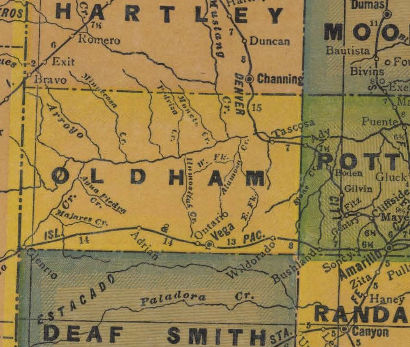
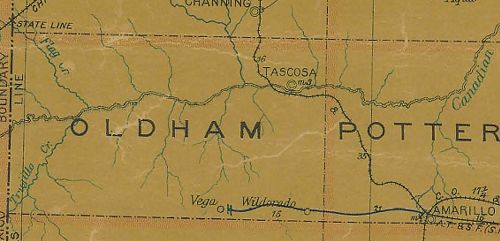
1907 Oldham
County postal map showing Tascosa
(NE corner of OLDHAM)
Courtesy Texas General Land Office
|
| Texas
Escapes, in its purpose to preserve historic, endangered and vanishing
Texas, asks that anyone wishing to share their local history, stories,
landmarks and recent or vintage photos, please contact
us. |
|
|
 HOME
HOME