|
|
From
his office in the 1857-vintage Land Office Building, Land Commissioner
W.C. Walsh had been watching the construction of the new Capitol since
the first shovel of dirt was tossed on Feb. 1, 1882. Not only was
he witnessing the biggest construction job to that point in Texas
history, Walsh had an official reason to follow the building’s
progress – he sat on the Capitol Board, the state entity overseeing
the project.
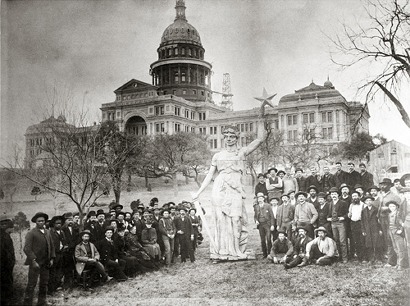
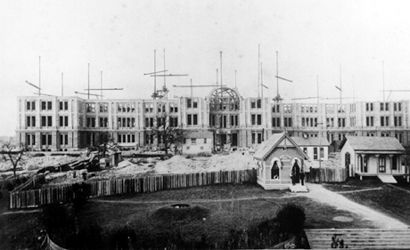
By the spring of 1887, the red granite, Greek cross-shaped base of
the future statehouse had been completed. Soon, work would begin on
the towering dome that would give the four-story government building
(the east-west wings are only three stories) its distinctive silhouette.
Born in Dayton, Ohio on the eve of the Texas Revolution in 1836, Walsh
had come to Texas with his family when
only four. They settled in Austin
when all it amounted to was an assortment of log cabins lining a broad
thoroughfare called Congress Avenue. Following his graduation from
Georgetown University in Washington, he returned to Texas
and went to work as a clerk in the land office. Walsh stayed there
until the beginning of the Civil War, when he signed up to fight for
the Confederacy. Though wounded three times, he survived the war.
Back in Austin, he farmed
and ran a rock quarry near Barton
Springs until 1873, when he became chief clerk of the House of
Representatives. Five years later, Governor R.B. Hubbard appointed
him to fill the unexpired term of Land Commissioner J.J. Gross. Elected
to a full term in November 1878, Walsh would serve until 1887.
As
the new Capitol
slowly took shape, as a member of the body charged with making all
the spot decisions that come up during such a large-scale project,
so did Walsh’s layman’s knowledge of architecture. Now, with construction
about to begin on the dome, Walsh grew increasingly uneasy. |
 |
“The plans,”
Walsh later wrote, “called for a dome of brick, the lower thickness
of the walls to be five feet and diminishing gradually to the foot
of the lantern.”
He figured the weight of the brick, added the weight of the substructure,
and went to bed, not liking the number he got. Assuming he had made
a mistake, the next night he went over his calculations and got the
same result.
“The weight shown not only wiped out the ‘factor of safety’ but exceeded
the theoretical resistance of the foundation,” he wrote. In other
words, the base of the Capitol
would not support a brick dome. At some point, either during construction
or over the course of time, it likely would come crashing down and
possibly take much of the rest of the building with it.
Walsh tore up his calculations and burned the scraps. “As far as I
could, [I] dismissed the question from my mind for ten days,” he continued.
But then he ran the numbers again, coming to the same catastrophe-protending
figure. This time he submitted the numbers to someone else, who came
to the same conclusion.
“I then hunted up [Gus] Wilke, the building contractor, and broached
the subject,” Walsh wrote. “He told me the question had been worrying
him for months, and he wished I could get some action by the Board.”
Walsh did just that, but the timing was bad. All the state officials
who sat on the board, including Walsh, were leaving office. Only the
state treasurer would still be on the board.
“The general thought was that the outgoing Board had brought the building
through troubles and discouragement to its practical completion, and
it was now too late for the retiring board to take up the question—besides
the new Board ought to have something to worry over,” Walsh wrote.
Now a private citizen, Walsh remained concerned. When the new board
took no action on the dome issue after its second meeting, Walsh took
the matter to the new governor, Sul Ross. The governor asked Walsh
to submit his concerns in writing and shrewdly asked if he minded
the document being made public. The former land commission said he
had no problem with that, and soon his belief that the blueprints
for the new capitol contained a potentially disasterous design flaw
hit the state’s major newspapers.
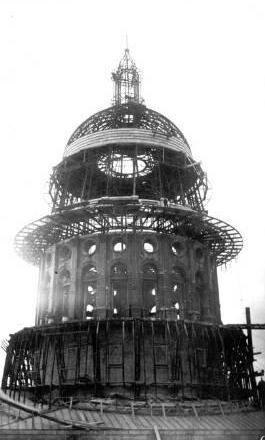
When that happened, Ross appointed a panel of Texas
and Louisiana architects to prepare a report on the dome issue. “After
thorough study [the architects] reported to the Governor that my contention
was correct, that the existing plan was dangerous, and recommended
the substitution of steel plates for the brick, above the walls.”
|
 |
Disaster likely
averted, Walsh was still not totally satisfied. He sent Capitol architect
Elijah E. Myers a copy of the report on the dome, asking for “at least
a personal explanation.” Myers’ secretary replied that his boss was
in ill health and unable to answer Walsh.
“The only theory I could ever work out was that the upper dome was
planned on the theory that the walls supporting it were treated in
the estimate as solid, while in fact from basement to top story they
were opened on four sides by immense arches. The mystery will never
be solved.”
By the time Walsh died on August 30, 1924, the ironclad Capitol dome
had stood for more than a quarter century and has now made it past
120 years.
© Mike
Cox - July
21, 2011 column
More "Texas
Tales"
See Texas
State Capitol Building |
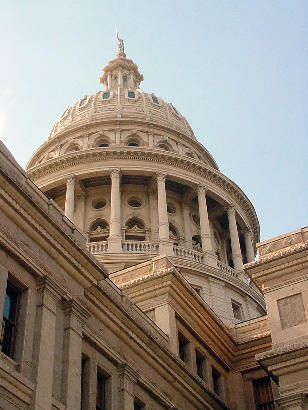
The Capitol
Dome today
TE Photo, 2004 |
| Books
by Mike Cox - Order Here |
|
|