|
|
| The
Navidad isn’t really much of a river, as rivers go – it’s not very
famous and can’t be compared to the stunning Guadalupe or majestic
Colorado, when it comes to beauty. But the little old Navidad just
might have a claim to fame that the others can’t equal. You see, the
Navidad has a past of mysterious and wild creatures, of the two-legged
variety, living along its winding path. |
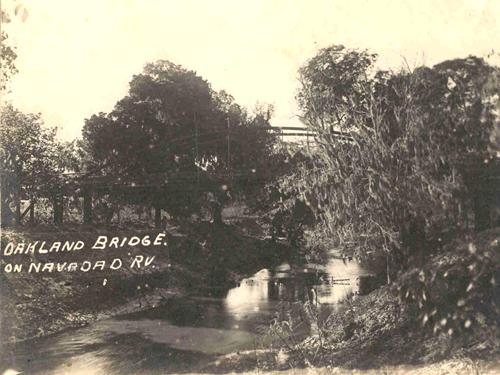
Oakland
Bridge on Navadad River
Vintage Photo courtesy of Nesbitt Memorial Library |
| In the early
days of Texas, settlers living near the banks of the Navidad, southeast
of Hallettsville,
were subjected to visits by beings of unknown origin – several hairy
and stealth-like individuals roamed through the brushy bottoms of
the river – witnesses indicating that there was a male and female. |
Many
folks back then were convinced that the male half of the duo had died
and only the female remained. She became known as the “Wild Woman
of the Navidad.”
In his book Tales of Old-Time Texas, well-known author J.Frank
Dobie hints that there might have even been three of the creatures
running together. But many of the old timers agreed that there had
been only two from the beginning. There were many who speculated on
the origin of the “never-seen” beings. Some thought they were run-away
slaves. But as Dobie writes, “To settlers living against the deep
woods and dense brush along the Navidad River no explanation was conclusive.” |
|
From
about 1836 through 1845, folks were still unsure if the surviving
creature was male or female. One settler, Samuel Rogers, saw three
sets of tracks in the spring of 1845. Indicating that instead of one
person, as previously thought, there might have been three individuals
of suspicious origin.
So now there was a group of “wild people.” Rogers had a hired man
by the name of Hall who also had misadventures with the creatures.
Hall claimed that they had taken one of his trace chains. Shortly
after this incident, only one set of tracks were seen in the area
and again folks began to speculate that two of the wild people had
died. From the size of the remaining tracks, they decided that the
living subject was a male.
The wild man would take what he needed from the farms in the area.
He would slip into the fields and steal potatoes. In his journal Rogers
wrote, “When the corn was in roasting ear he would come nearly every
night to get a supply.” Rogers along with some of his neighbors came
close to catching the wild creature once and during the chase he dropped
a basket containing various items. Rogers added this entry in his
journal, “This [basket] contained a shirt of mine, a novel, a Bible,
and many other articles taken from the house. The shirt had been torn
and then the rent sewed up as skillfully as any woman could have sewed
it.”
After the near capture of the wild man, the settlers decided to get
serious about hunting him down. Eight of them searched along the junction
of the Navidad and Sandies Creek. They didn’t find him but they did
find places where he had been hiding out. “One of them was a live
oak that forked about 30 feet above the ground. This fork formed kind
of a flat place on which he could lie down and sleep,” said Rogers.
Depending
on what source you are reading, you will find back-and-forth opinions
on whether or not the wild creature was male or female. I think many
like to believe that it was a woman for some romantic notion and the
like. In J. Frank Dobie’s book, he indicates that in the late 1830s
there were reports that the being was indeed a woman. According to
Dobie, settlers on the lower Navidad began to see tracks of two human
beings. Indications were that one was male and the other a female
with small delicate feet.
Various sources indicate that these individuals avoided any real mischief
and stayed secluded. They only took small portions of food and the
settlers tolerated this practice. Dobie includes in his book a narrative
by one of the residents living along the river who came in contact
with the wild people. Martin M. Kenney kept a record of what
he witnessed. Kenny surmised that the two mysterious ones were lost
children who had become separated from the family during the evacuation
of the area by folks running from the invading Mexican army in 1836.
In
his account, Kenney indicates that the larger tracks disappeared and
only those of the “wild woman” remained. Folks believed her to be
harmless but they still wished to capture her and take her back to
the civilized world. The opinion being that she was a lost white child.
Kenney wrote that she was seen once, during a failed attempt to ambush
her, and he described it this way: “The night was dark and they could
only see a shadowy form. It was slim and apparently unclothed, but
the color could not be distinguished.
“They sprang out to seize her, but, though they were active young
men, she was more agile still, and bounded away as silently and quickly
as the flitting of a shadow, and was instantly lost in the darkness.”
The wild woman struck fear into the hearts of the slaves back then.
The referred to her as “it” or “that thing that comes.” It has been
written that she could walk right past guard dogs, during the night,
and they wouldn’t bark or disturb her in any way. She would go into
a house and take bread and other food, always leaving half. If the
creature took tools or any other item, she always returned them clean
and in better shape than when she obtained them.
But just as had happened in the past, the question about the gender
of the mysterious one came up again. It seems that in the severe winter
of 1850, fresh tracks were found once more and this time the scent
was fresh. The settlers put hounds on the trail and the wild being
was forced to climb a tree. Looking down on his pursuers was a run-away
African male – he was so frightened that he wouldn’t come down and
the men had to climb the tree and take him by force.
J. Frank Dobie indicated in his book that the man’s tracks matched
those found before – the same footprints that were thought to belong
to the woman. The story goes that the “wild man” had been sold to
slave traders by his parents and was shipped to this country. A passing
sailor who knew the language of the man’s tribe was able to communicate
with him and learned that he and another man had escaped from the
ship somewhere near a large river. His companion perished at some
point and he was left alone.
Folks estimated that he must have been brought across the sea between
1820 and 1830 – part of his youth was spent roaming the region around
the Navidad and Sandies Creek. Slavery still existed after his capture
and the wild man was sold at public auction. With the abolishment
of slavery, he was set free and was said to have remained in his newfound
home. The wild woman was never again heard of and the legend of her
existence passed into history.
© Murray
Montgomery
Lone
Star Diary September 13, 2005 Column |
|
|
 HOME
HOME