|
‹ Barton
Springs, page 1
The
Sunken Gardens, enclosed by circular stones, was built between
1935-38 on the south side of the creek by the National Youth Administration.
This spring originally powered a mill, then an ice factory. The state's
first fish hatchery was established at Sunken Gardens. Most of the
walls have washed away and are in need of repair, but the spring still
flows. As of this writing, Sunken Gardens will probably be fenced
off to protect the Barton Springs salamanders.
A flood in 1935 left four inches of mud in the Barton Springs bathhouse
and washed away the Lake Austin Dam. Zilker
Park was left under water for days. A new bathhouse was
built in 1947 for $180,000. It was designed by Groos and Driscool,
the same firm that designed the Deep Eddy bathhouse. The 1947 bathhouse
still stands and has large open-air dressing rooms and grassy areas.
During World
War II, soldiers wrote to their families about fighting for Barton
Springs. It was an Austin
treasure. Little did they imagine that the land around Barton
Springs would develop rapidly after the war. An environmental
debate over the springs
has been raging since the late 1950s when the Parks and Recreation
staff noticed trash and dead animals in the runoff coming from the
Barton Hills subdivision, or what used to be the Rabb land, and high
levels of fecal coliform. In the 1960s, an environmental group formed
and began addressing these concerns with the Parks Department. A plan
for a greenbelt was drawn up but not built, yet the public showed
an interest in extending Zilker
Park up Barton Creek. However, the city didn't respond and valuable
recharge areas in the aquifer were rapidly developed. Robert Mueller
was a locker boy and cashier at Barton
Springs. He offered to sell a portion of his land, about forty
to fifty acres on the south side of the creek from the pool up to
Campbell's Hole, but the city declined to buy it. The city passed
up several opportunities to buy and protect the land surrounding Barton
Springs, and today it is an endangered natural resource.
|
 |
| Photo
courtesy Chandra Moira Beal, 2001 |
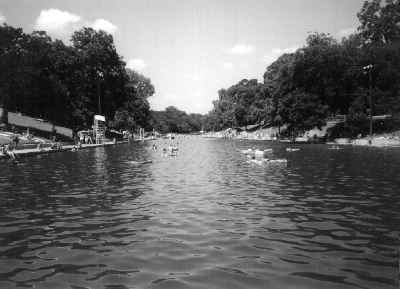
Barton
Springs does not use chlorine. Between 1929 and 1962, the pool
was drained twice per week and cleaned with copper sulfate to remove
the algae, which turned some of the rocks blue-green. In 1962, the
city stopped using chlorine; instead workers scrubbed it with giant
steel brushes pulled by tractors, then flushed it with water from
a fire hose. It takes forty-five minutes to drain the pool,
and about two hours to refill it. This practice continues today. The
endangered Barton Springs salamander survived the entire time
that copper sulfate was used to clean the pool.
Sheffield has witnessed floods that completely encircled the bathhouse,
yet the vegetation always grew back and helped make the water clear
because it kept the silt from being disturbed by swimmers. It is unlikely
that the salamanders are endangered by chemicals used in Barton
Springs. More likely, fecal coliform running off from development
all around the springs is the culprit. If fecal coliform counts are
above 200 colonies per 100 milliliters of water, and visibility is
impaired by more than four feet, the pool closes. The pool also closes
as a precaution when there is thunder and lightning, and if more than
one inch of rain has fallen over the Barton Creek watershed within
twenty-four hours. Folks in Dripping
Springs at the headwaters will call ahead to warn us if flooding
is imminent. For more information, see the chapter on Organizations
(page 337).
------------------------------------------------------------------------
Addendum:
Why is there algae in Barton Springs? Every day about noon, a bloom
of blue-green algae (oscillatoria) rises to the surface of Barton
Springs, turning the crystal clear waters into a murky soup. The
City of Austin has been
required by the U.S. Fish and Wildlife Service to change their maintenance
procedures to protect the Barton
Springs Salamander (the salamander was recently added to the Endangered
Species List). Unless the pool's flow reaches at least 54 cubic feet
per second, maintenance workers cannot lower the pool water to clean.
Average flow is currently about 30 cfs. The last time workers were
allowed to clean the pool was May 18, 1999. This is a complicated,
heated issue. For the full story, see Robert Bryce's recent article:
http://www.auschron.com/issues/dispatch/2000-04-21/pols_feature7.html
|
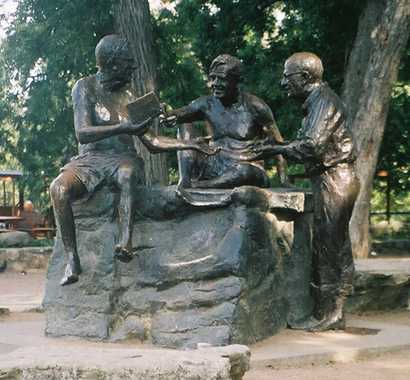 |
Philosophers'
Rock (Click on photo for plaque)
Photo courtesy Chia-Wei Wang, August 2006 |
The
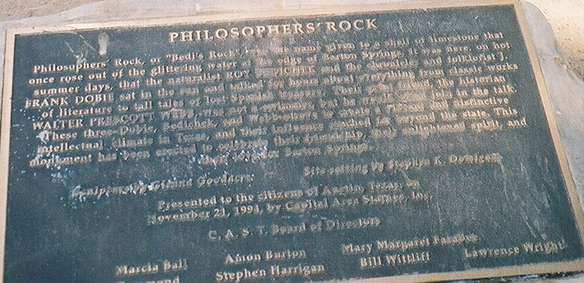
1950s also saw the development of Philosophers' Rock. Roy Bedicheck,
a naturalist, J.
Frank Dobie, a folklorist, and Walter Prescott Webb, a historian,
would gather on a flat rock near the diving board and talk about an
infinite number of things. John Henry Faulk, Walter Bremond, and Skinny
Pryor were known to drop in. A statue by Santa Fe artist Glenna Goodacre
at the main entrance to Barton
Springs honors these men. "If I have to fight for this country,
I will not fight for the flag, or the American 'way of life', or democracy,
or private enterprise or for any other abstractions, which seem cold
as kraut to me. But I will fight to the last ditch for Barton Creek,
Boggy Creek, cedar-covered limestone hills, blazing star and bluebonnets,
golden- cheeked warblers and black-capped vireos... This love of your
native land is basic." - Roy Bedicheck.
People often ask about the pecan tree directly across from
the diving board on the west side of the pool. No one knows exactly
but it is probably several hundred years old. In 1970 people feared
it would die so a backup tree was planted behind it. Support poles
were built around the original tree and the trunk gutted and rebuilt.
The older pecan tree finally succumbed but the stump was saved as
a lifeguard throne.
Page 3 - Barton Springs
Pool ›
Back to Barton Springs, Page
1 |
 |
| Photo
courtesy Chia-Wei Wang, August 2006 |
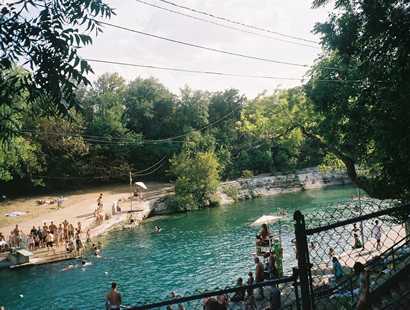
Barton Springs
TE Editor's
Note: This chapter is the text for pages 27 through 37 of Splash
Accross Texas - courtesy of the book's author, Chandra Moira Beal.
Thorough in research, rich in history, description and recreational
information, this engaging chapter should be read in it's entirety.
However, for quick reference for internet users, we take the liberty
of breaking up the chapter by topics ( in sequence ) as follows:
About
Barton Springs
Sunken
Gardens,1947 Bathhouse, The Environmental Debate
Maintenance,
& Endangered Barton Springs salamander
Philosopher's
Rock, pecan tree
The
Pool
The
Polar Bear Club, Barton Creek Greenbelt, New Trail
Barton
Creek
Swimming
Holes in Barton Creek
Zilker
Park
Botanical
Garden, Zilker Zephyr miniature train ride
Zilker
Hillside Theatre, Austin Nature Center, McBeth Recreation Center,
Beverly Sheffield Education Center
Butler
Brick Company
Addendum:
Barton Springs Endangered Salamander
Book Hotel Here › Austin
Hotels
|
|
|
 HOME
HOME