|
 |
Founder George
Smith
The School's founder,
first principal and teacher was Buffalo Soldier George Edward Smith.
Born into slavery in Virgina about 1847, Smith managed to escape to
Washington, D.C. where he was pressed into service digging trenches
for a threatened invasion by Confederate troops. Smith joined the
U.S. Army in 1869 and was stationed at Fort
Concho (San Angelo) and Fort
Davis.
After participating in various campaigns against the Apaches in West
Texas, New Mexico and Arizona, Sergeant Smith was discharged at Fort
Ringgold in 1874 - his dischage papers showing "excellent character."
He re-enlisted in Washington D.C. and was then assigned to the 10th
Cavalry - an all-Black Regiment that displayed a Buffalo on their
crest - for the name Buffalo Soldiers - given to them by the Cheyenne
Indians.
While serving his last months at Fort Concho, he was also serving
as an appointed school trustee for "Colored District # 1" of Tom Green
County.
After discharge he served as a Deacon in the San Angelo AME Church
and was soon appointed an elder (1883). AME Bishop Richard H. Cain
was recruiting men of excellent character to organize AME churches
where there were none and George Smith went to Brownwood
in 1885 to find only one AME Church - but no school for African-American
children. He organized classes and taught the children in the basics
- wherever a classroom could be found.
George Smith established the Lee Chapel African Methodist Church in
Brownwood in 1888 and that same
year he married Virginia Love. Together they would have 14 children.
Reverend Smith bought land for a home in the Bailey Addition of Brownwood
and with the same energy he fought Indians, established churches and
taught school, he worked to get water for his neighborhood - dying
on the very day (August 9th, 1912) that the project was finished.
Brownwood's George Smith Housing
Project has since been named to honor him. |
|
|
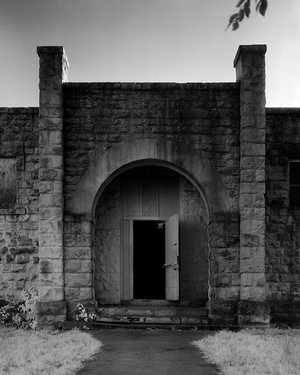
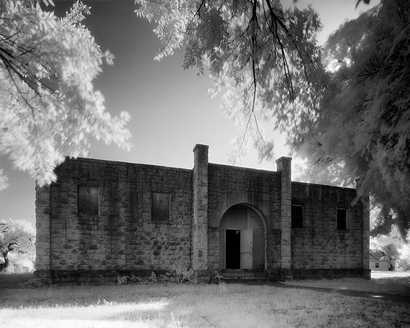
The
Rufus F. Hardin School entrance
Photo
courtesy Jason
Grant |
Educator Rufus
F. Hardin 1859-1949
There was only
one school for African-Americans in Brown
County in 1917 - and while it enjoyed no fixed location, it was
this school that was to become the R.F. Hardin High School in 1934.
Rufus Forley Hardin was born a slave in Kaufman County, Texas in 1857.
He started school at the age of 13 and four years later he left to
work on a cattle drive to Kansas where he attended a Kansas school
for eight months. He returned to Texas and enrolled in Sulphur Springs
school. At the age of 20 he taught school in Van
Zandt County and married Mary Vasher when he was 22.
His initial foray into farming was near Canton,
but he later bought land in Kaufman County near Terrell.
Hardin accepted a position of teacher with Brownwood Schools in 1896.
He earned a BA from Prairie View College and his wife died in 1903
when Rufus was just six weeks from receiving his MA.
While he was farming, he taught school in the winter - and attended
classes at several other schools - including Waco's
Paul Quinn College and Austin's
Tillotson College. In 1905 he married Mary Jane Lasseter - a woman
who shared his passion for education.
Hardin was a leader in the Lee Chapel AME Church - the same one founded
by George Smith in the 1880s. When funds were low, the Hardins often
spent their own money for supplies. Hardin also helped fill the Bailey
subdivision by building homes and selling them to responsible families
- at affordable terms.
In January of 1934 Mary died and Rufus had a stroke. He was unable
to return to teaching - but a remarkable record of 38 years is a fine
legacy that few can equal. He died in 1949, at the age of 90, but
the school is still standing - and after restoration - it should continue
as a memorial to a pioneer educator of Brown
County. |
The Building
While George Smith taught classes in churches and borrowed space -
one of the buildings used on the corner of Beaver and Cordell Streets
became known as the Cordell School - this was a simple two-teacher
school that taught six grades - which later expanded to include grade
eight.
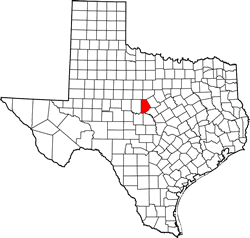
In 1910 lots were bought for construction of a proper school for "colored"
students but two portable buildings were brought in - in lieu of a
permanent structure. In 1917 both buildings burned and classes were
once again held in borrowed space - some classes being held in some
of Rufus Hardin's rental houses.
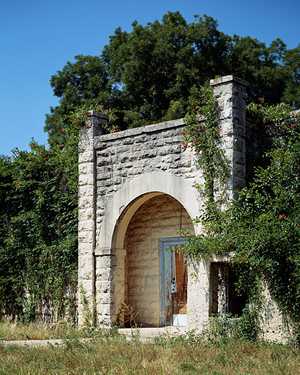
In 1916 Brownwood's Coggin School
burned and the charred but still usable stone was salvaged to build
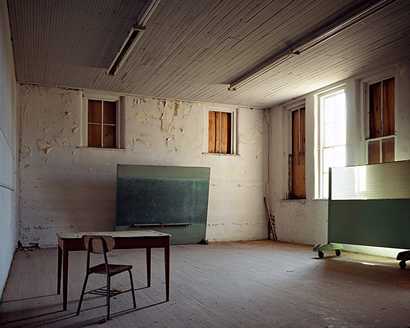
a proper four-room "Negro School." This was completed in 1917 and
consisted of an auditorium and thee classrooms. Lighting and a stage
were added in the first year and the building also became a community
gathering place. |
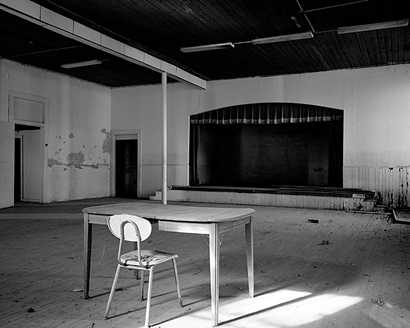
The Rufus F.
Hardin School Interior
Photo
courtesy Jason
Grant |
First named Brownwood
Colored High School, the school honored it's first five graduates
with the Class of 1918.
When Principal and Professor Hardin had his stroke in 1934 and was
unable to continue teaching, the school was renamed in his honor.
A former student (A.L.Reed) served as principal until D.V. Hall (Class
of 1922) was installed. The school expanded to 12 grades in 1947 and
became a fully accredited, graduating 13 students that year.
Desegregation in 1954 caused Brownwood
to integrate grades 9 through 12 - and overnight, Rufus Hardin High
was renamed Rufus Hardin Elementary. In 1966, rather than integrate
the elementary grades of Hardin school, the district chose to close
the school as a public institution and assigned Hardin students to
other Brownwood schools. |
|
|
Hardin
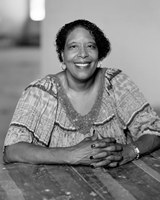
School alumnus Marrian Barron, Class of 1955
Photo
courtesy Jason
Grant |
In late 1966
the school served as a Project Head Start facility - but this only
lasted for four years. In 1970 the doors were shut - and have remained
closed until recently when The Rufus F. Hardin Museum Inc. was formed.
The building, eager to begin it's new role as museum is now awaiting
restoration and the public is invited to contribute to the project.
Willie L. Washington Gay is President of the Rufus F. Hardin Museum. |
The Rufus F.
Hardin School Interior
Photo
courtesy Jason
Grant |
| Texas
Escapes, in its purpose to preserve historic, endangered and vanishing
Texas, asks that anyone wishing to share their local history, stories,
landmarks and recent or vintage photos, please contact
us. |
|
|
 HOME
HOME