|
|
History in
a Pecan Shell
According to the
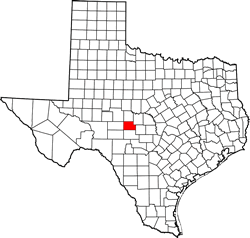
Handbook of Texas - Hext was settled in the 1870s and was known
by the name Maringo or Merrengo. It was renamed in the
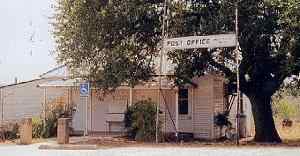
1890s for one Joseph Robert Hext. The post office was established
in 1897 which made the name permanent.
Hext hit its high-water mark about 1914 when it reportedly had 125
people, a cotton gin, a hotel and two general stores. The estimated
population was 40 in the mid-20s and after WWII
it rose to about 60.
[See Stories
of Hext as Told by Descendants ›
] |
 |
 |
Letters from
Descendants
I was very
pleased to see the site about Hext, Texas, named after my Great
Grandfather Joseph Robert Hext.
Most people knew him as Bob. He was born Aug. 31 1859 near Cherokee
Texas to Joseph Bruten Hext and Sarah Ann Salyer Hext. Joseph Bruten
was born in South Carolina and moved to Texas in 1844.
At the time Bob was born the Indians were still quite a problem
and several skirmishes with raiding parties took place around the
area. This problem continued until into the 1870's.
Bob and his brother James moved to start up ranching some twenty
mile north of Loundon Texas some time in the late 1880's and family
history claims they had quite a large bit of land. Within a few
years the partnership dissolved and James "Jim" moved his family
to Oklahoma.
My Grandfather, Ben Hext, was born in Hext in August of 1895. His
stories often told of how Bob gave away or traded large pieces of
his ranch either because of his inability to care for it or through
great generosity. We like to believe the generosity story. After
his wife, Leetie Anderson, died in 1926 he lived with Ben and his
wife Ruth Turner Hext and my father, Joe, in Eldorado,
TX. until his death in 1941. He is buried in Eldorado.
When the area residents decided to try and establish a post office
in 1895, they found the name Maringo was already taken and decided
to use the name Hext either to honor one of the first settlers in
the area or because the name Hext was surly not in use elsewhere.
I think that my grandfather, Ben, who was also a rancher, often
lamented about "loosing" so much land before he had grown up enough
to take over the cattle business. My family often visited the little
town in the late 50's as some of the family still lived there and
it was by then almost a ghost town, having only 30 or so in population.
Thank you for the site and I hope this background can be of help.
-
Bryan Hext, December 17, 2002
|
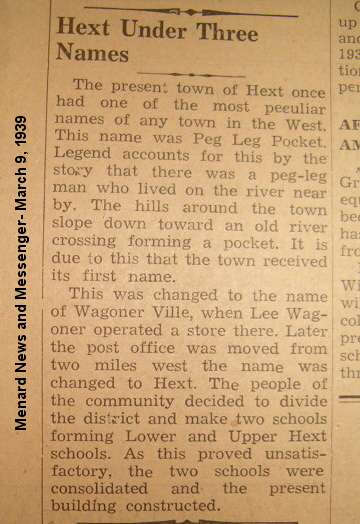 |
Hext Under Three
Names
1939 Menard News and Messenger newspaper article |
Hext, Texas,
AKA Peg Leg Pocket, Wagoner Ville
I’ve enjoyed viewing
your Texas Escapes site and want to
say thank you for your hard work.
As a historian/genealogist in the Menard County area, I have always
been interested in the earlier days of Hext. In the mid 70’s, I was
told by life-long Hext resident, Myrtle (Wagoner) Pope, born in 1901,
that Hext used to be called Wagonerville, because her father, George
H. Wagoner had the first house/store there. (George H. Wagoner’s 1956
obituary also reported this, saying he arrived in the area around
1899.)
I recently located the attached 1939 Menard News and Messenger newspaper
article that seems to back up this information, though the article
says the store owner was Lee Wagoner.
The newspaper’s addition of the 1st name as “Peg-Leg Pocket” could
be possible since the Peg Leg stage crossing was right outside of
present day Hext.
I thought you might find this as interesting as I do. - Regards, Alicia
Brown, June 03, 2011 |
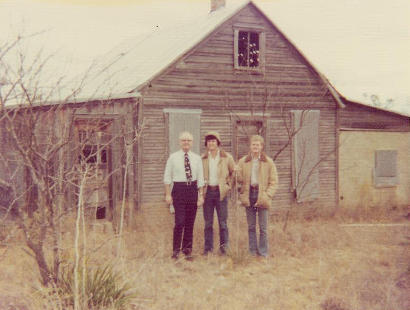 |
"Grandad's
House" - 1973
photo courtesy Helen Bethel Williams |
Subject:
Hext, Texas
I
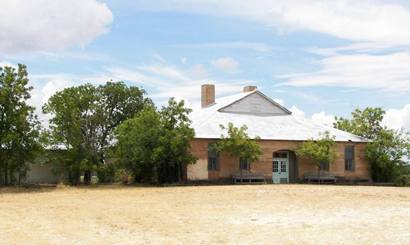
enjoyed seeing the picture of the school that I attended briefly
in 1938. At that time it was heated by wood stoves in the class
rooms and had outdoor "privies" (one for boys and one for girls).
We played on the cords of wood that were stacked across the back
of the play ground that were used for heating the schools.
I also attended the church with my grandfather, Maywood Bethel.
It was much more rustic at that time.
My grandfather moved his gin to Hext in 1920 from Ten Mile Crossing
in Menard County where he had operated it since 1904. The first
ginning season that it was operational at Hext was 1921. The gin
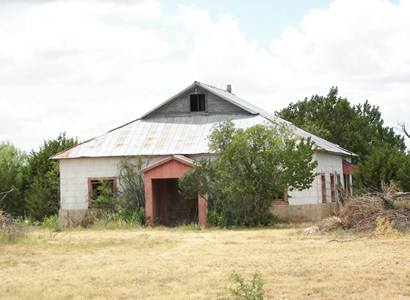
burned in the early 1930's and my grandfather operated a metal shop
thereafter until about 1950. I am enclosing a picture of the shop
that is still in Hext but has been padlocked since he died so is
just as he left it. Also a picture of his house that he built himself
but has now fallen into ruin. These pictures date from about 1973.
|
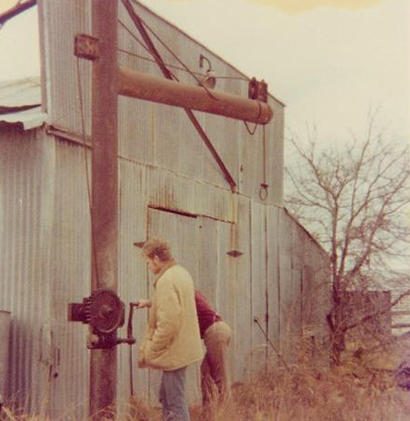 |
"Grandad's
Tin Shop" - 1973
photo courtesy Helen Bethel Williams |
Besides my grandfather
other Bethel family members were Brooks, Carroll, Sarah and Beth called
"Girlie", the three older sons, Lenson, Ion and Milligan, were away
at school before the move was made from the original site of the gin.
My father was Milligan also known as "Jiggs."
Other family members in the area were the Westbrooks. My grandfather's
uncle, Barney McGill (Uncle Gillie) Westbrook lived just to the south
of the site of the gin and farmed and his son, Barney Westbrook lived
just to the west of the site of the metal shop. Barney Westbrook and
his wife, Ethel, had a store, ran the post office and lived on the
premises. - Helen Bethel Williams, December 21, 2010 |
| Texas
Escapes, in its purpose to preserve historic, endangered and vanishing
Texas, asks that anyone wishing to share their local history, stories,
landmarks and recent or vintage photos, please contact
us. |
|
|
 HOME
HOME

 Texas
Gulf Coast
Texas
Gulf Coast East
Texas
East
Texas Central
Texas North
Central
Texas North Central
Texas South
Central
Texas South Texas
Panhandle
Texas
Panhandle South
Texas
South
Texas Texas
Hill Country
Texas
Hill Country West
Texas
West
Texas Texas
Ghost Towns
Texas
Ghost Towns Texas
Counties
Texas
Counties