|
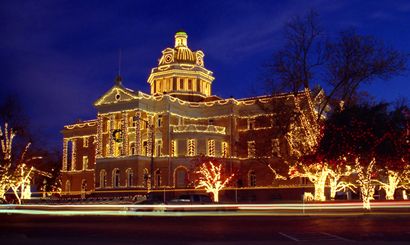
The former Harrison
County Courthouse lighted for Christmas
Photo courtesy Lori
Martin |
|
Marshall
has long been famous for the elaborate holiday lighting of their
courthouse. Strictly speaking, the building is technically the former
courthouse. It is now the Harrison County Historical Museum.
[
Holiday
Trail of Lights by Bob Bowman]
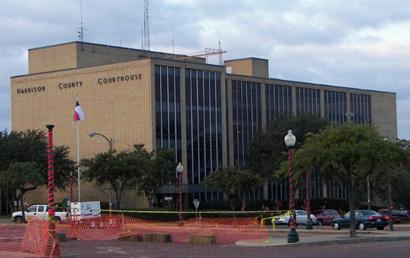
The current courthouse is a modern 1964 design and is located somewhere
else.
|
| The 1964 Harrison
County courthouse is a modern structure of glass and brick and was
designed by the architectural firm of Turnbull, Inc. |
The Fourth
Harrison County Courthouse
- Marshall, Texas
Houston at Washington
St., Marshall
Today the Harrison County Historical Museum
Recorded Texas Historic Landmark |
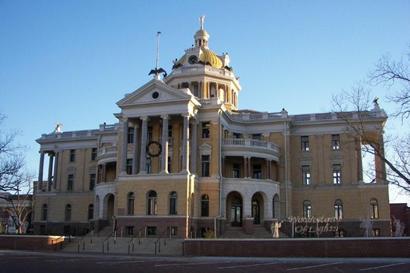
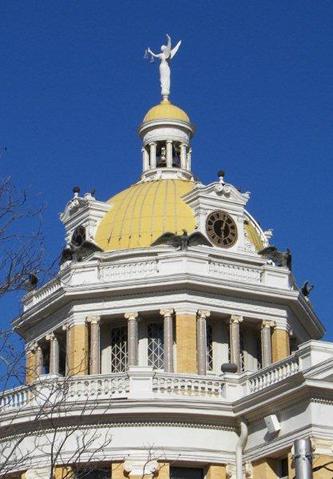
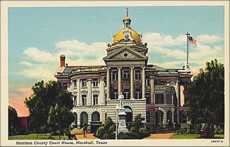
The 1900 former
courthouse
Photo courtesy Terry
Jeanson, December 2007 |
Date - 1900
Architect - J. Reily Gordon
Style - Renaissance Revival / Beaux Arts
Material - Granite, stone and marble
This building is sometimes compared with Gordon's 1901 McLennan
County Courthouse in Waco,
Texas. |
The
1900 former courthouse as it appeared in 1939
Photo courtesy TXDoT |
Historical Marker:
Harrison County
Courthouse
Built 1900. Cost
$62,000. Third on this site. (Little Virginia, 1851; brick Gothic,
1889, burned in 1899.) This one of granite, brick and marble. Capitol-styled,
classic Roman architecture, with a dome clock and belfry surmounted
by a symbolic figure of justice. In 1964 became site of Harrison County
Museum, in space allotment after new Courthouse was opened on Whetstone
Square.
Recorded Texas Historic Landmark - 1965. |
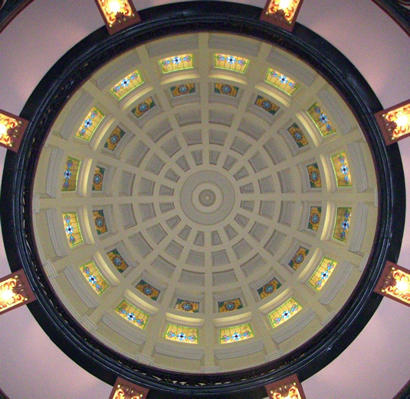
The 1900 Harrison
County courthouse dome
Photo courtesy Terry
Jeanson, December 2007
|
|
|
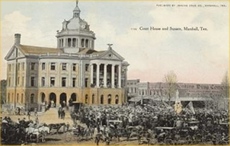
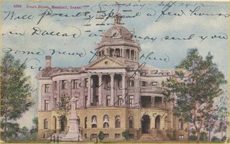
1908 postcard courtesy rootsweb.com/
%7Etxpstcrd/ |
|
|
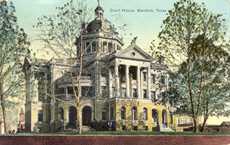
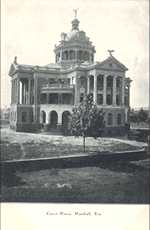
Postcard circa 1911 courtesy THC |
|
|
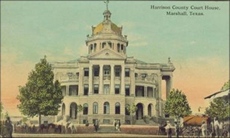
1912 Postcard courtesy rootsweb.com/
%7Etxpstcrd/ |
|
|
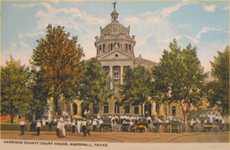
Postcard courtesy rootsweb.com/
%7Etxpstcrd/ |
|
|
Postcard courtesy rootsweb.com/
%7Etxpstcrd/ |
|
|
Postcard courtesy rootsweb.com/
%7Etxpstcrd/ |
|
|
Postcard
courtesy rootsweb.com/
%7Etxpstcrd/ |
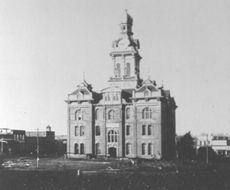
The Third Harrison
County Courthouse
circa 1889
- Marshall, Texas
Destroyed by fire
1899 |
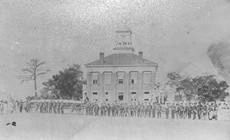
The Second
Harrison County Courthouse
circa 1848
- Marshall, Texas
Demolished in 1889 |
|
|
 HOME
HOME