|
|
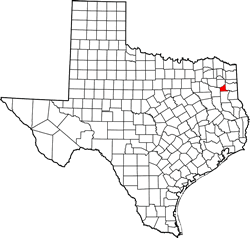
Covering
two of East Texas'
principal cities, Longview
and Marshall, this
Sunday Drive is almost metropolitan in nature.
Begin at in downtown Longview
with the excellent Gregg
County Historical Museum at the corner of Fredonia and Bank streets.
The museum's exhibits illustrate the development of Gregg County from
the days of the Caddo Indians and will prepare you for the rest of
your Sunday Drive.
Longview itself
was carved out of the pine forests in l870 when railroad engineers
surveyed a 50-acre tract deeded to the Southern Pacific Railroad by
O.H. Methvin. From the crest of Capps Hill, the surveyors, looking
into the distance to the south, remarked what a "long view" there
was from the hill. Longview
was made the county seat of newly-created Gregg County in l871.
Leaving the museum,
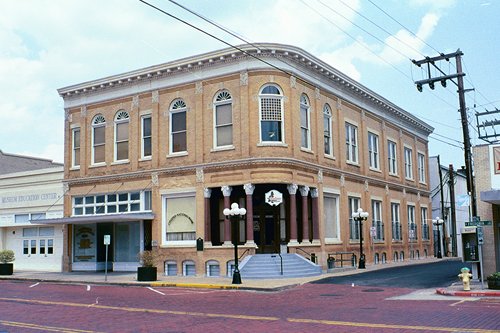
you'll want to spend some time walking the streets of downtown Longview,
where many of the city's oldest buildings are being preserved as the
result of a strong historical movement in the community. |
 |
|
Be sure to see
the historical marker to the last raid of the Dalton Gang at 200
North Fredonia. Here, at the First National Bank, a bloody gunfight
resulted in three deaths when the Dalton
Gang robbed the bank. The
robbery resulted in the ultimate capture of the gang, ending
its reign of crime and violence.
The Gregg
County Courthouse is also in downtown Longview.
Here is a statue to General John Gregg, a general in the Confederate
Army. Other Longview places of interest include:
- The Campbell
Honeymoon Home, located at 521 North Second Street. This was the
home of Texas Governor Thomas Mitchell Campbell when he married
Fannie Bruner while working as a clerk in the Gregg County courthouse
in l878.
- The Stagecoach
Stop Museum at 322 Teague, one of the few remaining homes from
Earpville, the forerunner of Longview. The building dates from
the early l860s.
- The Brown-Birdsong
home at 104 West Whaley Street. This Victorian home was built
in l879 by an early settler, B.W. Brown, a Methodist lay minister.
Brown helped create Gregg County.
From
Longview,
head east on U.S. 80. You'll pass through Hallsville
while traveling a scenic route characterized by meadows, ranches,
and turn-of-the-century buildings. Hallsville dates back to l839
when W.C. Crawford built a fort as protection against Indians. The
town was named for pioneer Elijah Hall in l870 when the railroad
arrived.
Longview
Hotels > Book Here
|
|
Entering
Marshall,head
for the downtown area to the south of U.S. 80. In the middle of
the downtown area is the Old Courthouse Museum on Peter Whetstone
Square. The museum includes an excellent exhibit of everything historical
in Harrison County, including Indian artifacts, pioneer relics,
needlecraft implements, paintings and drawings, religious memorabilia,
and much more.
Marshall was founded
in l842 and by l860 was the fourth largest city in Texas. After
the Civil War, it became the gateway to Texas when the Texas and
Pacific Railroad provided transcontinental railway service to the
west.
Marshall, named
for Chief Justice John Marshall, has an abundance of historical
homes and the best way to see them is to pick up a copy of Max
Lale's excellent historic tour guide from the Chamber of Commerce.
Most of the historic buildings are located around the downtown area
and near the railroad tracks on Washington Street.
Another excellent publication is the Marshall Stagecoach Trace
Guide, a driving trail of sites in Harrison County.
Some
of Marshall's most
interesting historical sites include:
- The Starr
Family State Historic Site, known locally as "Maplecroft"
for its abundance of maple trees. Located on 407 West Travis Street,
the site is open Wednesday through Sunday from 9 a.m. to 4 p.m.
The site tells the story of a prominent East Texas family since
its arrival in Texas in 1834.
- The Ginocchio
Historical District on North Washington Street. The area includes
the Ginocchio Hotel, once called "the finest overnight hotel and
eating establishment between New Orleans and Denver." Built in
the l890s, the hotel includes a rare, curly pine staircase. Also
in the historical district are several Ginocchio homes built in
the l880s, and the old Texas and Pacific Railroad Depot, one of
the most interesting depots
in East Texas.
- The Allen
House at 610 Washington, the museum and headquarters for the Harrison
County Conservation Society. The New England-style salt box house
was built in l879.
- La Maison
Malfacon, located aet 700 East Rusk Street, a bed-and-breakfast
inn that was once the home of Texas publisher Robert W. Loughery,
who became the U.S. consul to Acapulco, Mexico. The home was built
in l866.
- The site
of the State
Capitol of Missouri, 400 South Bolivar. The Confederate governor
of Missouri moved his government-in-exile to a one-story wooden
dwelling on this site during the Civil War after being run out
of Missouri by federal troops.
Marshall
Hotels > Book Here |
|
From
Marshall, head east
on Farm Road 1998.
At the Scottsville
community, take time to explore the Scottsville
Cemetery, which contains some of the most elaborate statutary
in East Texas. Of particular interest is a breathtaking statue of
a grieving angel. The gothic revival chapel made of stone was dedicated
in l904 by Pete and Betty Scott Youree in memory of their only son,
William.
Also at Scottsville is the plantation home of William Thomas Scott,
who built the home in l840 after living for several years in a log
cabin.
From Scottsville, continue on 1998 until you reach the intersection
of Farm Road 134. Head south on 134 to the one-time cotton community
of Jonesville.
Here, you'll find an honest-go-goodness general store of the kind
found around the turn of the century. The T.C. Lindsey & Company
General Store, which evolved from the Jones Trading Post, has been
in business since l847 and includes an enormous antique collection,
as well as run-of-the mill store items. The store has been the scene
of several movie and television productions. Nearby is a new museum
housing rare automobiles, jukeboxes, and other memorabilia.
You'll also find at Jonesville a cotton gin, one of the last such
businesses left in East
Texas; the home of Dr. Samuel Floyd Vaughn, which dates back
to the l840s; and Locust Grove, a stunning two-story house with
double porches built in l847.
From Jonesville, continue on 134 to Waskom.
Here, head south on Farm Road 9 until it intersects with Farm Road
2625. Follow 2625, passing through Crossroads, Rosobrough Springs,
Darco and Gailee, until it reaches Farm Road 968. Head west back
into Longview.
For meals, we recommend a couple of places, Johnny Cace's Seafood
and Steak House, an institution in East
Texas; Sally's Good Foods, also in Longview,
which specializes in homestyle country meals; Gable's Restaurant
in Marshall, which
takes pride in its chicken, steaks and seafood entrees; and Neely's
Sandwich Shop, also in Marshall,
famous for its "brown pig" sandwich.
(For additional information on places found on this
Sunday Drive, contact the Longview Chamber of Commerce, 100 Grand
Boulevard, Longview, TX 75604, telephone 214/753-3281, or the Marshall
Chamber of Commerce, P.O. Box 520, Marshall, TX 75671, telephone
214/935-7868.)
Excerpt by permission of author Mr.
Bob Bowman.
November 2000
Book Hotel Here
Longview
Hotels
Marshall
Hotels
|
| Texas
Escapes, in its purpose to preserve historic, endangered and vanishing
Texas, asks that anyone wishing to share their local history, stories,
and contemporary or vintage/historic photos, please contact
us. |
|
|
 HOME
HOME

 Texas
Gulf Coast
Texas
Gulf Coast East
Texas
East
Texas Central
Texas North
Central
Texas North Central
Texas South
Central
Texas South Texas
Panhandle
Texas
Panhandle South
Texas
South
Texas Texas
Hill Country
Texas
Hill Country West
Texas
West
Texas Texas
Ghost Towns
Texas
Ghost Towns Texas
Counties
Texas
Counties