|
|
|
It's
a good thing that General
Sam Houston wasn't blazing through Gonzales
in 1894 because torching their Romanesque Revival courthouse would
have been one difficult decision to make.
Bison Bill's and my first look at this limestone and red brick structure
came several years ago when Mr. and Mrs. Herda discovered that Shiner
did, in fact, have only one stoplight that was worth the wait. Since
Gonzales
figured so much into Texas
history and because it was only eighteen miles west of Shiner,
going there was a must.
So before you could say, "Come
and take it!," we were at the city that will forever be remembered
as where the Texans fired the first shots upon Santa Anna's men.
|
|
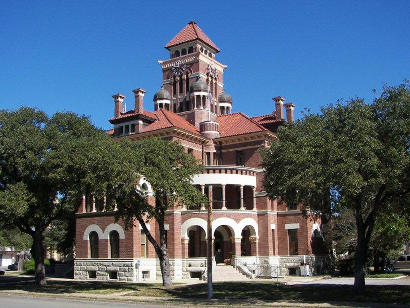
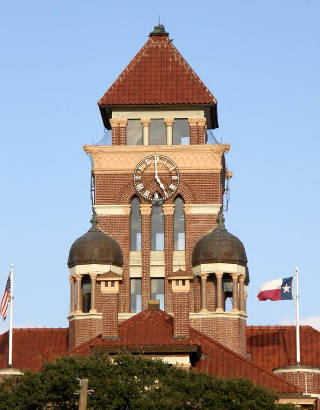
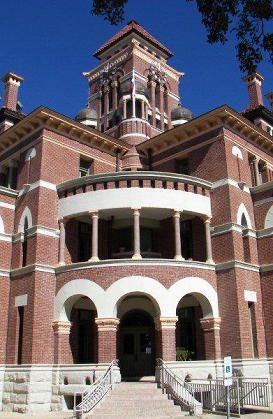
The 1894 Gonzales
County Courthouse
Photo courtesy Terry
Jeanson, November 2006
|
|
This
courthouse is a beauty. It has arches and turrets and balconies
and columns, just about anything a bird would want. Unlike many
courthouses built during this time, the clock tower and roof have
not been removed or replaced, and the façade has not been stuccoed.
There is a discrepancy as to what kind of material was used in the
arches above the windows, the railings, and the base of the building.
One source says it is of limestone quarried from nearby. Another
says it is of pre-cast concrete blocks. Since my degree was in flappery
and not in geology, either one looks pretty good to this eagle-eye
reporter.
It is understood that J. Riely Gordon is the architect, although
Otto Kroeger of San
Antonio is instead listed as contractor. At the time, county
officials considered Gordon a "rich city architect." However, his
papers at the University of Texas, Austin,
prove that he was the one who designed this courthouse.
|
|
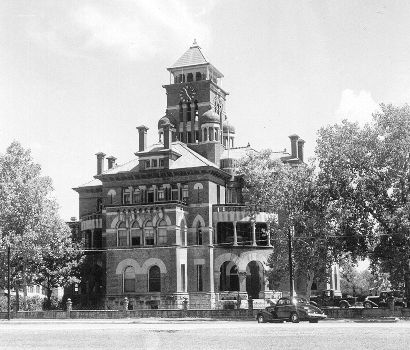
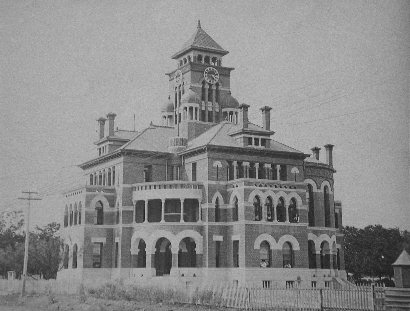
Gonzales County
Courthouse as it appeared in 1939
Photo courtesy TXDoT
|
|
Inside
the courthouse on the first floor are three paintings by artist
Carl Reuter, an 1870s German emigrant. One portrays downtown
Gonzales
in 1876 when cows were driven instead of cars. Thorton Chisolm himself
used to drive his cows through Gonzales
on his way to market in Missouri.
In another,
the artist depicts the 1836
siege of the Alamo where thirty-two men from Gonzales
were the only men who answered the plea of Colonel Travis. All defenders
perished at the Alamo.
Sam Houston's
order to retreat and the burning of Gonzales
began what is known as the Runaway
Scrape.
A third painting shows a 1925 view of the town as seen from somewhere
near the Old
Jail next to the courthouse.
|
|
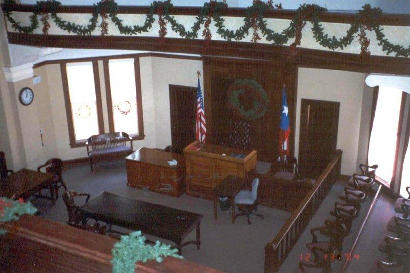
Gonzales County
Courthouse District Courtroom
Photo courtesy Terry
Jeanson, December 2004
|
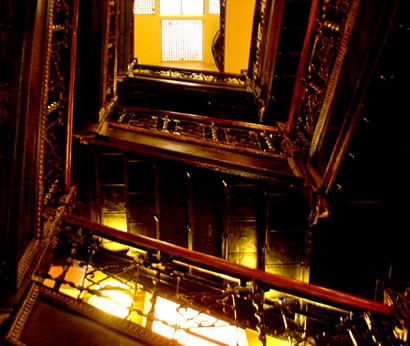
Courthouse Staircase
Looking Up
TE photo, 2002 |
|
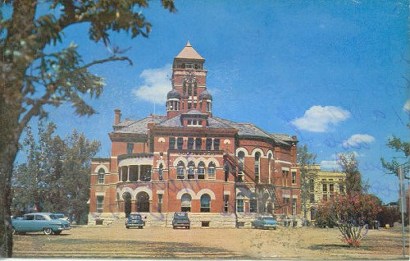
Gonzales County
Courthouse and
Jail
1950s Postcard courtesy www.rootsweb.com/ %7Etxpstcrd/
|
|
Speaking of
the Old
Jail, architect Eugene
T. Heiner, who also designed other grand Texas
courthouses, designed this jail to "hold 150 to 200 prisoners
in case of a riot." It had a room specifically for "lunatics" which
was later used for women and children. Now, I'm not making any comparisons,
but if you tell this story to women and children now, you probably
will incite a riot.
|
|
Gonzales County
Courthouse
Old photo courtesy THC
|
|
Gonzales has
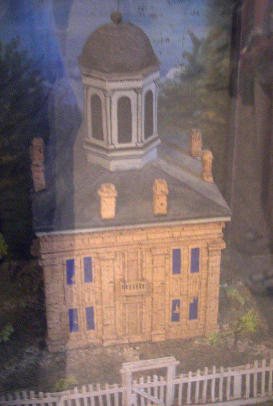
had four courthouses since the county was created in 1837.
The third one, built in 1857,
had a cistern in the middle of the courthouse that could hold over
three hundred barrels of water. It obviously didn't hold enough
because on December 3, 1893, the courthouse burned down. The cistern
didn't reappear until 1975 when a front-end loader disappeared under
the ground.
|
|
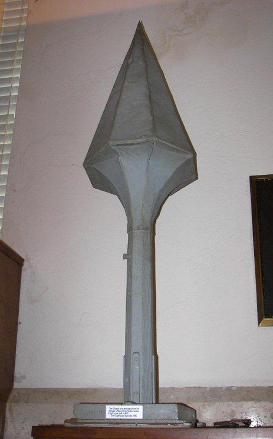
Steeple from
the 1857 courthouse
Photo courtesy Terry
Jeanson, October 2007
|
|
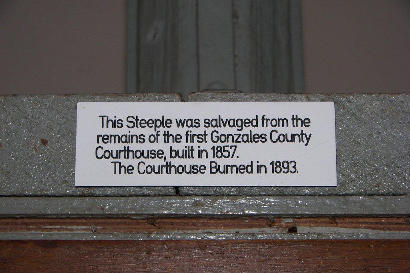
Placard at the
base of the steeple
Photo courtesy Terry
Jeanson, October 2007
|
|
Gonzales County
Courthouse SW entrance
Photo courtesy Terry
Jeanson, November 2006
|
|
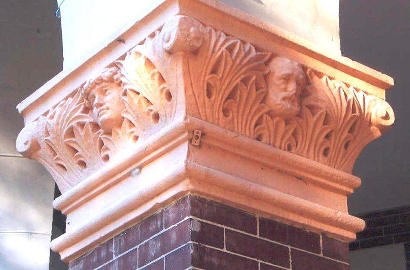
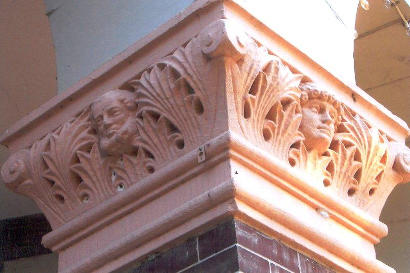
"The courthouse
has three faces on the capital of one of the brick columns at the
northwest corner entrance. The younger-looking face is the same
face in both of these pictures."
Photos courtesy Terry
Jeanson, September 2007
|
|
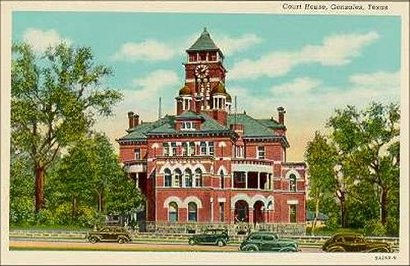
Gonzales County
Courthouse
1940s Postcard courtesy www.rootsweb.com/ %7Etxpstcrd/
|
|
The Old
Jail is now a museum, but the courthouse, recently restored,
is as good as ever. General
Houston would be proud to see how the town that he burned in
1836 has become the vital community it is today.
Copyright
Lou
Ann Herda, Ed. D
June 2001
References:
Gonzales County Jail Museum leaflet (pub. date unknown)
History of the Gonzales County Courthouses handout (pub. date unknown)
The History of Gonzales County, Texas, by the Gonzales County Historical
Commission, 1986 Oil Paintings Hanging in the Gonzales County Courthouse,
First Floor handout, by Genevieve B. Vollentine (pub. date unknown)
References and Additional Reading
Thanks to the Gonzales Chamber of Commerce for putting the materials
together for me.
Book
Hotel Here > Gonzales
Hotels
|
|
|