|
Constructed
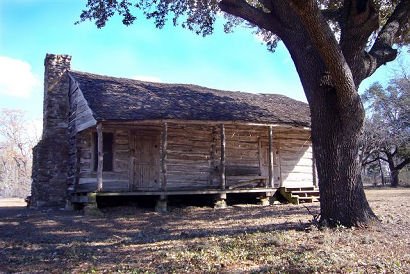
of hand-hewn logs, "The Brock Cabin" was built during the couple's
first year of marriage, with Andrew doing most of the work by himself.
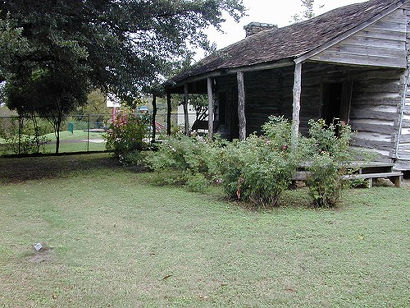
The small, soundly built cabin has two rooms across the front, a
loft, and a long shed room that spans the entire length of the back.
A galley porch graces the front of the structure and an unattached
kitchen once stood just outside the back door. Andrew labored long
and hard to build a suitable home for his young family, and he was
fond of saying," Rebecca would make me a green apple pie when I
did a good day's work."
At first, Andrew was more of a farmer than a rancher, his primary
crop being cotton, with a little
corn,
wheat, and oats on the side. The enterprising young farmer also
built and operated his own mule-powered cotton gin and a mill for
grinding meal and flour. Hauling cotton
to Laredo
for the Confederacy proved to be a profitable business during the
Civil War, and Brock supplemented this income by returning from
the border with goods to sell that were in short supply in wartime
Lockhart like coffee,
salt, sugar, and calico. Anticipating the end of the open range
in Texas, Brock also applied for and
received a patent for a wire stretcher.
Eight of the nine Brock children were born in the little log cabin
before the year 1874, when Andrew purchased a three room house furnished
with imported French furniture and moved the family to Lockhart.
Andrew continued to add to the newly purchased home with lumber
shipped in from Port
Lavaca until it was a rambling structure consisting of seven
rooms downstairs and three halls and two rooms upstairs with dormer
windows. The Brocks were proud owners of the first indoor tub in
the county. Made of zinc, it included a shower that was operated
by elevating two buckets of water over the tub. Rebecca Brock was
also one of the first women in the county to have a sewing machine.
While Mrs. Brock was busy making a home and caring for the family,
her husband was raising and selling mules in Missouri. Andrew Brock
also bred horses that he raced in New Orleans, St Louis, and New
York. Unfortunately he lost large amounts of money on this venture,
but resourceful as always, he began to recoup his losses by financing
the construction of buildings and renting them to businesses in
Lockhart. By 1900,
Brock owned twelve buildings, six of which were placed on the National
Register of Historic Places in 1978. The buildings, located on the
historic square in Lockhart,
are still in use today.
Six of the Brock children lived to adulthood, and having been given
between one hundred and two hundred acres of farmland as a wedding
present, each of them became residents and contributing members
of the community. In 1897, at the age of sixty-seven, Andrew Brock,
continuing to remain busy in his later years, applied for a patent
on useful improvements to disc cultivators and was granted the patent
on August 9, 1898.
Rebecca Brock died on November 10, 1900, and Andrew Brock died on
January 15, 1903. During their lives, Andrew and Rebecca were an
instrumental part in the transition of Lockhart
and Caldwell County
from an unsettled patch of wilderness into a growing and thriving
community. The “Brock Cabin” stands today as visible testimony to
their efforts and sacrifices. The Brocks are buried in the Lockhart
cemetery.
© Jeffery
Robenalt
"A Glimpse
of Texas Past" November
28, 2010 Column
jeffrobenalt@yahoo.com
See Lockhart, Texas
Lockhart
Hotels
|
 HOME
HOME