|
Watch your first
step.
TE
photo, 2005 |
|
Rosebud's
Carnegie Bridge
by Johnny Stucco
March
1, 2010
Andrew
Carnegie was perhaps the ultimate rags-to-riches story. After
becoming one of the richest men of his era, upon retirement he set
out to give his money away – with a vengeance. His gift of library
buildings across the English-speaking world is well known. (Two
Thousand, eight hundred buildings world-wide and nineteen hundred
and forty-six in the U.S. alone.)
Prior to 1872, Andrew
Carnegie had three passions: bridges,
railroad passenger cars and telegraphy. His iron mills were seen
as a subsidiary to his less-profitable Keystone Bridge Company,
which he himself called his “pet” interest. Carnegie’s passion for
bridges was
that they provided monuments that would endure for generations and
that they required engineering and architectural design (when constructed
on a large scale). These were skills that Carnegie greatly admired.
While the first bridge across the Mississippi (at St. Louis) was
widely known as the Eads Bridge (after its designer James B. Eads),
it was, in fact, constructed by Carnegie’s Keystone Bridge Company.
The bridge was started in the summer of 1868 and completed in the
spring of 1874.
While much has been written on the grand bridges, what are we to
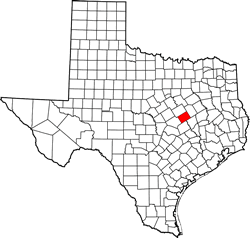
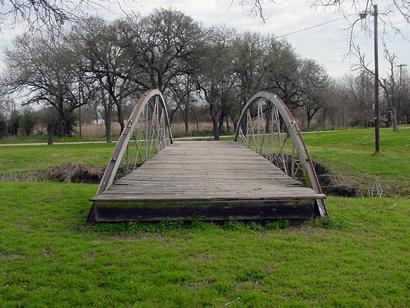
make of this tiny bowstring bridge in Rosebud,
Texas? Formed of Carnegie steel, it clearly dates much later,
but there is no date-plate attached.
Was it an experiment that produced few examples before being abandoned?
Were the sisters to this sample turned into scrap for WWII?
Searching the Internet brought up few clues. The overwhelming content
for a “Carnegie Bridge” search reveals a beautiful span in Cleveland,
over the Cuyahoga River, however, the reference to the name Carnegie
is an avenue by that name that connects to the bridge. It is now
known as the Hope Memorial Bridge, after Bob Hope’s father,
a local stonemason. Who knew? This modest little bridge sits on
solid ground in Rosebud’s
city park, providing no information – only mystery.
Rosebud
native Henry
Skupin (now of Houston)
called an old classmate who provided some information on how the
bridge came to be where it currently is, but nothing on its origin.
William
Tarver writes: “If I recall correctly from my youth, the bridge
was originally installed over Pond Creek in southern Falls
County. Excess erosion caused a new bridge to be installed. The
old bridge was purchased by the City of Rosebud
and the city paid to transport it to the city park to provide a
second means of egress for the park. I think the bridge was a ‘kit’
bridge manufactured by one of the Andrew
Carnegie’s foundries around 1900.”
For now, until more information is discovered, or until similar
bridges surface, Rosebud,
Texas has perhaps the only extant sample of a (small scale)
“Carnegie Bridge” in Texas.
[For Updates,
see Forum below:]
|
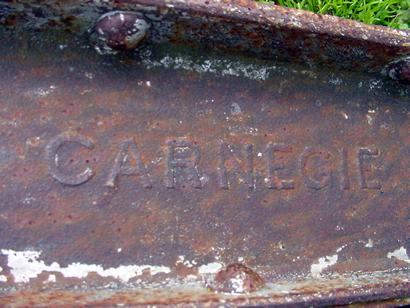 |
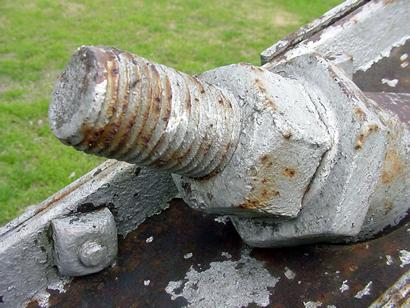
"The quailty
goes in before the name's welded on."
TE photo, 2005 |
FORUM - UPDATES
Subject: How the bridge came to Rosebud
Some years ago I read your piece on the bridge in Legion Park in Rosebud.
There were some questions about its origins. I recently was going
through an old Rosebud News, July 5, 1963, showing the moving of the
bridge and detailing its arrival in Rosebud.
I revisited your story. It was correctly stated that the bridge was
removed from Pond Creek, and a new bridge put in place. The Rosebud
bridge, according to the newspaper, was built in 1867 by King Iron
Works.
Felix Neinast, a County Commissioner at that time, requested that
the bridge be given to the City of Rosebud. The City actually refused
the bridge as they felt it would be too costly to maintain and would
not add anything to the park. The American Legion took up the cause
and decided to accept the bridge from the County and began a campaign
to raise money to replace the floor. Prior to being moved to Rosebud,
the bridge was in Lott
where it was repaired and repainted before being moved to its present
location.
I enjoy your [magazine] very much. Thank you for preserving history!
- Fran Hargrove, Rosebud, Texas, August 19, 2021 |
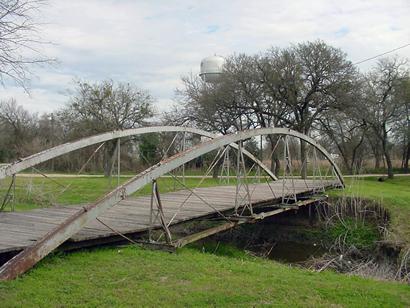 |
Repaired &
repainted in Lott
The bridge at its new home
TE
photo, 2005 |
Subject:
Rosebud Bowstring Truss Bridge
I’ve been enjoying looking around your site. The bowstring bridge
in Rosebud
is almost certainly made by the King Bridge Co. The reason for statement
is that the structure of the bowstring truss matches the King patent.
The Carnegie marks represent the mill that made the iron. King would
have likely made the bridge between the 1860s and the 1880s. I hope
this helps. Regards, Art Suckewer, January 12, 2014 |
"Bolt upright"
TE
photo, 2005 |
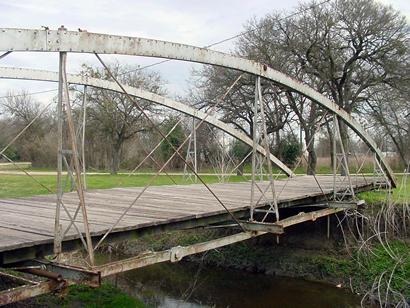
Form and Function
TE
photo, 2005 |
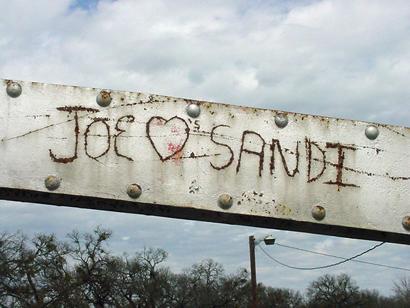
Romantic grafitto
TE photo, 2005 |
| Texas
Escapes, in its purpose to preserve historic, endangered and vanishing
Texas, asks that anyone wishing to share their local history, stories,
landmarks and vintage or recent photos, please contact
us. |
|
|
 HOME
HOME