|
 |
Spanish Fort,
Texas
by Robin
Jett
The Roads of Texas atlas AND Ghost Towns of Texas by T.
Lindsay Baker claim that Spanish Fort is a ghost town - but when
I visited it, quite a few live souls waved at me from their riding
lawn mowers. However, when taking into account the colorful history
of this now-sleepy town on the banks of the river that runs red (ok,
most of the time it's brown), the term "ghost town" aptly describes
this community.
The site that Spanish Fort now occupies was once a Taovaya Indian
village. Mostly, the natives peacefully farmed and traded with
the French. In 1759, Spanish troops under Diego Ortiz Parilla tried
to claim the territory after a Taovaya and Comanche raid on the San
Saba mission. To thwart the Spanish, the Taovaya built a large fort,
surrounding it by a moat. The Taovaya and Comanche tribes (some say
with French help, although that was probably not likely) captured
a Spanish canon, and used it successfully in a battle that made the
Lords of the South run for the hills. If the natives had known high-fives
back then, they probably would've exchanged several.
But the history of the Western Frontier proved that peace never remained
for long. In the 1830s, American settlers, in their good ol' manifest
ways, decided that the fort they found in the fertile Red River valley
should be rightfully theirs. Since they thought it belonged to the
Spanish (may have been the canon that led them to this conclusion),
they named the "new" town they founded Spanish Fort. The Taovaya,
decimated by smallpox, decided that the neighborhood was going to
the birds, so they headed west and merged with the Wichita.
Soon, the Chisholm Trail cut its way to Spanish Fort, which
now had a population of about 1,000. The crossing at the Red River
signaled the entry into untamed Indian Territory, which provided the
cowhands a reason to need lots of wine, women, and song. Spanish Fort
complied by opening 4 hotels, several saloons, bordellos, and a few
specialty shops, including the first store of that famous cobbler
H.J. Justin. The town also boasted a doctor, who remained busy tending
to the dying after gunfights. It has been told that on one Christmas
morning, 4 men found their way into the red soil of the Spanish Fort
cemetery after an all-night poker game at the Cowboy saloon went awry.
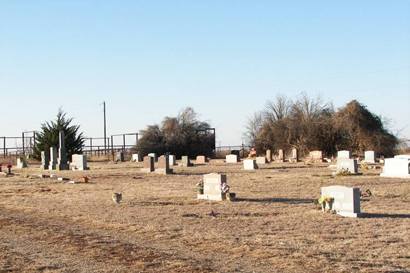
Ghost Towns tells of the cemetery holding 43 graves: 3 suicides and
40 murders.
Once the railroad made the Chisholm Trail obsolete, Spanish Fort lost
its glory. Being so remote from major roads and rail lines, the inhabitants
moved south to greener pastures. By the turn of the century the rough
trail town quieted into a laid-back, tiny community. With the discovery
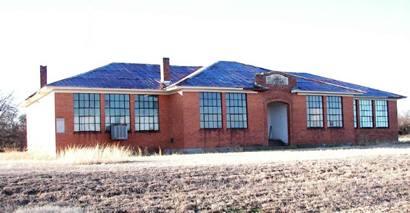
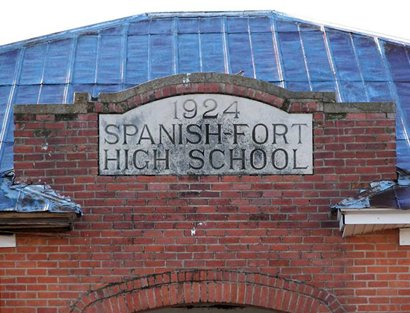
of oil in fields surrounding Spanish Fort, the town rebounded long
enough to open a schoolhouse in 1924, but now it too sits forgotten
along the road that once lead cattle across the banks of the Red River.
© Robin
Jett |
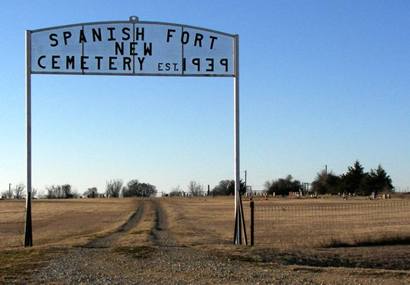
1939 Spanish
Fort Cemetery Entrance
Photo courtesy Barclay
Gibson, 2007 |
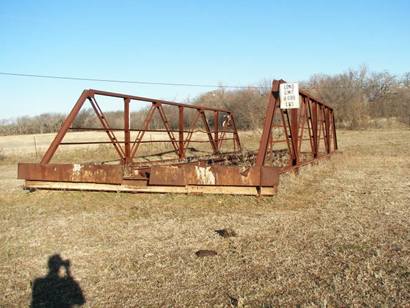
Abandoned Bridge
SE of Spanish Fort
Photo courtesy Barclay
Gibson, 2007 |
Bibliography:
Baker, T. Lindsay. Ghost Towns of Texas. Norman: University of Oklahoma
Press, 1986.
Farman, Irvin. Standard of the West. Fort Worth: TCU Press, 1996.
Jelks, B. Edward. Taovaya Indians. Handbook of Texas On-line.
Texas A&M University. The Roads of Texas. Fredericksburg, TX: Shearer
Publishing, 1988, rev. 1995,1999.
© Robin Jett
May 2002 |
|
| Texas
Escapes, in its purpose to preserve historic, endangered and vanishing
Texas, asks that anyone wishing to share their local history, stories,
landmarks and recent or vintage photos, please contact
us. |
|
|
 HOME
HOME

 Texas
Gulf Coast
Texas
Gulf Coast East
Texas
East
Texas Central
Texas North
Central
Texas North Central
Texas South
Central
Texas South Texas
Panhandle
Texas
Panhandle South
Texas
South
Texas Texas
Hill Country
Texas
Hill Country West
Texas
West
Texas Texas
Ghost Towns
Texas
Ghost Towns Texas
Counties
Texas
Counties