|
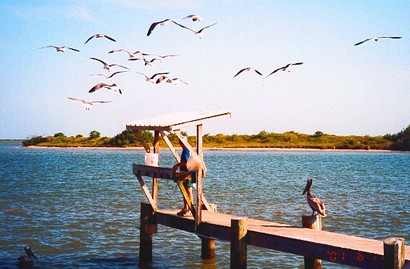
Seagulls
and pelican on the pier
TE photo, August 2001 |
History
in a Seashell
Thomas M. O'Connor was the owner of the 70,000-acre Alligator Head
Ranch in Calhoun
County. In 1909 the Calhoun Cattle Company platted the townsite
and two years later the International-Great Northern Railroad came
to town.
Now connected by the railroad, people turned the town into a summer
resort where it has remained ever since.
The town later became a terminus of the St. Louis, Brownsville and
Mexico Railway.
An ice factory made possible fish and oyster business and for some
time figs were one of the major crops. Fig Orchards Company of Port
O'Connor processed the figs for the farmers who raised them.
People could train over to Port O'Connor, sip ice-cold drinks and
have plates of Oysters in Fig Sauce.
The Gulf Intracoastal Waterway was dredged by 1939. This connected
New Orleans with Corpus
Christi and protected smaller craft from German submarines during
the early years of World War
II, but didn't help the tankers that had to run the gauntlet of
U-boats through the straits of Florida. Pipelines to the East coast
constructed in record time solved the problem.
Port O'Connor has had its share of storms. There was no population
when the storms that made Indianola
a ghost hit the area, and the same was true for the 1900
storm. But 1919, 1942 and 1945 had storms that damaged the town.
Hurricane Carla in 1961, completely leveled downtown Port O'Connor
which explains the absence of a town center.
In 1969 the town's population exceeded 1,000 due to employment opportunities
at the nearby Matagorda Air Force Base. It later dropped to around
800.
Port O'Connor continues to be an attraction for retirees, fishermen
and summer tourists. |
Port
O'Connor Chronicles
The
Old Lady and the Sea by Mike Cox
...On
Sept. 11, 1961, Hurricane Carla-one of the strongest hurricanes
ever to strike the state-virtually erased Port O'Connor and caused
extensive damage all the way to Galveston..... "There has never
been a storm on the coast with Carla's magnitude nor one that carried
so many freak winds," Sharp said after the storm..... Four days
after Carla's landfall, a group of citizens meeting at an elementary
school that had somehow survived elected her mayor of a town that
had been blown away. She worked with five local men chosen as commissioners
and along with local, state and federal officials to get Port O'Connor
rebuilt.... more
|
|
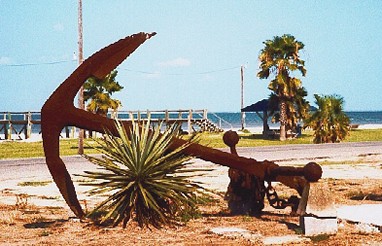
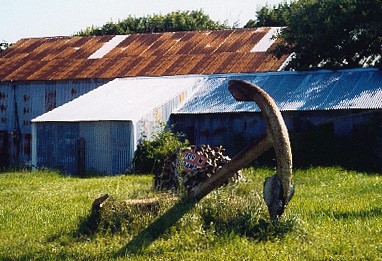
Landscaping
with anchors 101
TE photo, August 2001
|
|
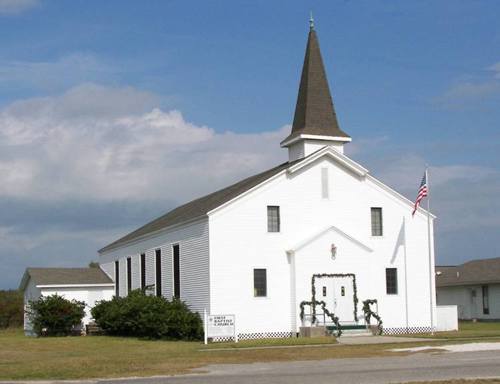
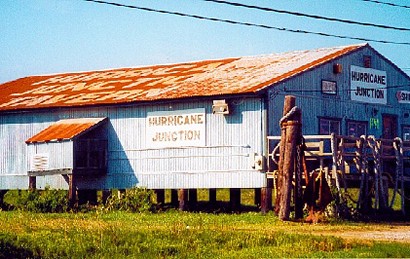
Seaside casual
architecture
TE photo, August 2001
|
|
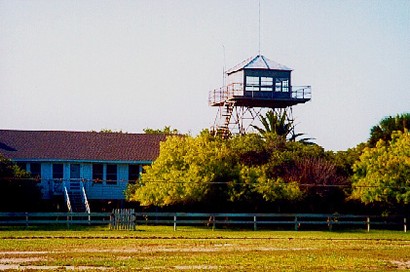
A
tower overlooking Matagorda Bay
TE photo, August 2001
|
Port O'Connor
Attractions
Matagorda
Island State Park
On Matagorda Island
Passenger ferry from the dock in Port O'Connor.
Port O'Connor Chamber of Commerce
PO Box 701 Port O'Connor, TX 77982 (361)983-2898 |
| Texas
Escapes, in its purpose to preserve historic, endangered and vanishing
Texas, asks that anyone wishing to share their local history and recent
or vintage/historic photos, please contact
us. |
|
|
 HOME
HOME

 Texas
Gulf Coast
Texas
Gulf Coast East
Texas
East
Texas Central
Texas North
Central
Texas North Central
Texas South
Central
Texas South Texas
Panhandle
Texas
Panhandle South
Texas
South
Texas Texas
Hill Country
Texas
Hill Country West
Texas
West
Texas Texas
Ghost Towns
Texas
Ghost Towns Texas
Counties
Texas
Counties