|
|
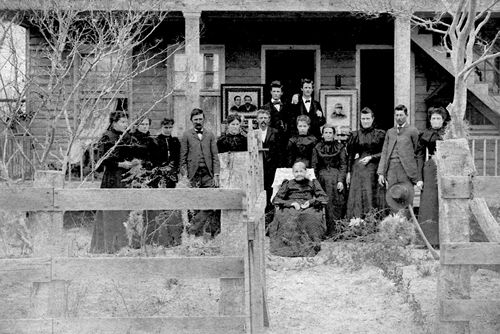
Joseph Kobitz
Family near Coleto Creek
Photo courtesy Frank Richard Brown |
History in
a Pecan Shell
A brief time line
of significant events in Raisin's history:
1889:
established as a stop on the Gulf, Western Texas and Pacific Railroad
from Victoria to
Beeville.
1892: The town gets a post office. The railroad called the
station Lucy, but the postal authorities rejected it - wanting
something more distinctive. The name Raisin was chosen to honor a
local rancher (J. K. Reeves) who had tried to grow grapes. Judging
by the name - it wasn't a successful venture.
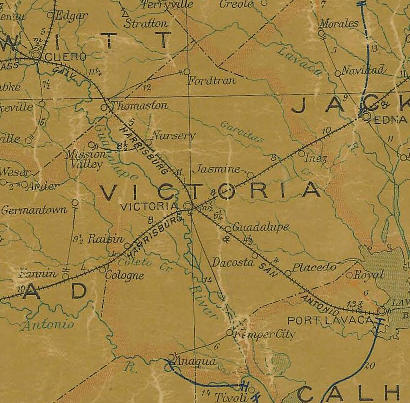
(See 1907 Victoria County postal map)
The nearby German settlement of Coletoville
took an interest in Raisin - probably due to the depot. C. T. Friedrichs,
built a gin, and a man named Kohl built a store. Frederichs was the
first postmaster and Kohl the second - serving from 1901 until 1914
1914: Post office closes
1930: The American Railway Express office, closes and Southern
Pacific discontinues passenger service - a result of a drop in passengers
from the opening of highway 59.
The population of the Raisin-Coletoville
area has remained at about fifty persons from the early 1900s
to the present.
See "Familes
of Raisin, 1900s Vintage Photos" › |
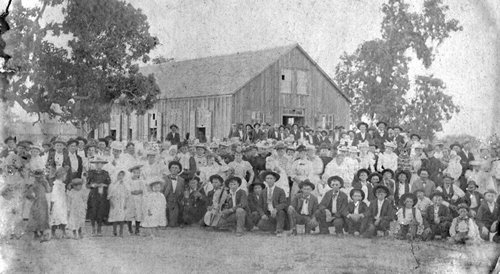 |
Old Frederich's
Dance Hall, circa 1890
Photo courtesy Frank Richard Brown
More Texas
Dance Hall |
FREDERICH'S
DANCE HALL in RAISIN, TEXAS
[The photo is]
from a collection
of old photographs that belonged to my great grandmother, Dora
Kobitz of the Cross K Ranch that resided on the Victoria
County shore of Coleto Creek.
Our family, the Kobitz family, lived on a large ranch that bordered
Coleto Creek on the Victoria
County side. Most of this property was taken when the Coleto
Resovoir was built in the late 1960's. but there is still a small
parcel about midway between Raisin and Coletoville.
My Grandfather, Preston Charles Kobitz, was the last born male in
the Kobitz family, and the last to live in the old ranch house.
In the late 1980's he wrote his remembrances of life in Raisin/Coletoville
during the early 1900's; The following passage is taken from those
writings:
Time Has Passed it By....
"Raisin was quite a little burg. Otto Kolh had the big general store.
Before the Postal Service started the rural mail service, he was also
Post Master. There was also a cotton gin, two dance halls. There is
a picture of the Frederick Hall among the old pictures. There was
a blacksmith shop and two saloons.
Frederichs Hall was quite large, and at Christmas there was a big
live oak decorated with popcorn on string. I do not recall if there
were apples and oranges. I do recall that there were many gifts under
the tree. There were many barbecues, usually on July 4th or other
special days. The charge was usually fifty cents for all you could
eat. It included potato salad, noodle salads, coffee, vegetables,
pickles, bread, and anything you would serve at home for a dinner,
it would be on their table. This was always a gala occasion. It would
start in the afternoon and end up with a dance at night. The saloons,
of course, did a big business! There was always a number of fights
and you could bet that a man named John Marr was in at least one of
them. The cotton gin, the blacksmith shop, the Otto Kolh store are
all gone, have been for years. Also the saloons. Time has passed it
by."
- Frank Richard Brown, June 22, 2007 |
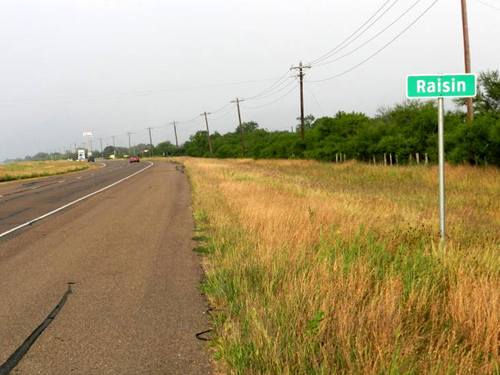 |
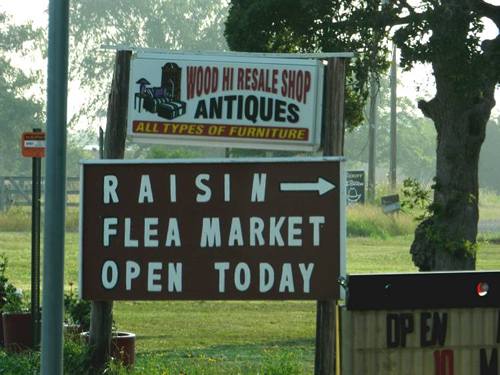
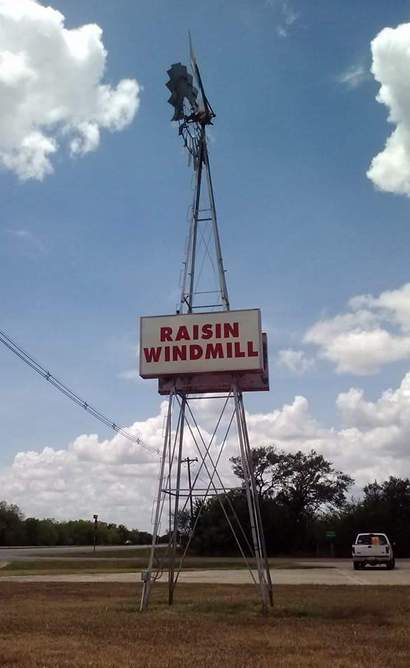
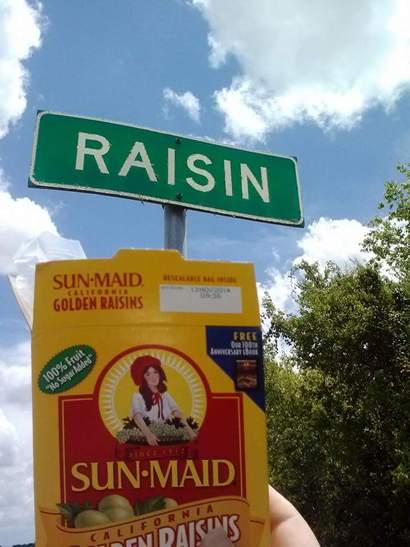
Raisin TX sign
with Sun-Maid Raisin
Photo
courtesy Elicia Cook, September 2017
More Texas Signs |
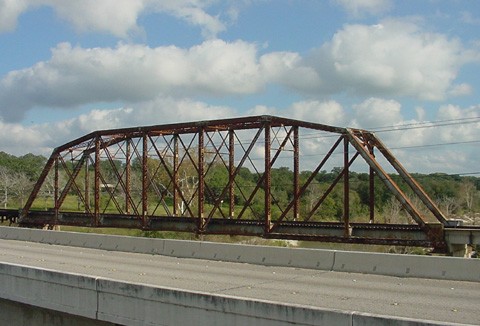
Raisin Bridge
over Coleto Creek
TE Photo,
2005
More Texas Bridges |
| Texas
Escapes, in its purpose to preserve historic, endangered and vanishing
Texas, asks that anyone wishing to share their local history
and vintage/historic photos, please contact
us. |
|
|
 HOME
HOME

 Texas
Gulf Coast
Texas
Gulf Coast East
Texas
East
Texas Central
Texas North
Central
Texas North Central
Texas South
Central
Texas South Texas
Panhandle
Texas
Panhandle South
Texas
South
Texas Texas
Hill Country
Texas
Hill Country West
Texas
West
Texas Texas
Ghost Towns
Texas
Ghost Towns Texas
Counties
Texas
Counties