|
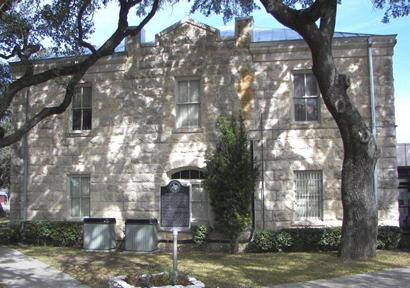
Real County courthouse
(South side).
Photo courtesy Terry
Jeanson, January 2008 |
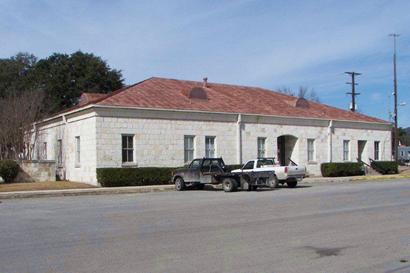
Ransom
Annex on the east side of the 1917 Real County courthouse
Photo courtesy Terry
Jeanson, January 2008 |
Photographer's
Note:
"The Ransom
Annex on the east side of the 1917 courthouse was completed in
1978 and is, essentially, the new courthouse. The 1917 courthouse
now houses county offices. This stone building was designed by Barton
D. Riley & Associates.
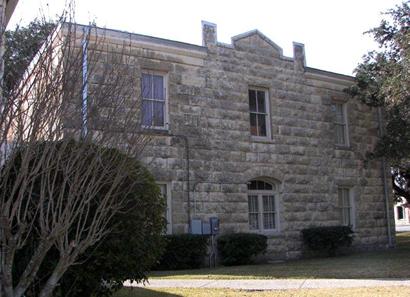
Both the South
and North
side of the 1917 Real County courthouse entrances were converted to
windows.
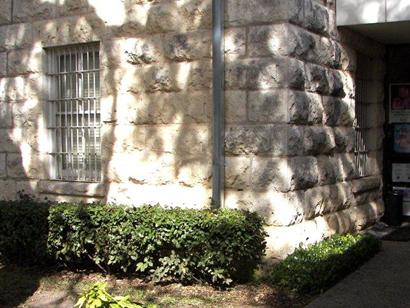
The courthouse contained a jail
with two small cells that was used until 1978. The bars can still
be seen on the windows." - Terry
Jeanson |
North side of
the 1917 courthouse
Photo courtesy Terry
Jeanson, January 2008 |
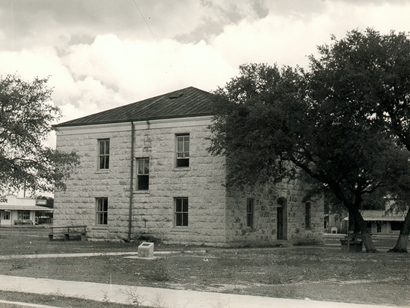
Real County Courthouse
as it appeared in 1939
Photo courtesy TXDoT |
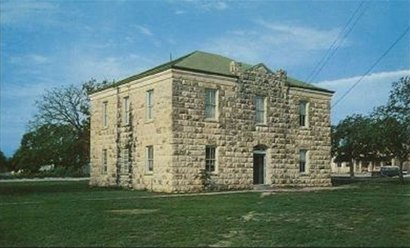
Real County Courthouse
in the 1950s
Postcard courtesy www.rootsweb.com/ %7Etxpstcrd/ |
The courthouse
jail with two small cells used until 1978.
Photo courtesy Terry
Jeanson, January 2008 |
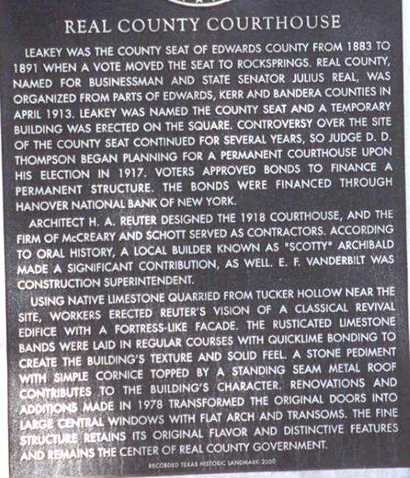
Real County courthouse
historical marker
Photo courtesy Terry
Jeanson, January 2006 |
Historical Marker:
Real County
courthouse
Leakey
was the county seat of Edwards
County from 1883 to 1891 when a vote moved the seat to Rocksprings.
Real County, named
for businessman and State Senator Julius Real, was organized from
parts of Edwards,
Kerr and Bandera
counties in April 1913. Leakey was named
the county seat and a temporary building was erected on the square.
Controversy over the site of the county seat continued for several
years, so Judge D. D. Thompson began planning for a permanent courthouse
upon his election in 1917. Voters approved bonds to finance a permanent
structure. The bonds were financed through Hanover National Bank of
New York.
Architect H. A. Reuter designed the 1918 courthouse, and the firm
of McCreary and Schott served as contractors. According to oral history,
a local builder known as "Scotty" Archibald made a significant contribution,
as well. E. F. Vanderbilt was construction superintendent.
Using native limestone quarried from Tucker Hollow near the site,
workers erected Reuter's vision of a Classical Revival edifice with
a fortress-like façade. The rusticated limestone bands were laid in
regular courses with quicklime bonding to create the building's texture
and solid feel. A stone pediment with simple cornice topped by a standing
seam metal roof contributes to the building's character. Renovations
and additions made in 1978 transformed the original doors into large
central windows with flat arch and transoms. The fine structure retains
its original flavor and distinctive features and remains the center
of Real County government.
Recorded Texas Historic Landmark - 2000 |
|
|
 HOME
HOME