|
|
 |
History in
a Pecan Shell
Once known as Peyton
Colony and Boardhouse (after the first structure built),
it was also referred to by white settlers as Freedman's Colony.
Settled just after the Civil War, the community’s namesake is Peyton
Roberts, an emancipated slave from Lockhart,
Texas. Roberts was joined by other freedmen and in the early 1870s
and land for a church was donated by the family of Jim Upshear who
arrived by wagon train from Virginia.
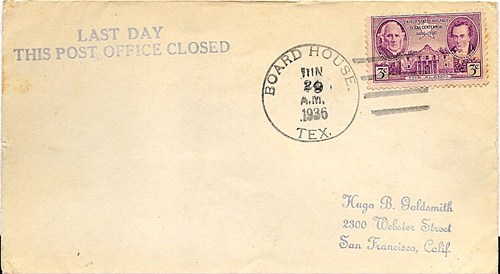
The community had its own post office (briefly) from 1898 through
1909 and again from 1918 until the Great Depression.
Today, descendants of the original settlers still live in the vicinity
and the population estimate for 2000 was 30. The Mount Horeb Baptist
Church is the community’s social center. |
Photographer's
Note:
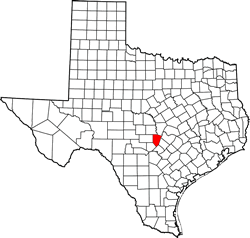
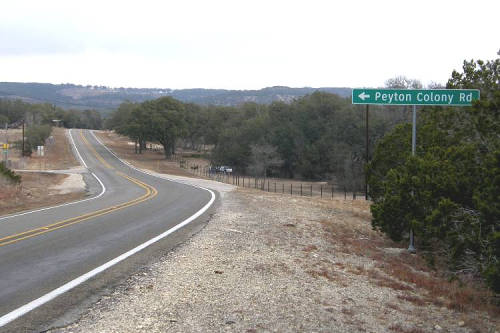
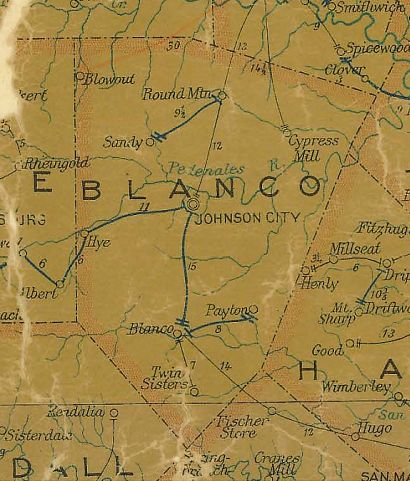
Peyton Colony is located about 7 miles ENE of Blanco
in Blanco County,
just off FM 165. Only after my last visit there did I see that the
Peyton Colony Cemetery is nearby, on private property. - Barclay
Gibson, June 27, 2010 |
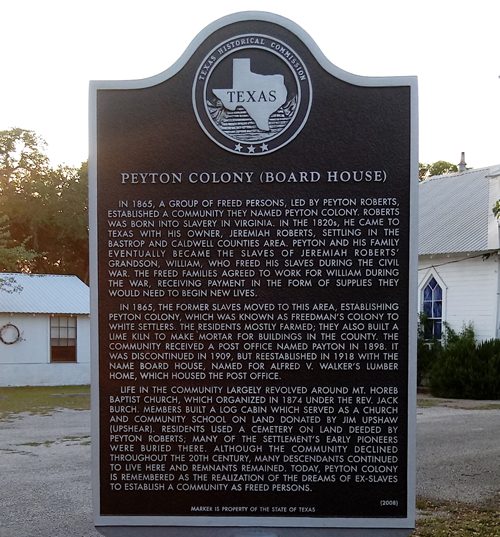
Historical Marker for Peyton Colony
which also went by the name Board House.
Photo courtesy Dustin
Martin, April 2018 |
Historical Marker,
593 Peyton Colony Rd.
in front of Mt. Horeb Baptist Church
Peyton Colony
(Board House)
In 1865, a group
of freed persons, led by Peyton Roberts, established a community they
named Peyton Colony. Roberts was born into slavery in Virginia. In
the 1820s, he came to Texas with his owner, Jeremiah Roberts, settling
in the Bastrop
and Caldwell counties
area. Peyton and his family eventually became the slaves of Jeremiah
Roberts’ grandson, William, who freed his slaves during the Civil
War. The freed families agreed to work for William during the war,
receiving payment in the form of supplies they would need to begin
new lives.
In 1865, the former slaves moved to this area, establishing Peyton
Colony, which was known as Freedman’s Colony to white settlers.
The residents mostly farmed; they also built a lime
kiln to make mortar for buildings in the county. The community
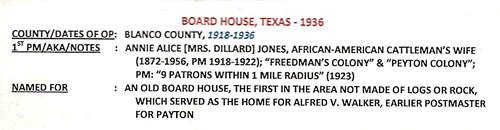
received a Post Office named Payton in 1898. It was discontinued
in 1909, but reestablished in 1918 with the name Board House,
named for Alfred V. Walker’s lumber home, which housed the Post Office.
Life in the community largely revolved around Mt. Horeb Baptist Church,
which organized in 1874 under the Rev. Jack Burch. Members built a
log cabin which served as a church and community school on land donated
by Jim Upshaw (Upshear). Residents used a cemetery on land deeded
by Peyton Roberts; many of the settlement’s early pioneers were buried
there. Although the community declined throughout the 20th century,
many descendants continued to live here and remnants remained. Today,
Peyton Colony is remembered as the realization of the dreams of ex-slaves
to establish a community as freed persons.
(2008) |
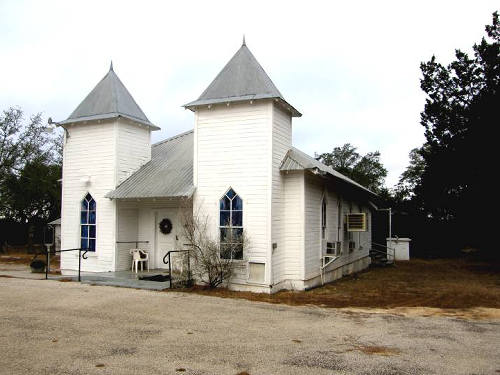
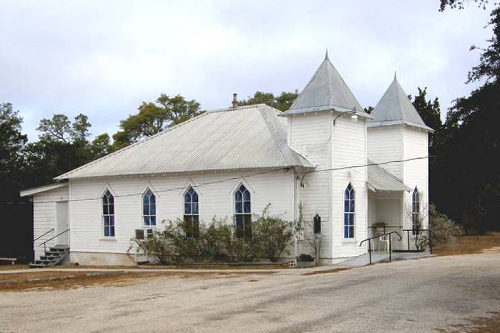
Mount Horeb
Baptist Church
On CR 409, one
mile N of FM165 |
Another view
of the Mount Horeb Baptist Church
Photo
courtesy Barclay
Gibson, 2009 |
Historical Marker
- on CR 409, one mile N of FM165
Mount Horeb
Baptist Church
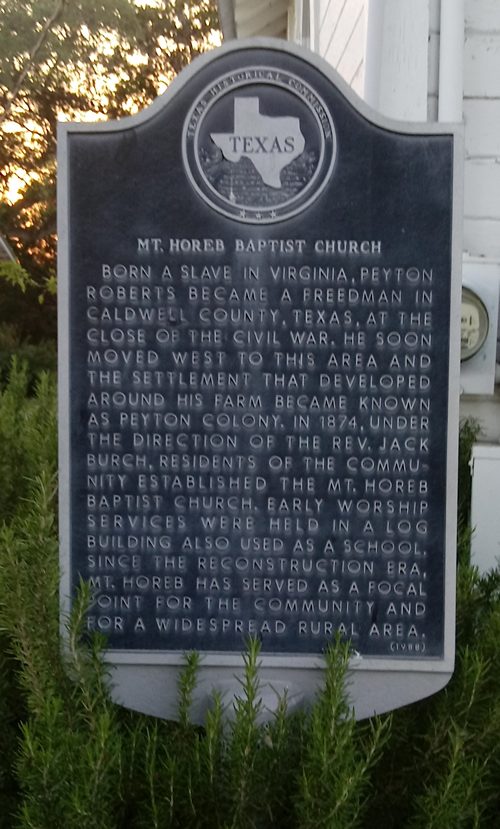
Born a slave in Virginia, Peyton Roberts became a freedman in Caldwell
County, Texas, at the close of the Civil War. He soon moved west
to this area and the settlement that developed around his farm became
known as Peyton Colony. In 1874, under the direction of the Rev. Jack
Burch, residents of the community established the Mt. Horeb Baptist
Church. Early worship services were held in a log building also used
as a school. Since the reconstruction era, Mt. Horeb has served as
a focal point for the community and for a widespread rural area.
(1988) |
Mt.
Horeb Baptist Church Historical Marker
Photo courtesy Dustin
Martin, April 2018 |
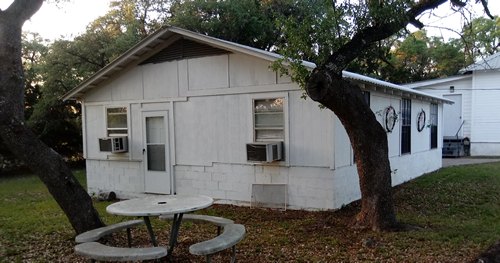
Building
next to Mt. Horeb Baptist Church.
Parsonage perhaps?
Photo courtesy Dustin
Martin, April 2018 |
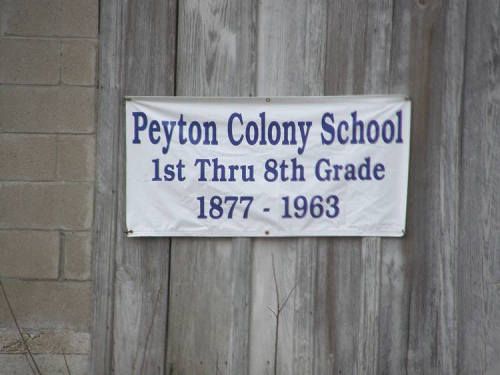
Peyton Colony
School
1st Thru 8th Grade
1877-1963 |
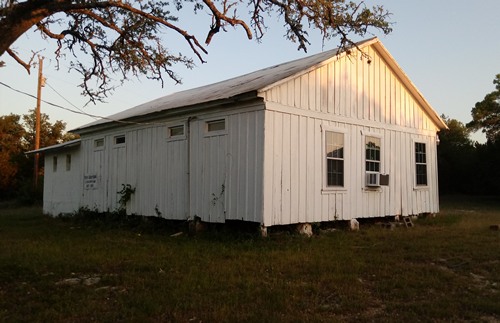
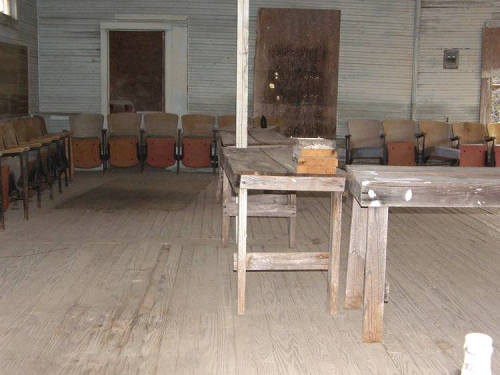
Peyton
Colony Schoolhouse today
Photo courtesy Dustin
Martin, April 2018 |
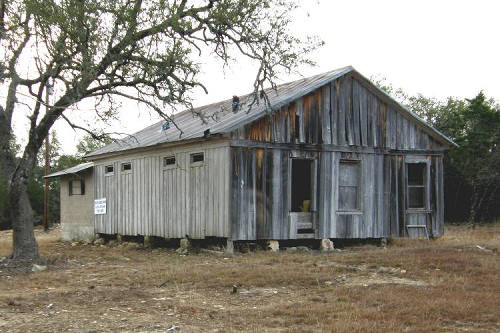
Peyton Colony
Schoolhouse as it appeared in 2009
Photo
courtesy Barclay
Gibson, 2009 |
Historical Marker
- roadside park, west side of 165 (8 miles NE of Blanco)
Peyton Colony
Lime Kiln
Peyton Colony was
a freedmen's community established in the 1860s under the leadership
of former slave Peyton Roberts. In addition to homes, the community
included a local school and Mt. Horeb Baptist Church.
This lime kiln was built by Peyton Roberts and his neighbors to provide
high quality materials with which to make mortar for buildings in
Blanco County, some
of which remain today. The kiln was restored in the 1960s in conjunction
with the construction of a roadside park at the site. It stands as
a reminder of the efforts of ex-slaves to begin new lives.
(1988)
Incising: Restored by Blanco Lions Club |
Peyton
Colony is featured in T. Lindsay Baker 's "Ghost Towns of Texas."
Texas Escapes, in its purpose to preserve
historic, endangered and vanishing Texas, asks that anyone wishing
to share their local history and new or vintage/historic photos, please
contact
us. |
|
|
|
 HOME
HOME

 Texas
Gulf Coast
Texas
Gulf Coast East
Texas
East
Texas Central
Texas North
Central
Texas North Central
Texas South
Central
Texas South Texas
Panhandle
Texas
Panhandle South
Texas
South
Texas Texas
Hill Country
Texas
Hill Country West
Texas
West
Texas Texas
Ghost Towns
Texas
Ghost Towns Texas
Counties
Texas
Counties