|
 |
History in
a Pecan Shell
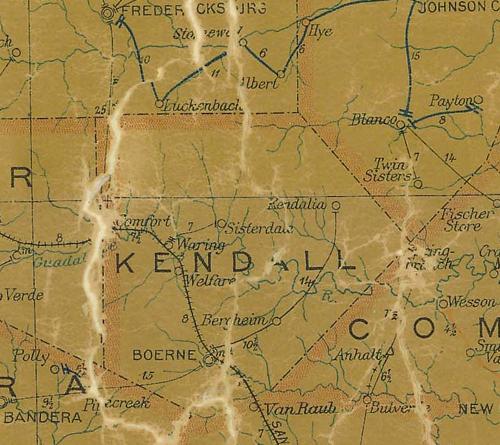
Prior to 1880 the
town was known as Bon Ton (French for “High-toned”) After the
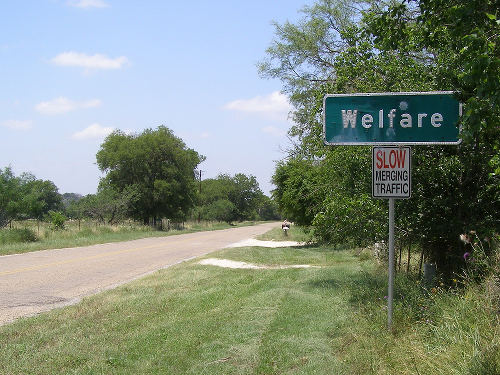
post office opened it was named Welfare – thought to be a corruption
of the German word Wolhlfarht – said to mean pleasant journey.
So, in true American fashion, the town had both a French and German
name before it was “adjusted” to an English word.
In 1887 the San Antonio and Aransas Pass Railroad connected San
Antonio and Kerrville,
allowing a market for locally produced goods. The town reached a high-water
mark of 275 residents in the early 1890s.
The first years of the 20th century were good to Welfare, but the
town suffered a drought and fire (which explains the lack of commercial
structures). Finally, the boll
weevil appeared, ruining the cotton
crops and reducing the population to a mere 25 residents – even before
the Great Depression. When it appeared things couldn’t get worse,
they did. In 1930 the town was bypassed by a new highway (Highway
87).
The trains stopped running past Welfare in 1970 and the post office
closed in 1976 – the year the rest of the county was celebrating the
Bi-centennial. From the 1940s through the 1960s the population was
40, dropping below that for the next twenty years. |
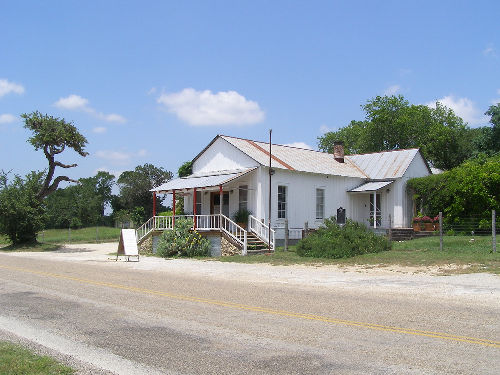
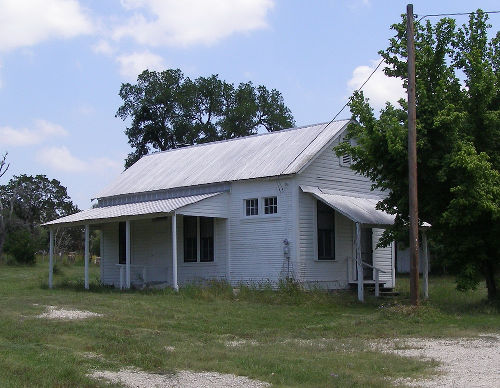 |
Welfare Schoolhouse
217 Waring-Welfare Rd.
Recorded Texas Historic Landmark
Photo
courtesy Will
Beauchamp, June 2010 |
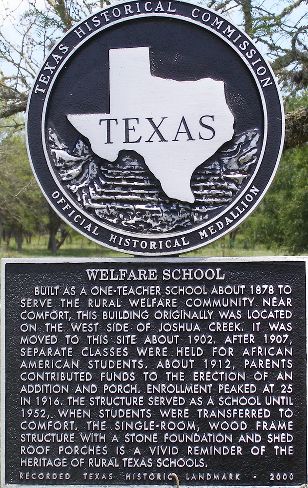
Historical Marker
Welfare School
Built as a one-teacher
school about 1878 to serve the rural Welfare community near Comfort,
this building originally was located on the west side of Joshua Creek.
It was moved to this site about 1902. After 1907, separate classes
were held for African American students. About 1912, parents contributed
funds to the erection of an addition and porch. Enrollment peaked
at 25 in 1916. The structure served as a school until 1952, when students
were transferred to Comfort. The single-room, wood frame structure
with a stone foundation and shed roof porches is a vivid reminder
of the heritage of rural Texas schools.
Recorded Texas Historic Landmark - 2000 |
Welfare
School historical marker
Photo courtesy Will
Beauchamp, June 2010 |
Historical Marker
on Waring-Welfare Road
Photo courtesy Will
Beauchamp, June 2010 |
Historical Marker
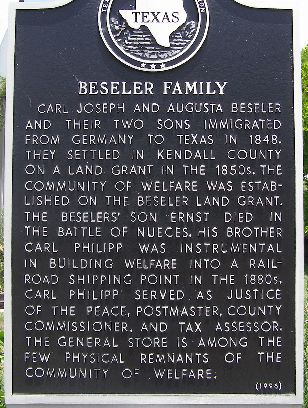
Beseler Family
Carl Joseph and
Augusta Beseler and their two sons immigrated from Germany to Texas
in 1848. They settled in Kendall
County on a land grant in the 1850s. The community of Welfare
was established on the Beseler land grant. The Beselers' son Ernst
died in the Battle of Nueces. His brother Carl Philipp was instrumental
in building Welfare into a railroad shipping point in the 1880s. Carl
Philipp served as justice of the peace, postmaster, county commissioner,
and tax assessor. The general store is among the few physical remnants
of the community of Welfare.
(1996) |
| Texas
Escapes, in its purpose to preserve historic, endangered and vanishing
Texas, asks that anyone wishing to share their local history, stories,
landmarks and recent or vintage photos, please contact
us. |
|
|
 HOME
HOME

 Texas
Gulf Coast
Texas
Gulf Coast East
Texas
East
Texas Central
Texas North
Central
Texas North Central
Texas South
Central
Texas South Texas
Panhandle
Texas
Panhandle South
Texas
South
Texas Texas
Hill Country
Texas
Hill Country West
Texas
West
Texas Texas
Ghost Towns
Texas
Ghost Towns Texas
Counties
Texas
Counties