|
|
A Very Brief
History of Flomot
The name is an
amalgam of the two counties Floyd and Motley. The post
office originally sat on the county line, but was later moved to a
private home.
The town already had a school and store established in the 1890s before
the post office opened in 1902.
In 1915 the post office was moved to W. R. Welch's home.
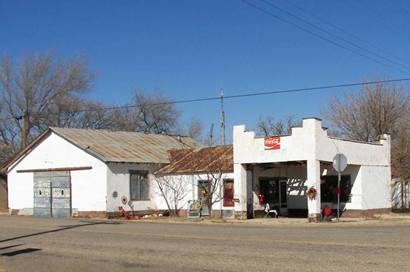
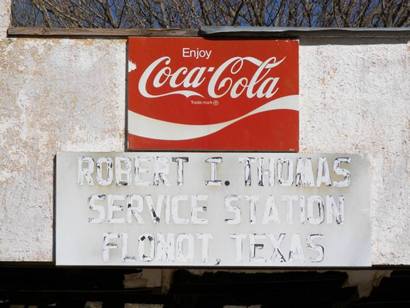
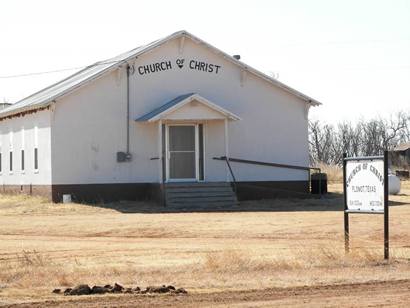
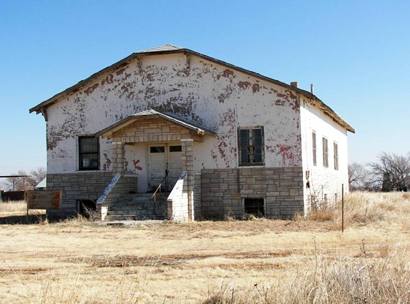
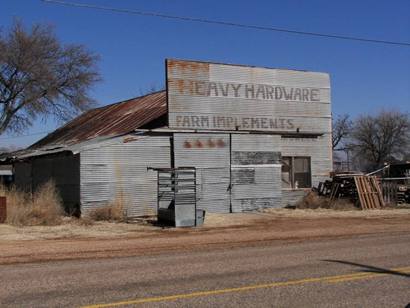
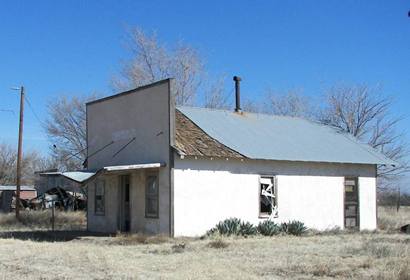
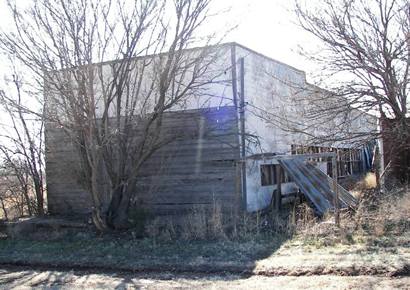
Flomot Landmarks / Images
Flomot as Remembered by Joe Garrett
|
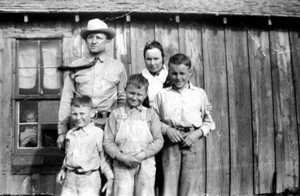
| "A
picture taken in 1939 of the Frank Garrett family of Flomot, Texas.
Front row: Joe Garrett, Raby Garrett, Calvin Garrett. Back row: Frank
Garrett, Dillie Morris Garrett. Picture taken at the farmhouse of
Alexander Shakespeare and Lillie Grimes Morris, Flomot pioneers, and
my grandparents." - Joe Garrett, January 24, 2005 |
Flomot
as Remembered by Joe Garrett
I was born in
Flomot, Texas, at home, on July 4, 1933, about one mile east of town.
My parents, Frank and Dillie Garrett, were sharecropper farmers from
the time of their marriage in 1927, then ran the in-town mercantile
store of Mr. A.J. Hudson from about 1937 until his death in about
1941. They then moved across the street and opened their own dry goods
store, which they operated until the end of WW2. Mr. A.J. Hudson had
been one of the founders of Flomot.
My Mother is still living today, age 99, at the Prarie House nursing
home in Plainview, where we moved in 1945. She is the only survivor
of the eleven children of Alexander Shakespeare Morris and Lillie
Grimes Morris. A.S. Morris had come to west Texas from Charlotte,
N.C., arriving in Flomot around 1905, just two years after the town
post office opened. Many Morris descendants still live in the area.
I remember Flomot before electricity or indoor plumbing, with basically
two cotton gins, two hardware stores (one with hitching post), three
service stations, one blacksmith shop, and three general stores, all
offering extensive credit. Flomot also had on school building housing
all twelve grades, one barber shop and two or three small restaurants.
During the war, farmers saved gasoline by riding horseback to town
and some came with horse and buggy rigs.
Our school was coal heated, with one big stove in the corner of each
classroom. Most classrooms housed at least two grades, with multiple
subjects taught by the same teacher. Many students at the school came
on horseback, simply hitching the horses during the school day. The
school fielded six man football teams, and good basketball squads.
My brothers and I attended Flomot schools until the family moved to
Plainview in 1945, and our store was sold to Mr. Tom Turner. By this
time, I was in seventh grade. Flomot had no paved roads, no medical
facilities, and very few amenities of any kind.
Ernest Fletcher, of Turkey, Texas, picked up and delivered Flomot
mail several times each week as part of his route on to Matador, then
back to Turkey. He drove a carry-all vehicle, and delivered cream
and eggs to the Matador or Turkey markets for my father, Frank Garrett,
who bought these items from local farmers.
Our family store served local farm families and seasonal Mexican harvest
labor. Credit was extended liberally, with payment expected when crops
were harvested and sold. My father often bartered groceries for musical
instruments, farm equipment, or old cars or trucks.
Flomot was strickly dry-land farming at the time, with cotton and
maize the staples. Farmers slaughtered their own pork, beef, and chickens,
often as an extended family or community effort. The school would
close for at least two weeks in the Fall to allow students to help
in harvesting cotton, all pulled by hand.
The disruption of life brought about by WW2 and the end of the depression,
plus improvements in transportation and communications, basically
brought about the end of Flomot as a necessary, vital community. The
school was consolidated with larger communities, and the town's identity
was essentially lost.
- Joe Garrett, La Quinta, CA |
Flomot Landmarks
/ Images
|
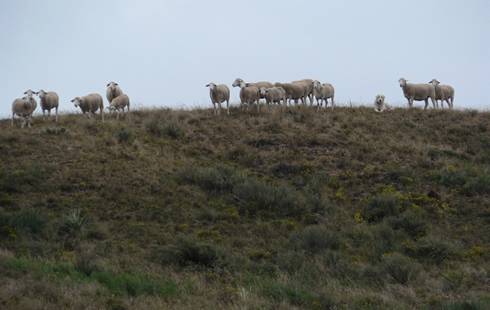
Sheep and sheep
dog near Flomot
Photo courtesy Eric Blackwell, November 2006 |
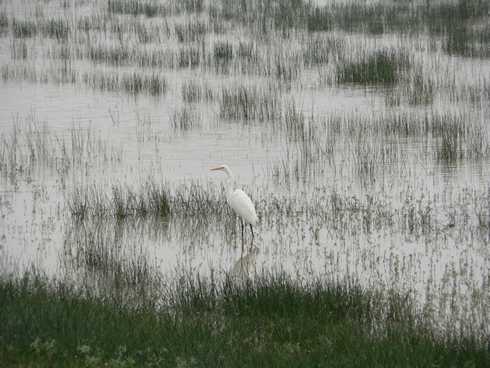
Common egret
in a field 20 miles west of Flomot
Photo courtesy Eric Blackwell, November 2006 |
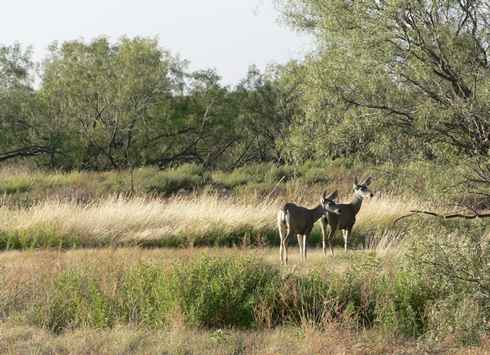
Mule Deer in
Flomot
Photo courtesy Eric Blackwell, November 2006 |
Flomot,
Texas Forum
Subject:
Flomot, Texas
Dear TE, I have lots of memories of Flomot, I grew up in Quitaque
and Flomot and still have family living and working in both towns.
My great aunt and uncle own one of the gins there in town as well
as an insurance agency. My grandfather was born (1921) and raised
there as well as his two sisters. My grandfather has passed away.
My great grand parents settled there and we still have a family
farm house and cemetery. I went most of my school days at the consolidated
school of Valley. I can still see the hazy air of ginnin’ season
vividly, but I rarely get to see that site any more. Anyway I am
not sure of the year, but I can tell you that my great grandmother
was also born there about 1898 or 1899. I can tell you for certain
I concur with the other [readers which have made comments], if there
is heaven it is there. The hustle and bustle of raising my children
in the fast-paced world we live in has made me realize that my life
then was indeed simple. It was most pleasurable, but lots of hard
work. While I never missed school due to the cotton being harvested
(cus we had strippers), I did my fair share of choppin’ cotton,
troppin’ cotton, and pickin’ and shellin’ peas, beans, gathering
eggs, milkin’ cows, all the things that helped keep a family going
in our corner of the world. My children only get small doses of
that, now that farming is not a matter of survival any more. Yes
I miss it, and I don’t miss it. I like my cell phone, my speedy
little car, a Walmart a couple of miles down the road. But I also
like the wide open spaces, the smell of Spring coming, and the ever-present
chewing gum and bottle of pop my great Uncle always had ready for
my sister, my cousins and me anytime we went to the gin, or just
anywhere we happened to be with him. - Trisha Appleby, Beaumont,
Texas, February 21, 2007
The man who
ran the little grocery store in the late 50's - early 60's was Harrison
George. He is deceased, but his wife Oma Lee still comes back to
Flomot for homecoming, which is held July 4 weekend every third
year (Next one will be in 2005). I graduated from Flomot High School
in 1969. My father and grandfather, Wayne and Horace Hunter, ran
a cotton gin there. My mother, Jimmie Speer Hunter, grew up in Flomot
and taught school there for a few years. It was a very good place
to live. There are fewer people living there now, but they are still
the best people you could hope to meet. Mary Ellen ("Dude") Barton
still lives there. She was inducted into the Cowgirl Hall of Fame
in Ft. Worth. - Anita Hunter, Lubbock, Texas, October 31, 2004
I
didn't grow up in Flomot, Texas. However I do have fond memories
of going there each fall. If there is a heaven it had to be there.
We were cotten pickers and we picked cotton for Mary Barton and
her brother, Francis Barton during the late 50's and early 60's.
They were some of the nicest people I ever met. I don't remember
the name of the man who use to run the small grocery store in Flotmot,
near the cotton gin, but he was always very nice to all of us, (always
gave us candy). I guess what I remember the most is that the people
there were really down to earth, hard working, and honest people.
Of all the places in the USA, Flomot is one place I long to go back
to. I loved the open spaces, the farms, the cold winters... I hope
it hasn't changed, it was perfect...(no I am not just thinking of
how a child remembers, my brothers and sisters were older than me
and they all agree on how nice it was). Thank you - Linda Merino
Foster, July 20, 2004
|
|
Texas
Escapes,
in its purpose to preserve historic, endangered and vanishing Texas,
asks that anyone wishing to share their local history and vintage/historic
photos, please contact
us.
|
|
|