|
Auther's
Note:
My mother always told us that Judge Roy Bean was one of her ancestors.
I have been searching the archives of his early life, and Ancestry.com
- and can’t find any thing to prove this. But somehow that story was
told to me even in the 1930’s. I did find out that he lived in San
Antonio from about 1865 to 1881. It was in the area what is now
W. Theo Ave, Conception Park and where Hwy 90 and IH 35 connect. But
none of my mother’s relatives lived in San
Antonio at that time. It is a mystery. They did come to Texas
in the late 1890’s.
He certainly led an interesting life! This is taken from all the websites
I have looked at, taking bits and pieces to make a story. If you like
history, as I do, you will like it! - Lois Zook Wauson |
|
|
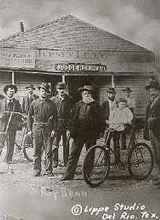
Roy
with beard next to cyclist
Old postcard |
Phantly
Roy Bean was born west of Shelbyville in Shelby County, Kentucky prior
to 1835 (some say as early as 1825). He was the son of Phantly R.
Bean and Ann H. Bean. He had four brothers and sisters, they were:
Sarah H. Bean, James C. Bean, Joshua H. Bean, and Samuel G. Bean.
It is said that the name Phantly Roy, was a variant of the name Fauntleroy.
The location of his birth is now a grove of locust trees.
His older brother Samuel Bean went off to fight in the Mexican war.
When Samuel Bean returned from the Mexican War he only stayed a short
time before he left home for good in May of 1845. Roy set off a short
time later to join him, perhaps when he was between 13 and15 years
of age. The two brothers got a job driving a team of six yokes of
oxen in a wagon train from Independence, Missouri, through Sante Fe,
New Mexico, and down to Chihuahua, Mexico.
In Chihuahua, Roy got crossways with a local bad man, who hated gringos,
and Roy killed him. This was a common reason for people to "move on"
in the west. Roy set out for California, to find his other older brother.
Joshua provided his brother with room, board, and fine clothes, the
pockets of which he kept full of spending money. An 1850 census for
San Diego shows Roy living in a boarding house with his brother Josh.
So this much of the story appears to be true.
Joshua Bean was the last alcalde (an alcalde was the mayor of a Spanish
town and also a judge) of the pueblo of San Diego, and after the city
was incorporated, was the first mayor in 1851.
Joshua Bean had been appointed as a Major General in the state militia.
Joshua took Roy under his wing when he arrived. Roy took advantage
of having a brother who was so highly regarded, and busied himself
with such activities as gambling, cock fighting, horse racing and
fandangos. General Joshua Bean secured for Roy a position as Lieutenant
in the state militia. Roy’s appearance was described as "handsome
as Adonis" with a fair and rosy complexion and silky black hair.
Unfortunately, Roy got in trouble with the law in February 1852. Roy’s
pistol duel with a man named John Collins was heralded as a social
event with a large crowd in attendance. Both men were evidently on
horseback, and Collins fired two hasty shots at Roy who returned fire,
hitting Collins in the leg with his first round, and hit his horse
with the second. Both men were arraigned in Judge Ames court, being
fined and jailed. A San Diego newspaper reported the events on March
27, 1852, and referred to Roy as P. R. Bean, and that was the last
time Roy was ever referred to using the name Phantly, or even with
the letter P. in his name. From then on it was just Roy. Roy spent
just a month in jail before escaping. From there, he followed the
footsteps of his brother Joshua, who had moved on to San Gabriel,
just outside of Los Angeles.
Joshua had established himself as the owner of the Headquarters Saloon
in San Gabriel. Unfortunately, Joshua Bean was waylaid and killed
one night on the way home from his saloon in November of 1852. Roy,
who by this time had cleared up his legal problems in San Diego, inherited
the saloon. Evidently Roy was relishing his roll as a saloon proprietor.
This description of Roy was left by Major Horace Bell in "Reminiscences
of a Ranger":
" I rode up to Headquarters and was met by a very handsome black bearded
young man by the name of Roy Bean, brother and successor of General
Josh Bean. The General had been proprietor of the Headquarters, the
first grog shop of the place. Roy was dressed in an elegant Mexican
costume, with a pair of revolvers in his belt, while a bowie knife
was neatly sheathed in one of his red-topped boots."
Roy managed to run the business into the ground, apparently due to
the fact that he was his own best customer. Deep in debt and on the
verge of losing the saloon, Roy got into a romantic entanglement over
a Mexican maiden. He fought and won a duel for her affection. But
the friends of the dead suitor took his death so hard that they strung
up Roy and left him dangling from a tree limb.
Either the branch was too low or the rope stretched allowing the lucky
victim to stand on his tiptoes until a passerby cut him down. The
close call left Roy with a permanent crick in his neck that forced
him to rotate his shoulders in order to look from side to side.
Deciding a quick change of climate would be good for his health, Roy
went back east to New Mexico, around 1860 in search of his surviving
brother. Sam, like deceased Josh had done right well for himself,
becoming the wealthiest member of a frontier community in New Mexico
and was the county sheriff to boot. Never one to wait for an invitation,
Roy moved right in. It was Old Mesilla, New Mexico. Roy arrived broke
and in rags, but Sam took his younger brother in. Samuel and Roy both
operated the business, and were dealers in merchandise, liquors, and
had a fine billiard table. Roy and Samuel were Confederate sympathizers.
Roy organized a Confederate band called the "Free Rovers" which was
known to others as "the Forty Thieves."
Roy committed himself body and soul to the Confederate cause. In this
thrilling fantasy, he cast himself as spy and scout from the ill-fated
invasion of New Mexico by Rebel Texans and accompanied them back to
the former Lone Star State after the bold gamble went bust.
While
Roy’s war record is open to question, his arrival in San
Antonio at the height of the conflict is a documented fact. After
the Battle of Glorietta Pass, on March 1862, the Texans began retreating
to San Antonio. After
first taking money from his brother's safe, Bean joined the retreating
army. For the remainder of the war, he ran the blockade by hauling
cotton from San
Antonio to British ships off the coast at Matamoras, Mexico, then
returning with supplies.
For the next twenty years, Bean lived in San
Antonio, working nominally as a teamster. He attempted to run
a firewood business, cutting down a neighbor's timber (in other words
peddling stolen firewood). He then tried to run a dairy business,
but was soon caught watering down the milk, and later worked as a
butcher, rustling unbranded cattle from other area ranchers. (Didn’t
this man have one honest bone in his body?)
On October 28, 1866, he married sixteen-year-old Virginia Chavez.
She was the daughter of a respected San
Antonio rancher named Leandro Chavez. Roy and Virginia lived on
the Cavez land at what later became Beanville, which now is
the 400 block of Glenn Ave. in San
Antonio. (I checked and this is right off of S. Flores St. by
Burbank High School. There is a Blue Moon Café nearby, which I want
to check on and see if I can get a flavor of the area).
Within a year after they were married he was arrested for aggravated
assault and threatening his wife's life. Despite the tumultuous marriage,
the two had four children together, Roy Jr., born the year Roy and
Virginia married, Laura or also called Adelaide, born 1872, Zulema
born 1874, and Sam born 1875. The 1880 census showed also, some one
named John Toney, listed as an “adopted son”.
By that time, Bean was operating a saloon in Beanville. Several railroad
companies were working to extend the railroads west, and Bean heard
that many construction camps were opening. A store owner in Beanville
"was so anxious to have this unscrupulous character out of the neighborhood"
that she bought all of Bean's possessions for $900 so that he could
leave San Antonio.
Roy
Bean left San Antonio
alone to go to West Texas.
He put his children with a couple named Mr. & Mrs. Simon Fest, Jr.
In the 1880 census Roy Bean said he was “widowed”. He was not widowed,
but his wife obtained a divorce and probably left him because of the
abuse. Some say she remarried later and had more children. It is not
known if the children ever lived with her again.
Bean followed the railroad, the Galveston, Harrisburg and San Antonio
Railroad (also known as the Sunset Route) which was pushing westward
from New Orleans, across western
Texas, toward El
Paso, across miles of scourching Chiuahuan Desert, infested with
bobcats, rattlesnakes and scorpions (local called Vinegaroons by local
Texans) and new railroad towns were prospering. By spring of 1882,
Roy knew an opportunity to make lots of money lay in the railroad
towns. By then, Bean was gray bearded, portly, fond of beer and whiskey.
Fleeing his marriage and illegal businesses in San
Antonio, Roy headed to the tent city known as Vinegaroon
Roy Bean opened a tent saloon in Vinegaroon
in 1882. He served railroad workers whiskey from a tent. As his own
best customer, he was often drunk and disorderly.
Thus began his most notorious life, when he was appointed the Justice
of the Peace, in Vinegaroon,
Texas. Vinegaroon
changed to Langtry,
Texas and Roy Bean became The
Law West Of The Pecos. |
"They
shoe horses, don't they?"
August 2, 2010 Guest Column
© Lois Zook Wauson
Lois Zook Wauson's book "Rainy Days and Starry Nights' (2004) is a
collection of her stories about growing up in South Texas during the
1930s and 40s. |
|
|
|
 HOME
HOME

 Gulf
Coast
Gulf
Coast East
Texas
East
Texas Central
North
Central
North Central
South
Central
South Panhandle
 South
Texas
South
Texas Hill
Country
Hill
Country West
Texas
West
Texas Ghost
Towns
Ghost
Towns State
Parks
State
Parks