|
Although
he was the first child born in the Governor's Mansion, Temple found
out (upon reaching adulthood) that fact and a two-cent piece would
buy him a cup of coffee. He lived with his sister after the death
of his parents and by the time he was thirteen he either signed up
or his sister signed him up to go on a cattle drive where the coffee
was free. Our sources tell us he later took a job as a night clerk
on a Mississippi riverboat. That was a pretty impressive entry on
a 19th Century resume, although it doesn't mean as much now.
In New Orleans, a Senator Winwright, a friend of Temple's father arranged
to have Temple serve as a congressional page in Washington-on-the-Potomac.
Apples, they say don't fall far from the tree, and so it was in Temple's
case. While Sam had been adopted into the Cherokee clan, Temple was
adopted into the tribe of lawyers and became a politician.
The truth is that Temple earned his law degree by returning to Texas
and entering the brand new Agricultural and Mechanical College. It
was so new that they hadn't even started telling Aggie jokes yet.
They did start telling them in Temple's freshman year, but they didn't
learn about punch lines until after Temple transferred to Baylor University
(back when it was still in Independence,
Texas). He graduated with honors in 1880 and passed the bar to
become the youngest practicing lawyer in the state. |
|
|
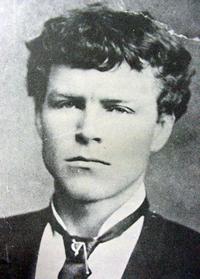
Temple
Lea Houston
Photo courtesy Texas State Library |
He was the Brazoria
County Attorney in 1881 when the Governor offered him the job
of DA for the entire Panhandle
region. The 35th Judicial District was comprised of 26 unincorporated
counties, and accommodations were at the best dismal. Not wanting
to be alone on the high lonesome, Temple got married on St. Valentine's
Day 1883 to Laura Cross of Brazoria
and they moved to the town of Mobeetie,
which had been known as Hidetown only a few years before.
They weren't there long, when Temple got elected state senator. He
spent a few years in Austin
making lots of friends and some enemies. He gave the dedication speech
in 1888 for Texas ' new
Capitol building, stating that the capitol building would some
day be of interest to archeologists.
He ran for Texas Attorney General, but lost, and returned to the Panhandle
to do legal work for the railroad.
He and his family then moved to Oklahoma and Temple added to his flamboyant
reputation by taking on controversial cases.
One case involved defending a woman named Minnie Stacy - a woman with
a soiled reputation. He had all of ten minutes to prepare a defense.
Since everyone in town knew her - or perhaps we should say everyone
in town was aware of her reputation, Temple knew that a defense was
hopeless. So he attacked men in general for creating women like her
and was so forceful in his condemnation that there wasn't a dry eye
in the courtroom - excepting the lawyers.
Temple wore his hair shoulder-length and would walk down the street
holding hands with his wife. He liked to wear Prince Albert coats
and rattlesnake-skin neckties (a popular tourist item in San
Antonio). It is said that Edna
Ferber in her book Cimmaron modeled her character Yancy Cravat
on Temple Lea. Cimmaron was made into a movie - twice.
Temple survived an assassination by somehow managing to be shot in
his law book. The book and bullet were recently on loan to The Bob
Bulluck State History Museum in Austin.
He is famous for his defense of Minnie Stacy - but also for a remark
made to a judge about a prosecutor: "Your honor, the prosecutor is
the first man that I've ever seen that can strut while sitting down."
He unsuccessfully ran for Governor of Oklahoma, and died of a brain
hemorrhage in 1905. One of the most elaborate floral arrangements
was from Minnie Stacy. While the rest of his family rests in Texas,
Temple is buried beside his wife in Woodward, Oklahoma.
© John
Troesser
First
published October 2002 |
Source:
The Golden Heritage and Silver Tongue of Temple Lea Houston by Bernice
Tune, Eakin Press 1981
An Informal History of Texas from Cabeza de Vaca to Temple Houston,
Frank X. Tolbert, Harper, 1961 |
|
|
|
 HOME
HOME