|
| Ask
someone to recall railroad buildings
from their childhood memories and they are likely to mention a depot
or perhaps a roundhouse. But there was another railroad
building very common across Texas, in
small towns and large, that few people
recall: the railroad tower. Most people referred to these as
"signal towers" or "switch towers", but they were formally
known as "interlocking towers", and their locations and designs
were carefully managed and approved by the Railroad Commission. The
purpose of an interlocking tower was to provide for efficient and
safe passage across "at grade" rail junctions where the rails were
owned by different companies. |
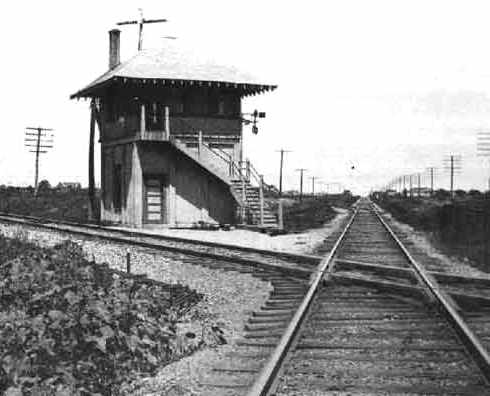 |
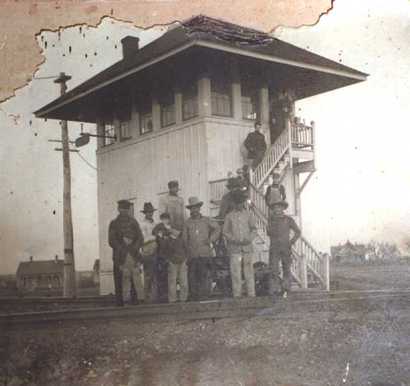
"The original
Tower 64 around 1930. The track straight ahead is looking toward Commerce,
Texas on the St. Louis Southwestern (Cotton Belt). Track to the left
is the Missouri, Kansas and Texas toward Denison. Structure that can
be seen in the distance is the MKT Hunt Yard office in Greenville,
Texas."
Photo courtesy Katy Railroad Historical Society |
"The current
structure that still stands at the crossing appears to be the lower
half of the original Tower 64."
Photo courtesy Myron Malone. |
| In
1901, a new state law tasked the Railroad Commission with developing
rules to govern safety at all places where two different railroads
crossed, and by 1902, they had produced rules governing such crossings.
The basic rule was very simple - if a crossing was not controlled
by an approved interlocking system, then all trains had to come to
a complete stop before crossing the junction. Stopping and restarting
a train was time consuming and inefficient, so the railroads were
motivated to build interlockers at junctions that had frequent traffic.
Using manual or electronic control systems, an interlocker would provide
distant signals to the rail lines to indicate whether the crossing
could or could not be occupied by an oncoming train. If a train had
a "clear" signal, it could maintain speed and cross the junction without
stopping. |
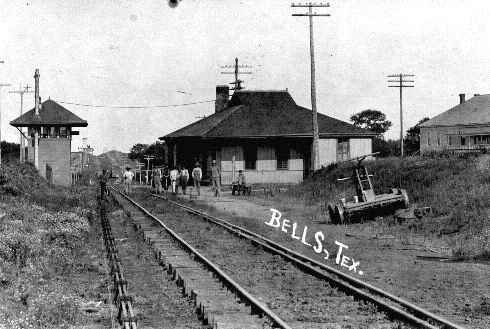
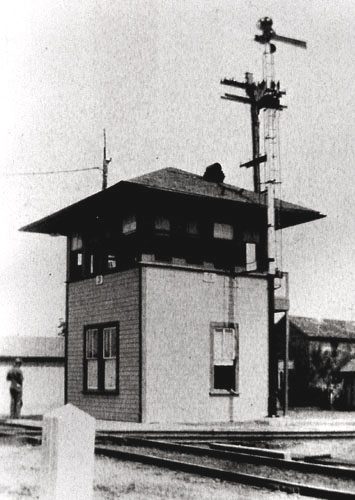
Railroad Interlocking
Tower 20 in Bells
1902 photo courtesy George Kimbrough |
| In
the early years, interlocking systems were typically installed in
towers staffed with personnel responsible for controlling the signals.
But at rail junctions where one line was heavily used and the other
line was seldom used, this was an inefficient approach. There was
little for a tower staff to do because the signals would almost always
be set to allow passage on the busy line. This problem was solved
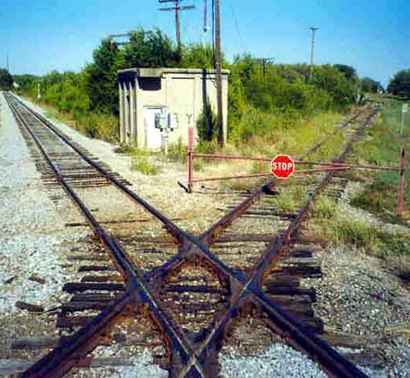
through the use of a "cabin interlocker", a small, unmanned hut that
contained the signal controls that could be manually operated by a
train crew needing to get a "clear" signal for permission to cross.
The controls were generally left with the "clear" signal given to
the busy line so that the frequent trains on that line did not need
to stop. |
| "A very
old photograph showing Tower 69 in Celeste, TX. Photograph
from the Mackie Don Baber collection, courtesy of Jerry Hunter." |
| The
Railroad Commission assigned a number to every interlocker they approved.
The first three interlockers were authorized on May 21, 1902 to control
crossings at Bowie
(Tower 1), San Antonio
(Tower 2) and Flatonia
(Tower 3). By the mid-1960s, advances in electronic control technology
had resulted in the widespread use of automatic interlockers, systems
that detected the approach of trains and automatically issued the
proper signals. The Railroad Commission decided to get out of the
business of approving interlockers, and the last interlocker to receive
a number was Tower 215 at Bloomington in 1966. Very few original railroad
towers have survived to this day. Two excellent examples are Tower
3 in Flatonia and Tower
19 in Dallas http://www.towers.txrrhistory.com/019/019.htm
|
Railroad Interlocking
Tower 3 in Flatonia
Photo courtesy of Flatonia Chamber of Commerce |
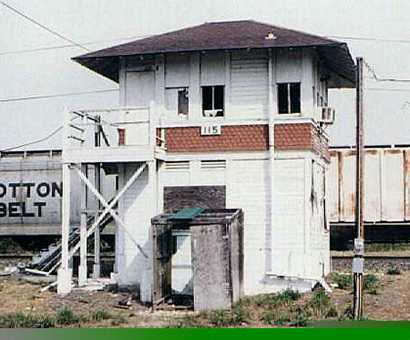
"Abandoned,
but still standing in November, 1996, Tower 115 in Eagle
Lake sits silently as an eastbound Southern Pacific freight rumbles
by on the Sunset Route headed for Houston. The tower was razed shortly
after this photo was taken."
Photo courtesy Jim
King |
The Texas
Interlocking Tower Home Page
http://www.towers.txrrhistory.com/index.htm
is a non-commercial project currently underway to document the history
of all of the interlocking towers in Texas. Historic photos have been
found for many towers, but there are literally dozens of towers for
which historic photographs have not been located. Towers sometimes
show up in the background of other photos. For example, Tower 36 (Bryan)
shows up in the background of a photo postcard, and Tower 4 (Dalhart)
was found in the background of some old photographs of Main Street
in Dalhart. Our only Tower 7 (College
Station) photo is from a 1920s vintage aerial photo of Kyle Field!
Perhaps your collection of old photographs includes a railroad tower.
If you find such a photograph, or if you have personal recollections
of a hometown railroad tower that you wish to share, please visit
the Texas Interlocking Tower Home Page http://www.towers.txrrhistory.com/index.htm
and use the email links there to contact the webmaster.
© Jim
King
They
Shoe Horses Don't They
November 10 , 2006 Column |
|
|
 HOME
HOME