|
|
|
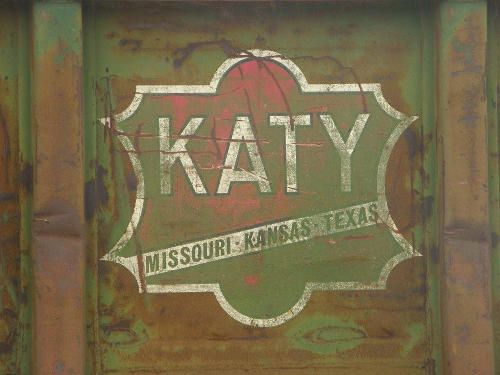
The
KATY no longer exists, but artifacts can still be found on rolling
stock.
TE photo, May 2010
|
It’s
fair to say that Smithville
might well be one of the more insignificant towns between Austin
and Houston if it wasn’t
for the railroad. After the Missouri, Kansas and Texas (KATY) railroad
acquired the old Taylor, Bastrop and Houston line in the early 1890s,
the Katy built significant yards in Smithville,
as well as a huge passenger depot and a two-story Railroad YMCA.
The railroad even dictated the layout of the
town. Hotels and the YMCA were located conveniently near the tracks
while the railroad’s engineers clustered together in two story homes
near the river – as far as they could get from the noise and grime
of the roundhouse and yards.
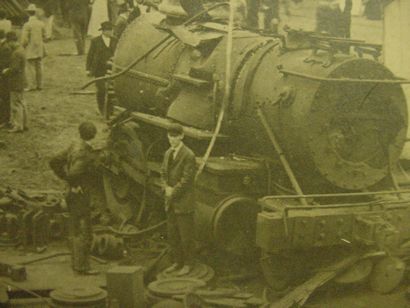
Smithville was
the scene of the 1911 boiler
explosion - perhaps the largest railroad disaster outside of collisions
or derailments. |
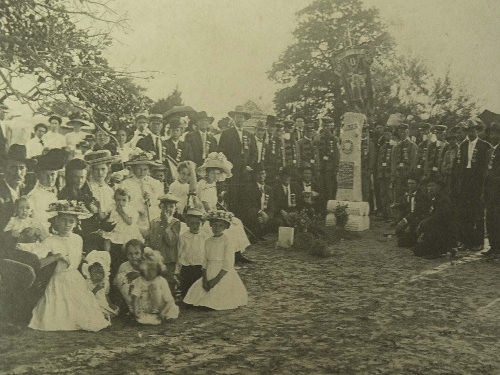
Memorial
Service for C. W. Phelps,
one of the men killed in the 1911 roundhouse accident. |
|
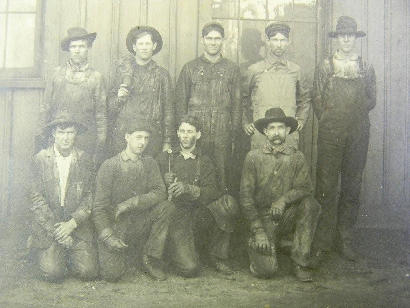
Railroad
Yard Workers
Eight out of nine railroad workers prefered the clean-shaven look
around 1910. The third man from left (bottom row) appears to be
considering sending a chisel into the kneecap of his co-worker.
|
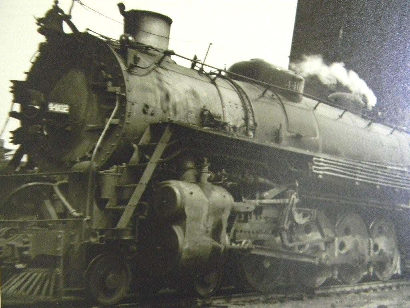
Locomotives
too big to fit into a single photo No. 23
Engine # 4402 lets off steam in the Smithville Yards
No Date |
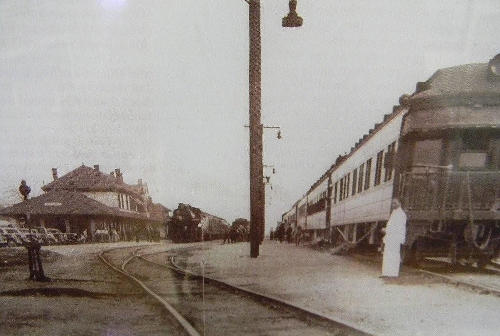
| Arrival
and Departures c. 1930s |
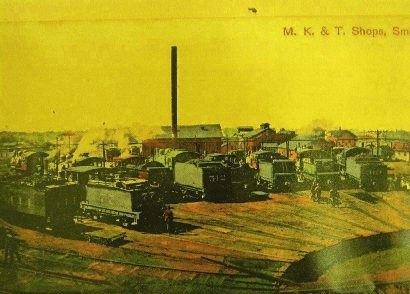
| A tinted
postcard of the Katy Roundhouse and turntable |
|
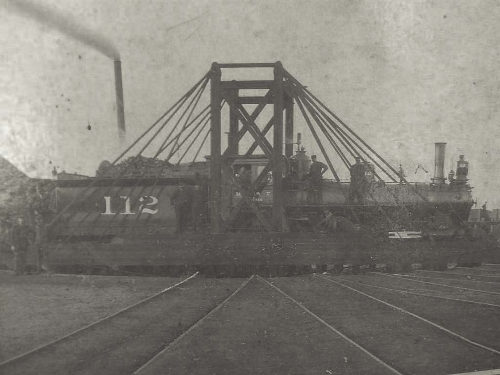
A "gallows"
type turntable - the first of three used in the yards.
Note smokestack in previous postcard.
|
The
railroading history of the town is preserved today in Smithville’s
Railroad Museum (which shares space with the Smithville Chamber) in
James Long Park at the southern end of Main Street.
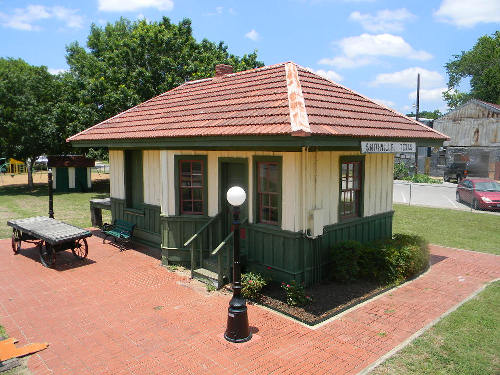
Beside the museum, which houses photos, and artifacts, an outdoor
section includes an old depot (moved in from West
Point, Texas) and several cabooses as well as a vintage section
car.
June 3, 2010
©John Troesser
See Smithville's 1911
Locomotive Boiler Explosion |
|
|