|
History on
a Pecan Shell
In view of the
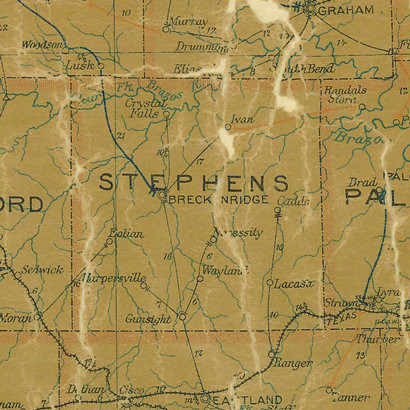
Gunsight Mountains, the town was settled in the late 1870s
with a post office being granted in 1880 when the population was 50.
The town was all set for a boom with the discovery of oil in the 1920s.
The town also had the benefit of being near the railroad (The Wichita
Falls and Southern). The boom only raised the population to 150 and
Gunsight lost both its railroad connection and its post office in
the 1920s. The town's history from that point on is only known to
a few.
It no longer appears on the state map and the population is given
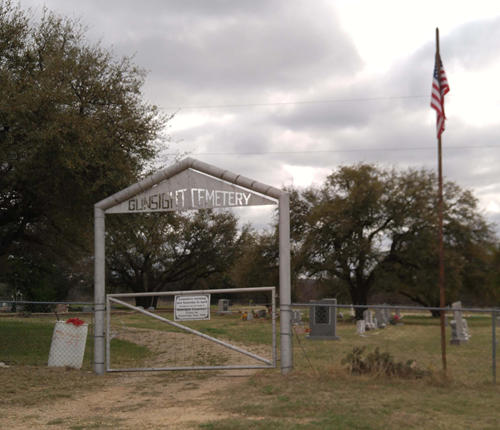
as a mere six people. The TxDoT County map shows the town in the smallest
of print and a small cemetery at the site. |
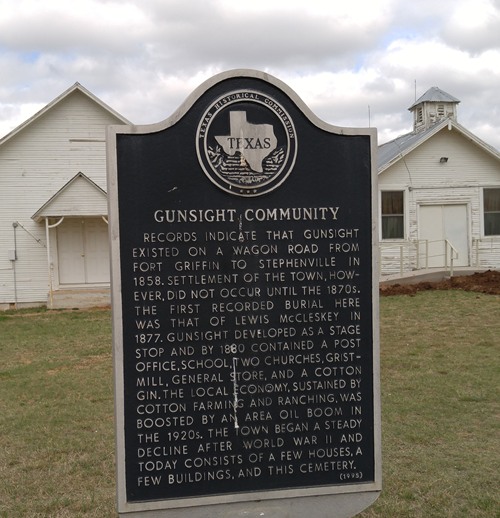
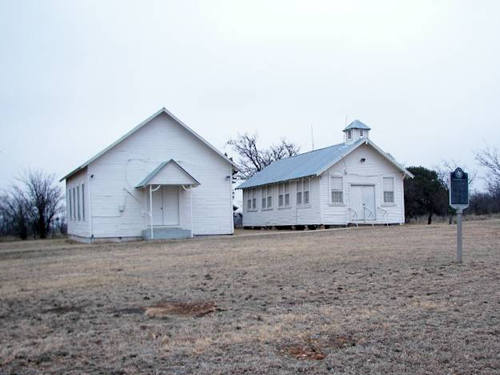
Gunsight Community
Historical Marker with the church and what may have been the school
in the background.
Photo
courtesy Dustin
Martin, March 2017 |
Gunsight, Texas
Historical Marker:
Gunsight Community
Records indicate
that Gunsight existed on a wagon road from Fort
Griffin to Stephenville
in 1858. Settlement of the town, however, did not occur until the
1870s. The first recorded burial here was that of Lewis McCleskey
in 1877. Gunsight developed as a stage stop and by 1880 contained
a post office, school, two churches, gristmill, general store, and
a cotton gin. The local economy, sustained by cotton
farming and ranching,
was boosted by an area oil boom in the 1920s. The town began a steady
decline after World
War II and today consists of a few houses, a few buildings, and
this cemetery.
(1995) |
A Visit to
Gunsight, Texas
Photographer's
Note
Remote towns, just dots on the map, such as Gunsight and Eolian
often yield the most interesting subjects - Barclay
Gibson |
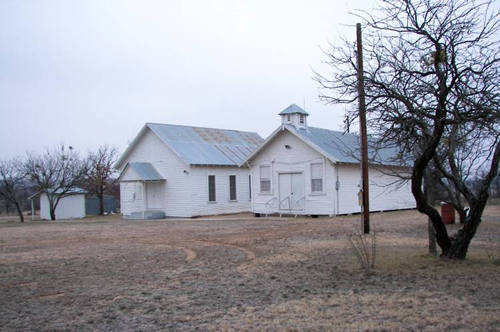
Gunsight church
on CR 157
Photo courtesy Barclay
Gibson, February 2007 |
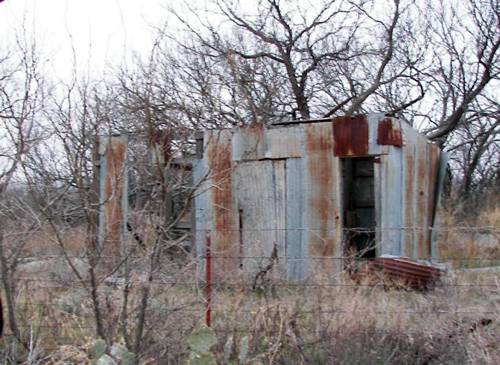
Shed wih cactus
in Gunsight
Photo courtesy Barclay
Gibson, February 2007 |
Gunsight
(From Cut
and Shoot, Gun Barrel City, Gunsight, Point Blank and Winchester,
"Texas Tales" column by Mike Cox)
"The stereotypical Texan is seldom gun shy when it comes to settling
a difficulty with violence, a mythology reflected in the number of
Lone Star communities with names
evocative of rough and tumble ways.
At least five such towns come to mind: Cut
and Shoot, Gun
Barrel City, Gunsight, Point
Blank and Winchester...
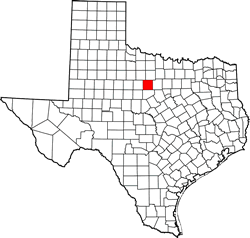
Gunsight, a mostly ghost town in Stephens
County with only six residents as of the last census, dates back
to 1879. It was named for a set of low mountains that from a distance
look like the V-shaped notch in the middle of a gunsight.
A year after its settlement, Gunsight got a post office which lasted
it until the Breckenridge
oil boom of the late teens played out in the 1920s when the Wichita
Falls and Southern Railroad closed its station there..."
more |
 |
| Texas
Escapes, in its purpose to preserve historic, endangered and vanishing
Texas, asks that anyone wishing to share their local history, stories,
landmarks and recent or vintage photos, please contact
us. |
|
|
 HOME
HOME