|
|
| Thomas
Deye Owings was the scion of several prominent colonial Baltimore
families. He was a colonel and hero of the War of 1812 [and] was Kentucky's
original industrialist and iron master, also holding several political
offices. He was also commissioned by Stephen F. Austin in Jan. 1836
to raise 2 regiments of Kentuckians to fight for Texas Independence
from Mexico, sacrificing as a result the life of one of his sons during
the Goliad Massacre.
Nevertheless, Owings lived the last 16 years of his life in total
obscurity and anonymity at Brenham,
Texas, and died there in 1853. |
Thomas
Deye Owings was born at Cockeysville, Maryland, a suburb of Baltimore,
on March 7, 1776. He was the first son born to the John Cockey Owings
and wife, Colegate Deye Colegate Owings. His older sister, Cassandra
Van Pradelles, was lost at sea c. 1813/1814, and according to her
legend, was a victim of Lafitte pirates. T. D. Owings was born into
the colonial middle to upper class society, who inhabited a series
of 2-story mansions, such as Sherwood or Bellefield; owned many slaves,
and generally relied on tobacco culture for export to England. Although
not heretofore mentioned, the Owings children are believed to have
been educated by private tutors.
Other than tobacco farms, Cockeysville was also surrounded by several
deposits of iron ore, probably hematite of about 50% purity, as well
as of marble and limestone , which eventually accounted for many small
quarries. By 1774 the North Hampton iron furnace was already producing
pig iron, later supplying cannon balls and canister shot used by the
Continental Army. Thomas' father, many of his uncles, and his future
brother-in-law, the French Lieutenant Benedict Van Pradelles, were
all veterans of the American Revolution, some of them present at the
Battle of Yorktown. Hence, it was probably the fortunes of the North
Hampton iron furnace, which created Capt. John C. Owings' interest
in iron-smelting in Kentucky.
It is unknown how John Cockey Owings became so interested in territorial
Kentucky property, which at one time was part of Virginia, but Christopher
Greenup, later one of J. C. Owing's partners and governor of Kentucky,
is one possibility. Another possibility was Jacob Meyers, who in 1782
acquired a 10,000-acre tract of Kentucky land, which patent was signed
by Virginia Gov. Patrick Henry, and Meyers began building the Slate
Creek iron mill (later the Bourbon iron furnace) in 1787. During the
late 1780s, John Cockey Owings began making significant land purchases
in present-day Bourbon and Bath counties, Kentucky, which eventually
included the Meyers tract, and may have reached a total of 70,000
acres. The writer believes that John C. Owings engaged his future
son-in-law, Benedict Van Pradelles, to oversee his property in Kentucky,
and David Owings reported to the writer that in 1790 Van Pradelles
advertised in the Lexington Gazette for recovery of a lost pocketbook,
which contained papers written in French. In 1790 Van Pradelles married
Owings' oldest daughter Cassandra and left immediately for France.
The Bourbon iron furnace went online (blast) in 1790, and in May 1791,
was purchased by John Cockey Owings and Company, a joint stock company,
which included Owings, Greenup, Walter Beall and Willis Green. In
1794 additional partners were added. In 1795 John Cockey Owings emerged
as sole owner.
In 1795 J. C. Owings sent his 19-year-old son, Thomas Deye Owings,
to Kentucky to oversee his lands, and to manage the Bourbon iron furnace
and grist mill. Despite his [young] age, T. D. Owings was married
before he left Baltimore in 1795.
One article reported that: "...The Slate Furnace, also known as the
Bourbon Furnace, was built by Jacob Meyers. It was later bought and
operated by a syndicate headed by John Cockey Owings, for whom Owingsville
is named. This furnace was built just 16 years after the building
of Boonesboro. A fort was constructed for the protection of workers
(and manned by 17 Kentucky militiamen). At least one of the early
iron workers was killed by hostile (Shawnee) Indians. Incidentally
it was the iron furnace, which furnished cannon balls and canister
shot used by Andrew Jackson at the Battle of New Orleans..."
The Bourbon furnace was the first iron-smelting operation built west
of Allegheny Mountains. The furnace first began to make 10-gallon
pots for boiling out salt at the Salt Lick Springs, but the pioneer
needs soon forced the owners to make cut nails, pots and other cooking
utensils, horse shoes, axe blades, hoes, stoves, plow shares, pig
iron and bar iron.
The blast machinery was energized by a water wheel turning in Slate
Creek. The "ore mines," composed of high grade hematite or magnetite
ore about 50% pure, were located at Howard Hills and Black Horse Banks,
about 2 miles from the furnace, and 3 tons of ore, pulled by oxen,
were needed to produce 1 ton of pig iron. Products, which included
cannon balls and canister shot, were hauled over the Iron Furnace
Pike to Frankfurt on Kentucky River, from whence they were floated
to Ohio River and to all points in the Midwest, as well as to New
Orleans in time for the battle there in 1815.
Actually, 3 original ledgers and one account book survive between
1796 and 1818 of the Bourbon furnace. One ledger is in chronological
order from Jan. 15, 1796 until Nov. 30, 1797. All four items are deposited
in the archives of East Library at the University of Kentucky. Originally
the location consisted only of the furnace and grist mill. In 1798
the Slate Forge was built on Slate Creek, 3 miles from the furnace.
In 1811 a commissary was built at the furnace for the convenience
of the iron workers, but in 1814 it was moved into Owingsville.
In 1810 Thomas D. Owings became sole owner of the furnace. And whatever
else there is to say, it became obvious by 1812 that Owings was becoming
quite wealthy. It seems strange, however, that none of this was reflected
in the will of John Cockey Owings in Baltimore, written in Feb. 1810,
shortly before his death. The will stated that Owings had left only
$1 to his oldest son, Thomas Deye Owings, and nothing at all to is
oldest daughter, the widow Cassandra Deye Van Pradelles, who at the
time was running a boarding house in New Orleans. Nearly all of his
property was left to his younger children.
Following his first wife's death Ca. 1801, Thomas Deye Owings married
Mary Nicholas in Lexington on March 17, 1804, the daughter of Col.
George Nicholas of Kentucky and Mary Smith of Baltimore. Their progeny
included Thomas Cockey Deye, George Nicholas, John Cockey, Colegate
Deye, Mary Nicholas, Robert Smith, ( massacred at Goliad, Texas, Mar.
27, 1836), John Cockey 2, Jul 26, 1847 (killed in the Mexican War
on July 26, 1847), and Ann Eliza.
The new Owings home was indeed pleasing in appearance, and included
kitchen, servants' quarters, and basement. He hired Benjamin Latrobe
of Washington to design and build the residence, using hand-carved
woodwork and mantels, made from black walnut wood. There was a wide
hall in the center of the building from whence a spiral staircase,
made of mahogany, was built up to the third floor. The stairway was
built in Baltimore, and its parts were hauled across the mountains
to Owingsville in ox carts. In 1813 the staircase had cost $10,000,
and the entire mansion had cost $60,000, a magnificent sum in that
age. Today the "Col. Owings House," the Owings House, or Owingsville
Banking Company is occupied by a banking institution, a lawyer, and
others. It is listed in the National Register of Historical Places.
The surviving stones of the Bourbon furnace are also listed, being
now within a highway roadside park, an effort successfully completed
jointly by the Owingsville Jaycees and the state Highway Department.
The park and iron furnace ruins were dedicated on July 1, 1969.
Thomas
Deye Owings exhibited his patriotism during the War of 1812. He raised
a regiment of 377 soldiers, and on April 1, 1813, he received a commission
as colonel of the 28th U. S. Infantry. He immediately attached his
Kentucky regiment to General Shelby's army, which in Sept. 1813 became
a part of General W. H. Harrison's army of the Northwest. The latter's
troops captured Detroit on Sept. 29th. Gens. Harrison, Shelby and
about 3,500 soldiers under their command continued to press British
General Proctor and his Shawnee Indian allies. Eventually they defeated
them at the Battle of the Thames, northwest of Detroit, during which
time the Shawnee Chief Tecumseh was killed.
Col. Owings distinguished himself once more in battle when 28 soldiers
from his regiment joined Commodore Oliver Hazard Perry's fleet as
sharpshooters in the rigging of the ships. After Perry lost his flagship
Lawrence, he continued the fight aboard the Niagara until he defeated
the British fleet at the Battle of Lake Erie, fought on Sept. 10,
1813.Another interesting saga in Thomas D. Owings' life occurred in
1814, when Owings was on a visit to Baltimore and he met Louis Phillipe
of France, the son of the Duke of Orleans. Louis Phillipe, although
he had been a successful general under Napoleon, had been exiled in
1813 because of a suspected plot against the republic. Owings invited
the dapper French aristocrat to visit his home in Kentucky. According
to family records, Louis Phillipe remained Owings' guest from July
17, 1814 until July 22, 1815, after which the French nobleman returned
to France and reclaimed his estates. Replacing King Charles X on the
throne, Louis Phillipe was crowned "King of the French," following
a revolution in 1830. He remained on the throne until 1848, when another
liberal revolution toppled him, and he fled in exile to England. Actually
another account claimed the visitor was an imposter.
Owings studied law under Col. Nicholas between 1797 and 1798. He was
elected and served in the Kentucky House of Representatives from 1815
until 1818. He also served as Associate Judge of the First Circuit
Court in 1811, and years later he was elected state senator in 1823.
It
seems logical; too, that Stephen F. Austin of Texas had at least a
passing acquaintance with Thomas D. Owings, although the first offer
for Kentucky troops passed from Owings to Austin. By Nov. 1835, solicitations
for troops to fight in the Texas Revolution against Mexico were published
up and down the Mississippi and Ohio River valleys from New Orleans
to Cincinnati, and Owings may simply have responded to that request.
By 1798 Austin was living at the lead mines in Missouri, and since
Austin graduated from Transylvania College and remained in Lexington,
Kentucky, until 1810, the probability is great that the two men first
met at that point. A few extracts from Austin's letter to T. D. Owings,
dated New Orleans, Jan. 18, 1836, follow: |
To Col. T. D.
Owings
Sir:
Your offer to furnish one or more regiments, not to exceed 1,500 men,
to be in Texas March next, armed and equipped for the service of Texas
… your offer is accepted - The Regiment … will be received into the
service of Texas on terms…enacted by the Provisional Government by
their ordinance of Dec. 5 …The expense of arming and equipping said
force … will be refunded to you at the close of the war… On your arrival,
you will report yourself to the Governor of Texas or the Commander
in Chief of the Army… The bounty lands for the volunteers are to be
located under the direction of the government. - S. F. Austin
|
Actually,
long before the date of the foregoing letter, Thomas D. Owings was
already active in recruiting Kentucky volunteers for the Texas Army.
On Dec. 25, 1835, Robert Smith Owings, T. D. Owings' son, enlisted
in Capt. Burr H. Duval's company of "Kentucky Mustangs." By the end
of Jan. 1836, Duval's company of Bardstown, the Paducah group of Capt.
Peyton S. Wyatt's company, and Capt. Amon B. King's Paduacah Volunteers
were already at New Orleans, awaiting shipment to Texas. Both R. S.
Owings, Duval and 75 other Kentuckians were murdered at the Goliad
Massacre.
On Jan. 20, 1836, Austin wrote Gov. Henry Smith that he had engaged
Col. Owings to enlist 1,500 men for service in Texas. On Jan. 24,
1836, while aboard the schooner Tuscarora, Austin wrote Gov. Smith
that he (Austin) had directed Texas agent William Bryan to provide
$35,000 worth of articles for Col. T. D. Owings' troops. On Jan. 28th,
Bryan's report to the governor showed that $5,000 had been deposited
for Owings in the Bank of Orleans.
On Feb. 16, 1836 Austin, while soliciting in Nashville, Tennessee,
wrote a letter to his cousin, Mary Austin Holley, that Col. T. D.
Owings was en route from Kentucky with a regiment of troops for the
Texas Army. On March 27, 1836 (the same day that 75 of his Kentuckians,
about one-quarter of Col. James Fannin's ill-fated army, were massacred
at Goliad) Samuel M. Williams, Austin's secretary at San Felipe, wrote
from New Orleans that: "...Col. Owings is on the march with 1,400
men, left Maysville on March 12th, is armed principally with U. S.
Yagers (muskets)..." In April, 1836, William Bryan, purchasing agent
for Texas, wrote President D. G. Burnett that: "...the $5,000 in the
bank for Col. Owings has been used by us,.. Not one dollar of means
is now left... and the result will be that Col. Owings will lose the
large amount he has expended on us..." From the last letter, it appeared
likely the Thomas D. Owings personally paid for the recruitment, arming
and transportation for his Kentucky troops with no monetary remuneration
from the Republic of Texas. And because of the quick termination of
the war, many of Owings troops never experienced any military action.
However he later was awarded 4 land grants from the State of Texas,
which was probably intended as reimbursement for his expenses during
the Revolution. Also Thomas D. Owings drew as sole heir the last pay
of his massacred son, Robert S. Owings, although the latter's name
was garbled either as Robert G. Owings or Charles Robert Owings in
the Revolutionary records.
Thomas
Deye Owings never returned to Kentucky to live, except possibly for
a couple visits, after 1836, and the last sixteen years of his life
again are marked by extensive obscurity. Also, why he chose Brenham,
Texas as a place to live is also marked with mystery. In 1838 it was
a very sparsely-populated rural community known as Hickory Grove,
when it changed its named to Brenham in 1843, and in 1844 became the
county seat of Washington County. T. D. Owings lived to have two more
of his sons predecease him, the first being Thomas Cockey Deye Owings,
who died there in October, 1837, still single. The second son was
John Cockey Owings, who also fought during the Texas Revolution, and
died at Brenham in July, 1847, also still single. They were the first
members of the Owings family to be buried in the Old
Masonic Cemetery in Brenham.
During the sixteen or seventeen years of Thomas D. Owings residence
in Texas, it would appear that he was neither penniless nor enduring
poverty. He was apparently involved considerably in land speculation,
and other than his land grants from the State of Texas, he purchased
ten tracts of land from private sources. When the 1850 Washington
County, Texas census was enumerated, Thomas D. Owings was recorded
at residence 200, page 299-A, living in the household of Rebecca and
A. G. Compton, who was a Brenham merchant with $8,000 of assets. Perhaps
Owings was away at census time, and Mrs. Compton reported several
incorrect items. T. D. Owings was listed as being born in Texas rather
than Maryland; no assets for him were reported, and the census listed
his age as 65 when in fact he was actually age 74. In his article,
George Stone reported that Owings died in his home on October 6, 1853,
so most likely he allowed the Compton family to live in his home,
in return for cooking and care during his geriatric years. T. D. Owings
was age 77 at the time of his death, and he was the third Owings family
member to be buried in the Old
Masonic Cemetery.
This
article would be remiss without adding a paragraph about Major John
Calvin Mason and his wife Ann Eliza Owings. Mason was born in Mount
Sterling, Kentucky in 1802, and he graduated from Mount Sterling Law
School and Transylvania College in 1823. From about 1826 until 1838,
he owned and operated the Bourbon iron furnace. He served in the Kentucky
House of Representatives for 2 terms. In 1846 he enlisted during the
Mexican War in Col. Ben McCulloch's Texas Rangers, Worth's Division,
under Gen. Zachary Taylor. Mason was wounded at the Battle of Monterrey
and he was "appointed quartermaster with the rank of major following
gallantry in battle in the field..."
While returning from the war, Mason stopped in Texas long enough to
marry Ann Eliza Owings, T. D. Owings' daughter, in San
Antonio in 1847; the newlyweds soon returned to Kentucky. Mason
was elected to the 31st, 32nd, and 35th U. S. Congresses, and he was
an elector to the Democratic National Convention in Charleston in
1860. When Mason found himself so close to the Ohio River while living
in a slave state in 1861, he moved his family to Brenham,
Texas. Already age 60, Mason served the Confederacy in the Brenham
Graybeards of the Texas State Troops in 1863. In 1864 his wife Ann
Eliza Mason died, leaving a houseful of infants and children, and
she was the last Owings family member to be buried in Brenham.
Mason died aboard a steamship at New Orleans in 1865, and Kentucky
brought his remains back to the State Cemetery in Frankfurt. Afterward,
their oldest daughter brought her siblings back to Kentucky to live.
However, all records or markers of 4 Owings burials at Brenham,
Texas appear to be lost. |
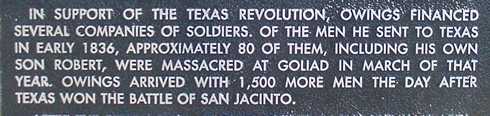 |
| Historical Marker
Text (partial) from the 2006 marker placed at the gate of the Masonic
Cemetery in Brenham.
TE photo, November 12, 2006 |
|
Col.
Thomas Deye Owings was an American hero in every sense of the word,
having distinguished himself in battle in 1813. He was Kentucky's
pioneer industrialist, having earned a fortune while operating the
first iron smelter, located west of Allegheny Mountains. He was
a socialite who built a very exclusive mansion in Owingsville, where
Henry Clay, Prince Louis Phillipe, and a host of others were often
entertained. The State of Kentucky, the Daughters of the American
Revolution and perhaps others have honored him often on several
historical markers.
Stephen F. Austin engaged Col. Owings to raise 2 regiments of troops
to fight in the Texas Revolution, and 75 of them were brutally slain
during the Goliad
Massacre. In spite of his Texas Revolutionary achievements,
the remains of Thomas Deye Owings rest today in the the Masonic
Cemetery in Washington
County in total anonymity and oblivion, and no one in Texas
bothers to remember who he was.
|
© W. T. Block,
Jr.
"Cannonball's
Tales" November 14, 2006 column
Editor's note: A detailed and illustrated bio of Thomas Deye Owings
can be found on the author's website. The above is a condensed version
of that article
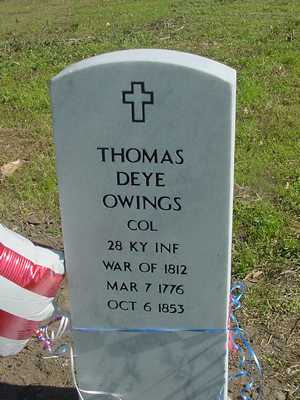
Editor's Note: This oversite was corrected on November 11, 2006
with the dedication of a historical marker at the Masonic Cemetery
gate as well as an upright marble VA marker within the cemetery grounds.
|
|
|
 HOME
HOME