|
Books by
Jeffery Robenalt
|
|
The
tragedy that was Goliad
had its roots in the Tampico Expedition of November 15, 1835, when
General Jose Antonio Mexia attacked Tampico, Mexico, with three
companies of troops who enlisted for service at New Orleans. The
attack was unsuccessful, and most of the men were captured the next
day by Santa Anna’s troops. Twenty-eight members of the expedition,
most of them Americans, were tried as pirates, convicted, and executed
by firing squad. On the whole, the reaction to the Tampico executions
in the United States was that Mexico was acting well within its
rights.
The lack of protests to the Tampico executions led Santa Anna to
believe he had found an effective deterrent to the Americans that
he expected would soon flock to the assistance of Texas.
At his urging, the Mexican Congress passed the decree of December
30, 1835, which directed that all foreigners taken in arms against
the government of Mexico should be treated as pirates and executed.
However, Santa Anna’s army took no prisoners at the Alamo.
It was left to General Jose Urrea, commander of the Mexican forces
advancing into Texas from Matamoros,
to take action on the murderous decree.
|
|
|
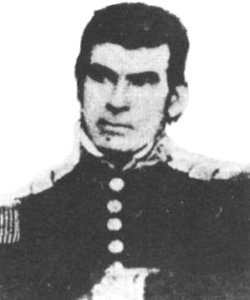
General
Jose Urrea
Wikipedia |
General
Urrea was first faced with enforcing the decree when his troops
captured the survivors of Francis W. Johnson’s party at the Battle
of San Patricio
on February 27, 1836. When he reported the prisoners to Santa Anna,
the dictator ordered him to carry out the decree. Although reluctant,
Urrea issued the order to execute the prisoners. However, when Father
Thomas Malloy, a priest of the local Irish colonists, interceded
on behalf of the condemned men, Urrea relented and sent the prisoners
to Matamoros for disposition, thus washing his hands of their fate.
General Urrea’s respite was short-lived. On March 15, at Refugio,
he was again confronted with the dilemma of enforcing the fatal
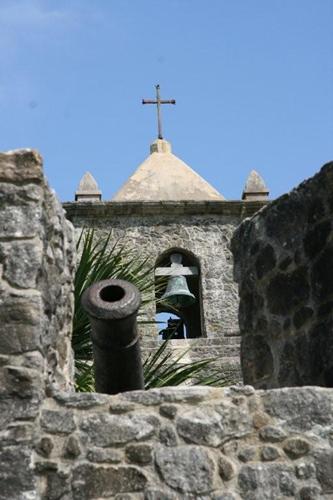
decree. This time, thirty-three Americans were captured at the Nuestra
Senora del Refugio mission, half of them members of Captain Amon
B. King’s company. King and his men had angered the local citizens
by burning several ranches and killing eight innocent Mexicans sitting
around a campfire, and the people demanded justice. This made General
Urrea’s decision much easier. He executed King and fourteen of his
men, more for their murderous acts than to satisfy the decree, and
released the others.
|
 |
|
The Mexican
advance continued until General Urrea’s scouts reported that the
Texans were occupying Presidio La Bahia at Goliad.
Sam Houston,
the commander of the Texas army, ordered Colonel James Walker Fannin
to abandon Goliad
and retreat to Victoria
on March 11, but Fannin hesitated to await word from Captain King,
whom he had sent to Refugio
with a substantial force. Though he learned of King’s fate on March
17, Fannin failed to order a retreat until the following day.
|
|
|
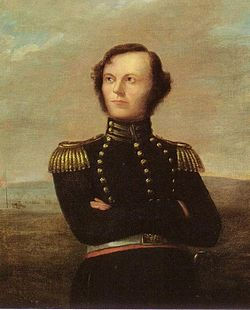
James W. Fannin
Wikimedia Commons |
|
The Texans finally
began their retreat, under the cover of a heavy fog, on the morning
of March 19. Fannin insisted on taking nine artillery pieces and
1000 extra muskets on the march, slowing the pace considerably.
Urrea was unaware of Fannin’s departure until two hours later, but
the Texans wasted an hour of their lead struggling with the largest
cannon while crossing the San Antonio River.
A mile past Manahuilla Creek, yet another precious hour was frittered
away in the middle of the prairie, when Fannin ordered a halt to
rest and graze the oxen. Many of the Texas officers protested the
stop, arguing that the column should not halt until reaching the
protection of the trees along Coleto Creek. Fannin chose to ignore
their counsel. Ever since the fight at Mission Concepcion, prior
to the siege of San
Antonio, Fannin had held the Mexican army in contempt, and he
was sure Urrea would not dare give chase.
The
Texans had barely resumed the march when a supply cart broke down.
While the supplies were being transferred to another cart, Fannin
sent a party to scout ahead. As the Texans closed on Coleto Creek,
Mexican cavalry emerged from the trees. Fannin immediately formed
his men and artillery into a moving square and advanced on the creek,
but their ammunition cart was next to break down. A hurried council
was called to determine the feasibility of taking as much ammunition
as they could carry and continuing the advance, but General Urrea
took note of the confusion among the Texans and launched an attack.
Cut off in the middle of the open prairie with little water and
much of their vision obscured by tall grass, there was little for
the Texans to do but ready their defensive square to receive the
Mexican attack. The sides of the hollow square were three ranks
deep, with the artillery placed at the corners. Each man received
three or four muskets. Bayonets, pistols and ammunition were also
abundant. The Mexican attack was simultaneously launched against
all four sides of the square, and the fighting raged until sunset.
|
 |
|
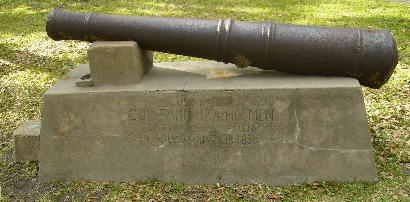
"Used by
Col. Fannin and his men
on Fannin's battlefield in Goliad County, in 1836"
On display in Fannin Plaza, downtown Goliad,
Texas
Photos courtesy Sarah
Reveley, 2009
|
|
During the night,
Fannin’s situation became critical due to the lack of water and
the inability to light fires to treat the wounded. A cold, rainy
norther and the cries and moans of the wounded added to the misery
and demoralized the Texans. The idea of escaping was discussed in
a council of officers, but it was rejected when the men voted unanimously
not to abandon the wounded. All that remained was to begin digging
trenches and erecting barricades of carts and dead animals. However,
by the time this was accomplished, General Urrea had been reinforced
with the addition of fresh troops and artillery.
At
sunrise, the Mexican artillery opened fire in preparation of resuming
the attack, and Fannin was convinced that further resistance would
be futile. After consulting with his officers, he decided to seek
honorable terms of surrender and hoped that the Mexicans would honor
them. Terms were drafted, seeking to guarantee that the wounded
would receive proper treatment, and that the men would eventually
be paroled to the United States.
Unfortunately, Urrea was bound by Santa Anna’s orders and the Decree
of December 30, and he lacked the authority to accept any terms
other than unconditional surrender. In a face-to-face meeting, he
made it clear to Fannin that the fate of the prisoners rested with
Santa Anna. He could only promise to intercede on the Texans’ behalf.
The document of surrender signed by Fannin states that the Texans
surrendered “subject to the disposition of the supreme government.”
Apparently this fact was never made clear to the men, since the
accounts of several survivors indicate that the Texans were led
to believe they were surrendering as prisoners of war.
|
 |
|
The Texans surrendered
their arms and the uninjured and slightly wounded were marched back
to Goliad
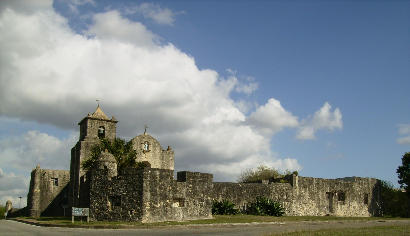
and imprisoned in the chapel of the Presidio La Bahia. The wounded
prisoners, including Colonel Fannin, were returned to Goliad
over the next two days. On March 25, eighty prisoners from the Georgia
Battalion, who surrendered near Dimitt’s Landing on the same terms
accorded to Fannin, were added to the Goliad
prisoners.
In
keeping with his promise to Fannin, General Urrea wrote to Santa
Anna from Victoria,
where the majority of his forces had advanced, recommending clemency
for the prisoners. However, the General mentioned nothing of the
surrender terms the Texans had drafted. Santa Anna replied to Urrea’s
letter by ordering the immediate execution of these “perfidious
foreigners.”
Evidently, the dictator doubted General Urrea’s willingness to act
as executioner, because he also sent a direct order to the “Officer
Commanding the Post of Goliad
” to execute all of the prisoners he was holding. The order was
received by Colonel Jose de la Portilla, whom Urrea had left in
charge. Portilla spent a restless night considering his options,
but he finally concluded that he had no choice except to obey Santa
Anna. He ordered that the prisoners be shot at dawn.
As
the sun rose on Palm Sunday, March 27, 1836, the prisoners who were
able to walk were formed into three groups. The largest group, including
the prisoners from the Georgia Battalion, was marched along the
Bexar Road in the direction of the upper ford on the San Antonio
River. Another group was led along the Victoria Road toward the
lower ford, and the final group was marched in the direction of
San Patricio.
On the whole, the prisoners moved quietly and held little suspicion
of their fate because they had been told a variety of lies; the
most common of which was that they were to be marched to Matamoros
or Copano for sea passage to New Orleans.
At previously selected locations, less than a mile from the presidio,
the three groups were halted. The guards on the right side of the
columns then countermarched to the join the guards on the left side.
At a prearranged signal the guards raised their muskets and fired
on the prisoners from point blank range. The wounded and dying were
then bayoneted or clubbed to death, and most of those who had survived
the initial volley were ridden down and lanced by Mexican cavalry.
The men who were wounded in the Battle of Coleto were shot
or bayoneted where they lay inside the presidio chapel.
After watching helplessly while his men were butchered, Colonel
Fannin was the last prisoner to be put to death. Because of his
wounded leg, he was taken to the courtyard in front of the chapel,
blindfolded, and seated in a chair. He made three final requests;
that his personal possessions be sent to his family, that he be
shot in the heart and not the face, and that he be given a Christian
burial. None of the three requests were honored. His possessions
were stolen, he was shot in the face, and his body was burned along
with the other approximately 400 Texans who met their fate that
day.
|
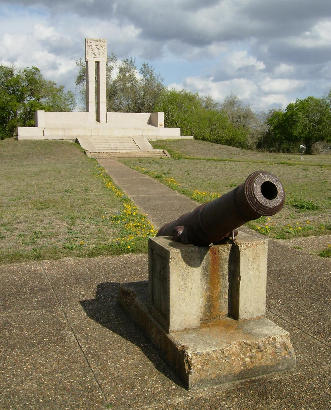 |
The centennial
monument to Fannin and his men just east of the Presidio
Photo courtesy Sarah
Reveley, 2009 |
| The remains of
the prisoners were left exposed for the vultures and coyotes until
June 3, 1836, when General Thomas J. Rusk was passing through Goliad
in pursuit of a retreating Mexican column. After gathering the remains,
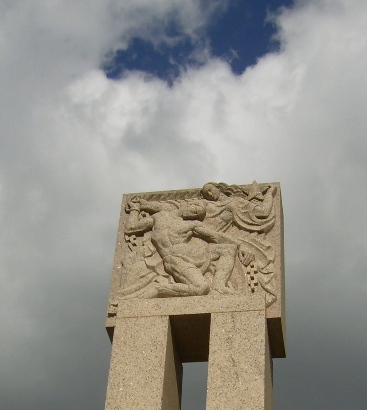
Rusk had them buried with full military honors. On June 4, 1938, a
massive pink granite monument was dedicated on the site as part of
the Texas Centennial.
|
 |
|
Although
a military disaster, the tragedy at Goliad
had a profound effect on the Texas Revolution. When the massacre
occurred, Texas had no army, and the
new ad interim government was floundering. Moreover, the Texas
cause was fully dependent on the generosity and largess of the United
States. If Santa Anna had simply dumped the prisoners on American
soil, penniless and without means of support, the mismanagement
and incompetence of the Texas government would have been exposed.
Texas prestige would have fallen in American eyes, and aid may well
have dried up.
Instead, the few survivors of the tragedy quickly spread the word,
and the massacre at Goliad
branded Santa Anna as an inhuman despot and the Mexican people,
whether deserved or not, with a reputation for cruelty. A burning
desire for revenge arose among the people of Texas,
and Americans were now firmly united behind the Texas
cause of independence. Soon the plains of San Jacinto would echo
with heroic shouts of "Remember Goliad!” as well as "Remember the
Alamo!"
© Jeffery
Robenalt, March 1, 2012 Column
jeffrobenalt@yahoo.com
References ›
See Goliad
More "A Glimpse of Texas Past"
More Columns
|
References
for "Massacre at Goliad: A Texas Tragedy"
|
|
Bradle, William
R. (2007), Goliad: The Other Alamo, Pelican Pub Co, ISBN 9781589804579.
Casteneda,
H.W. (1970), The Mexican Side of the Texas Revolution, Texas Graphic
Ideas ASIN B003MOPMG1S.
Davenport,
Harbert; Roell, Craig H. "Goliad Massacre": Handbook of Texas Online.
Retrieved 18 July, 2011.
Fehrenbach,
T.R. (2000), Lone Star: A History of Texas and Texans, Cambridge:
Da Capo Press, ISBN 0-306-80942-7.
Hardin, Stephen
L. (1994), Texian Illiad: A Military History of the Texas Revolution,
Austin, Texas: University of Texas Press, ISBN 0292730861.
Hopewell,
Clifford (1998), Remember Goliad: Their Silent Tents, Netlibrary,
ISBN 9780585294568.
Pruell, Jakie
L.; Cole Everett B. (1985), Goliad Massacre: a Tragedy of the Texas
Revolution, Eakin Press, ISBN 9789890154762.
Stout, Jay
A. (2008), Slaughter at Goliad: The Mexican massacre of 400 Texas
Volunteers, Naval Institute Press, ISBN 978159114832.
Wharton, Clarence;
Barnard, Joseph Henry (1968), Remember Goliad: A Rollcall of Texas
Heroes, Rio Grande Press, Glorieta, N. M.
|
|
|
 HOME
HOME