|
|
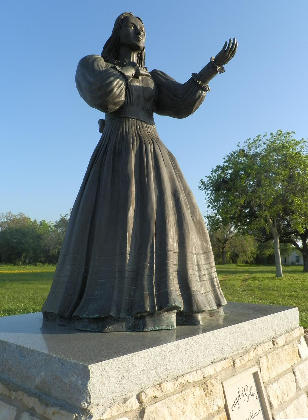
She
was known, by the Texans, as a "high bred beauty" and the "Angel of
Goliad." A tenderhearted Mexican lady who will forever be remembered
for her many acts of kindness during those dismal days of the Texas
Revolution.
Although there is some doubt as to her real name, she is commonly
identified as Francita Alavez and history records that she
was a compassionate and beautiful woman.
She acquired the name, Angel of Goliad,
because of her efforts to help Texas soldiers who had been captured
at the Battle of Coleto. |
 |
After that battle,
in March of 1836, Texas troops under the command of Col. James W.
Fannin, Jr. surrendered to Mexican forces. Information found in The
New Handbook of Texas states that: "Fannin's men had agreed upon
and reduced to writing the terms upon which they proposed to capitulate."
It was the custom in those days that men taken as prisoners of war
would eventually be paroled and returned to their country. This is
what Fannin had expected would happen to his men. The Mexican commander,
Gen. Jose de Urrea, had told him that they would be treated honorably
and not be harmed. But as was his habit, Gen. Santa Anna overruled
Urrea and ordered all the prisoners to be executed. At sunrise on
Palm Sunday, March 27, 1836, 342 men including Col. Fannin were put
to death. (See Goliad
Massacre)
After
this horrible chain of events, stories began to surface about the
exploits of Francita Alavez. Some of the survivors of the massacre
told of the kindness they were shown by the wife of a Mexican officer
known as Captain Telesforo Alavez. She was credited with persuading
one Mexican officer not to carry out his orders to execute Texas soldiers
who had been part of Maj. William P. Miller's command. These men had
been held as prisoners at Copano Bay and then taken to Goliad
to be murdered with all the rest.
Other stories indicate that Francita slipped into the fort at Goliad
the evening before the massacre and brought out several of the men
and hid them. If she had been caught saving these men, the "Angel
of Goliad" would have probably been executed.
Francita Alavez, when at Copano Bay, noticed that the Texas prisoners
there were being badly treated. She observed that the men were tightly
bound with rope that was restricting the circulation of blood to their
arms. Survivors reported that she convinced the Mexican soldiers to
loosen the ropes and to feed the prisoners. Following the defeat of
Gen. Santa Anna at the Battle
of San Jacinto, Capt. Alavez took Francita and returned to Matamoros,
Mexico. While in that city, she aided Texas soldiers who were held
prisoner there.
Capt.
Alavez moved on to Mexico City and there he abandoned Francita and
left her penniless. This seemed to be a habit of Alavez - he also
abandoned another woman, considered his legal wife, before he came
to Texas with Francita. According to The New Handbook of Texas,
later research indicates that Francita was probably his mistress.
When the "Angel of Goliad"
returned to Matamoros she was without food or shelter. But the Texans
there remembered her acts of kindness towards them and they came to
her rescue. There seems to be little else known about Francita Alavez
from the time she returned to Matamoros. I was unable to find any
record of when or where she died. Information about her is so vague,
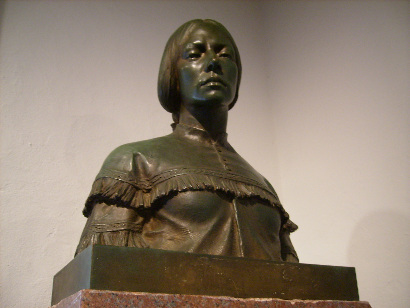
that historians really don't know what name she was known by. Her
first name has been given as Francita, Francisca, Panchita, or
Pancheta, and her surname as Alavez, Alvarez, or Alevesco.
|
 |
|
Several
years after the Texas Revolution, two doctors who were prisoners
at Goliad
and spared by the Mexicans, told of the humanitarian acts of Francita
Alavez on behalf of the Texans. These eyewitness accounts, by Dr.
Joseph Barnard and Dr. John Shackelford, caused the deeds of this
compassionate woman to become widely known.
Because of her many acts of kindness toward men considered to be
her enemy, Francita Alavez will forever be remembered as a heroine
of the Texas Revolution and the "Angel of Goliad."
The
Lavaca County, Texas,
area has ties to the Angel of Goliad.
One of the survivors of the Goliad
Massacre, Isaac D. Hamilton, escaped and was recaptured at Dimmitt's
Point. He was sent to Victoria
and was again scheduled to be executed.
But while Hamilton was awaiting his fate, word came that Sam
Houston's army had defeated Santa Anna at San
Jacinto. While the Mexicans were in a state of confusion, Hamilton
escaped once again. He was aided by none other than Francita Alavez.
According to The New Handbook of Texas, Isaac Hamilton died
at Moulton,
Texas in 1859 and was buried in the Old Moulton Cemetery.
© Murray
Montgomery April 20, 2004 column
More Lone
Star Diary
|
|
|
 HOME
HOME


