|
|
To
the East Texas of 1900,
whose non-native population can be delineated as the overflow of the
Anglo-Saxon Lower South, a Dutch colonization scheme must have appeared
somewhat phenomenal. To the promoters, who were owners of Kansas City
Southern Railroad, it was sound business, designed to convert surplus
railroad acreage into cash, and to stimulate business along those
points of the line which were barren of population.
Arthur E. Stilwell, dreamer and railroad entrepreneur of the late
nineteenth century, expressed no qualms about accepting credit for
the plan. Financier and head of Guardian Trust Company of Kansas City,
Stilwell entered railroading, seeking a sea outlet for Midwestern
wheat for export, hoping to keep that product more competitive in
price, and to evade the exorbitant rates charged by the East-West
lines.
Stilwell must be remembered as the man who, when stymied in his efforts
to build Kansas City Southern trackage (hereinafter abbreviated K.
C. S.) to the sea, dug an eight-mile ship canal and carried the sea
to the rails at Port
Arthur. When likewise stymied for domestic capital during the
panic of 1893-1895, Stilwell turned to Amsterdam bankers, and raised
the $10,000,000 needed to bring the K. C. S. rails south from Siloam
Springs, Arkansas - hence the appellation "Dutch-American railroad."[1]
As a result of one of his famed 'hunches,' Stilwell envisioned a thriving
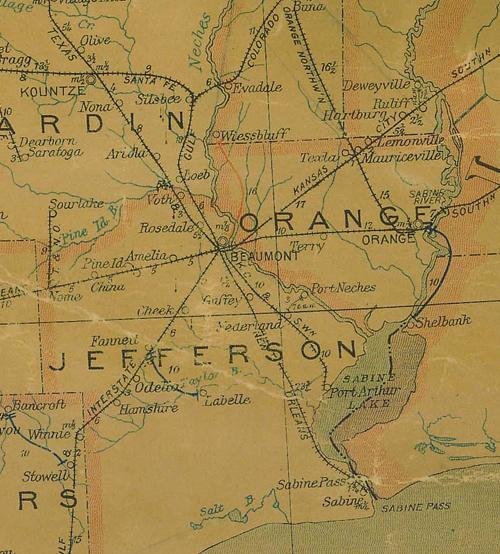
community of Dutch rice farmers on the coastal plain north of Port
Arthur, of which he said: |
| Again my thoughts
turned to Holland, and I decided that as we owed a debt of gratitude
to the Dutch people for their faithful support of the Kansas City
Southern, here was a chance to repay a part of it, to say nothing
of the fact that the people of that country make exceptionally capable
farmers. So I founded a town and called it Nederland, and instructed
my emissaries to make a drive on the country districts of Holland
to entice a good class of citizens to the newly-organized community.
We housed them in a large hotel (Orange Hotel) especially erected
for that purpose and gave them good accommodations at reasonable rates.
As soon as they could buy their property and build their homes, we
could bring over another delegation and put it through the same process...[2] |
When the flow
of domestic capital slowed to a trickle in 1893, Stilwell recalled
a Dutch acquaintance, Jan de Geoijen, a coffee merchant of Amsterdam,
whom Stilwell had met on a trans-Atlantic crossing. He rushed to Holland
and upon enlisting de Geoijen (phonetically anglecized to "deQueen")
as his Holland agent, managed to unload $3,000,000 of the railroad's
securities in twenty-seven minutes. Thereafter Dutch investors and
workers were granted a large voice in the management and operation
of Stilwell's company.[3]
By 1897, after K. C. S. trackage had reached Port
Arthur, Dutch natives were employed at all levels. H. Visscher,
an Amsterdam accountant sent over to examine the railroad's books,
remained in Kansas City as the company's treasurer. In Port
Arthur, the firm organized a number of subsidiaries, including
Port Arthur Townsite and Land Company, with M. R. Bos as its first
immigrant manager; Port Arthur Canal and Dock Company; and Port Arthur
Rice and Irrigation, which also operated the Port Arthur Experimental
Farm.[4]
H. H. Beels, a Dutch immigrant railroad builder on the Great Plains,
became resident engineer for Port Arthur's canal project. Jacques
Tutein-Nolthenius[5] became a trustee of the townsite company and
vice president of another K. C. S. affiliate, the Missouri, Kansas,
Texas Trust Company of Kansas City. Nolthenius was also right-of-way
buyer for the railroad. W. I. Vandenbosch became the railroad's emigration
agent, commissioned to recruit Hollanders who had earlier settled
in Iowa and Michigan. L. Zylekins was Port
Arthur's first depot agent.
Jan van Tyen arrived in Port
Arthur as Holland's consul and de Geoijen's personal emissary,
became manager of Port Arthur Land Company and Holland-Texas Hypotheek
Bank, amassing quite a fortune in the course of his lifetime. His
business associate, E. J. Everwijn-Lange was another early and prominent
Port Arthuran, who later returned to Holland. A. J. M. Vylsteke, Holland's
first vice-consul and agent for Joseph dePoorter Steamship Line, was
one of Port
Arthur's first citizens, living in a tent on the townsite before
it was surveyed. By 1903, Port
Arthur's Dutch immigrant population was estimated at 150 persons.
In November, 1897, the Herald stated: "...Port
Arthur is a new opening and the shrewd Hollanders are quick to
take advantage of it..."[6]
Stilwell's south Jefferson County land holdings came into existence
on October 15, 1895, when he purchased 41,850 acres of land
from Beaumont Pasture Company at $6.75 an acre. On December 4 of that
year, title was transferred to Port Arthur Land Company, Other than
the railroad's right-of-way, 4,000 acres were reserved immediately
and platted for the townsite of Port
Arthur. That left approximately 37,000 acres, which were surplus,
to be utilized for agriculture and other purposes.[7]
That Stilwell prudently planned to assure the success of his Dutch
colonization attempt, to include a church and school, is quite evident.
That his project essentially failed is more attributable to the temperaments
and eccentricities of particular immigrants, who were unaccustomed
to American soil, climate, language, and folkways; to actions of his
emigration agents; and to the failure of rice markets and other uncontrollable
factors.
Vandenbosch made a number of trips to the Dutch
colonies in Iowa and Michigan to recruit prospective settlers to the
new colony. On one trip, he managed to induce eight Iowans to come
to Texas and investigate conditions for resettlement. Texas Colonization
Company of Iowa's advertisements in the Dutch-language newspapers
expounded concerning the agricultural advantages to be found in Southeast
Texas' soil and climate. During 1898 Bartle J. Dijksma, and
immigrant horticulturalist at Port Arthur's experimental farm, painted
rosy, prosaic pictographs of Nederland in Holland, Michigan's Dutch-language
newspaper, De Grondwet.[8]
One result of those early land promotions in the North was the arrival
in May, 1897 of Gatze Jan (George) Rienstra, Nederland's first
settler. On his initial visit, Rienstra expressed satisfaction with
the site of the proposed colony, with Port
Arthur's experimental farm and pleasure pier, and noted that his
fellow Dutch immigrants, Port Arthur farmers J. Gautier and a Mr.
Engelsman, were prospering. On his next trip, Rienstra left his kitchen
stove, farm implements, and personal effects standing beside the railroad
tracks at Nederland
while he drove his wagon on to Port
Arthur to purchase lumber.[9]
In Holland, Jan de Geoijen employed J. E. Kroes, the former inspector
of Netherlands-American Steamship Company, to screen prospective applicants
and establish their suitability for resettlement. Emphasis was placed
on the sturdy Dutch farmers of the provinces of North Holland, Friesland,
Groningen, and Gelderland, among whom agents of Port Arthur Land Company
circulated. Again, the picture most often painted was that of a 'Garden
of Eden' in East Texas, rather than that of open pasture land which,
as of 1897, had only one economic boon to warrant its habitation
- the newly-laid railroad trackage. Tradesmen, clerks, shopkeepers,
teachers, even pastors, were solicited as well, in order to stabilize
the economic and social requirements of the planned community. When
the first group of these settlers had liquidated their assets and
prepared to travel, Albert Kuipers, a Dutch employee of the land company
who had been recruiting in Holland, made arrangements at Antwerp to
escort the first contingent of settlers to their new home in East
Texas.[10]
In
the meantime, Stilwell moved ahead with his plans for Nederland
and its rice industry. In 1896, he began Port
Arthur's experimental farm, the purpose of which was to experiment
with all varieties of domestic animal and plant life, determining
which strains were most suitable for growing in the climate of south
Jefferson County.
In March, 1897, he transferred F. M. Hammon, superintendent of the
railroad's farm at Amoret, Missouri, to Port
Arthur as the new farm's manager. At the same time, G. W. J. Kilsdonk,
a well-known bulb grower and horticulturalist of Holland, arrived
to work on the farm and as the vanguard of the Dutch settlers slated
for Nederland.
In July, 1897, the farm superintendent was reporting 'great
success' in the growth of sea island cotton, rice, asparagus, two
varieties of tobacco, and other farm products. By then the farm's
facilities included 80 acres of bearing pear trees as well as olive,
fig, and orange orchards, and a large herd of imported Jersey cattle.
That Stilwell overlooked no possibility is evident in the farm's adoption
of the umbrella china as the ideal shade tree for the Dutch immigrants'
front lawns. A thousand seedlings for transplanting in Nederland were
awaiting the arrival of the human transplants from Europe.[11]
During the late summer of 1897, Port Arthur Land Company began
work on the first buildings at Nederland.
The three-story, 33-room Orange Hotel (named for the ruling house
of Holland and built on the northwest corner of N. 13th and Boston)
was begun, and by November, was nearing completion. Its purpose was
to provide room and board at reasonable rates for the new immigrants
until each had completed his own home. As might be expected, the hotel
soon became the center of social life in the new community, religious
as well as educational. Kilsdonk was also transferred to Nederland
as the land company's resident overseer. He immediately began work
on two store buildings, and soon afterward became Nederland's
first merchant.[12]
On
December 24, 1897, Stilwell, Jacques Nolthenius, and Judge
J. M. Trimble, as trustees of the land company, platted the first
townsite of Nederland, which spanned both sides of the railroad track,
and reserved to themselves "exclusive rights to erect.... street car
lines, railways, electric lights,... gas and water pipes, mains and
conduits...." With particular intent to please the immigrants, they
established two parks, Mena, named for the young and beautiful queen-regent
of Holland, and Koning (King's) Park. Street names were in the Dutch
language, and included such names as Kuipers Straat (street), de Geoijen
Straat, Wilhelmina Straat, and Heeren Straat.[13]
In October, 1897, Stilwell organized the Port Arthur Rice and Irrigation
Company, capitalized at $50,000, with intent to build a Neches River
pumping plant and a system of 25 miles of rice canals sufficient to
irrigate 5,000 acres. The company's headquarters were built at a point
two miles south of Nederland
(on Rice Farm Road), and its management was assigned to Superintendent
Hammon. Construction work on the canal system began in January, 1898,
with 55 men and 27 mule teams, supervised by D. Zimmerman, a railroad
engineer who had been transferred from Kansas City.
At Smith's Bluff, a mile north of Nederland
on Neches River, a 100-horsepower steam pumping plant, with an outflow
of 18,000 gallons a minute, was installed. Two miles of inclined,
outflow flume were constructed above ground level, with the river
end elevated fifteen feet. (In 1922 the canal levees were flattened
to provide the plant road into Pure Oil (Unocal) refinery.) By the
end of 1898, seven miles of the canal system had been completed
and three other miles were still under construction. During 1898,
the rice company planted 700 acres of rice (460 of which returned
a $21,000 profit), which production along the canal system reached
13,000 acres by 1904. Rice production increased so rapidly, that the
capacity of the pumping plant and outflow flume had to be tripled
within two years, forcing the irrigation company to increase its capitalization
to $150,000. Width of the outflow flume was increased to 100 feet
and pumping capacity to 78,000 gallon per minute.[14]
On
November 18, 1897, Port Arthur Herald splashed its front page
with news of the first contingent of Dutch immigrants for Nederland,
46 men, women, and children.[15] They arrived at Galveston
on November 14th, but for some unexplained reason, did not arrive
in Port Arthur until three days later. Galveston Daily News carried
the following notation: |
The steerage
passengers, fifty in number, were undoubtedly the finest lot of people
that have been brought here by any vessel recently. They all had money,
the least any one of them had being $30. The majority were bound for
the new Holland colony at Nederland on the Kansas City Southern railroad,
and at least one of the steerage passengers had bought his farm before
he left the old country.
All these colonists were inspired to try their fortunes in this country
by Mr. Albert Kuipers, who has been over a considerable portion of
the west and finally settled on Nederland as the ideal spot...
After inspection, the Nederland party was placed aboard a tug and
conveyed across to Bolivar and thence by Gulf and Interstate (rails)
to destination. Before leaving the vessel, the passengers united in
a resolution, with Mr. Kuipers as chairman, by which they extended
a vote of thanks to Capt. Hansen and officers of the steamer Olinda
for kind and courteous treatment received during the voyage, and that
they were pleased to recommend the Diederickson line to the traveling
public...[16] |
The Herald stated
that many of the passengers spoke some English, and expressed favorable
reactions toward their new country and Port
Arthur. The article added that they were met at the depot by "several
of their countrymen," as well as the land company representatives,
after which the newcomers were fed at the Terminal Hotel and then
taken to the Nash House for the night. Afterward, the immigrants "thronged
the streets, bent upon sightseeing..."[17]
In a letter written to Holland on the same day, Kuipers reported that
he was immediately beseiged by prospective employers. In great demand
were the Dutch women and girls to work as household servants at $10.00
per month. Kuipers reported as well that he immediately secured employment
for the men as teamsters and railroad laborers at $1.50 daily, as
well as carpenters and gardners.[18]
After they had rested, the vanguard of settlers were taken to the
Orange Hotel in Nederland,
where they immediately selected their land and began preparations
to build homes. The newspaper gave the following partial list of arrivals:
D. Ballast, N. Rodrigo and six children; J. H. Muller, A. Teggelaar,
N. Ernsting, L.Tynkema. R. van Dalen, H. P. de la Bye, P. Koimann,
M. Jorritsma and son, B. H. Lans, W. F. Lans, A. J. Rysemann, J. G.
van Tyl, K. Bronstsema, Miss Waterdrink, Jan Tromp, C. van der Bout,
M. Koot; A. J. Ellings, wife and four children; T. ten Dekker, and
J. C. van Heiningen.[19]
The
next known contingent to arrive, 16 persons, came on the Diederickson
line steamer Lauenberg to Galveston,
arriving there on March 1, 1898, after a stormy voyage of three
weeks. More than half of that group were comprised of the Maarten
Koelemay family, including his wife Antje, sons Peter, John, Klaas,
Martin and Lawrence; and daughters Tryntje, Dieuwertje, and Klaasje,
all of the latter at or approaching adulthood. Koelemay, a cheese
maker of Hoogkarspel, near Enkhuizen on the Zuider Zee, brought his
cheese molds with him, expecting to continue his former occupation,
but that proved impossible in the warm and humid climate of Southeast
Texas. The family, who arrived simultaneously with a blustering cold
"norther," found the 'promised land' of Nederland
to consist of one muddy street, "a few houses, a hotel, a blacksmith
shop, a mercantile and a hardware store, a couple of saloons, and
acres and acres of unfenced, unimproved lands...."[20]
The
third group of whom the writer has a record arrived at Galveston
and Nederland
on the same date, March 28, 1898, aboard the German liner Olinda,
after a stormy, 21-day crossing from Antwerp, which saw the vessel's
stearing gear break. Again Galveston Daily News reported that the
26 passengers for Nederland,
including 20 young men, were "the finest-looking company of immigrants
seen at Galveston
in many years." Each was reported as being clean-shaven, and freshly-attired
"in white linen" and black ties.[21] These arrivals of Dutch immigrants
at Galveston
continued for many months and years thereafter, with a fourth group
arriving on the German liner Curatyba on April 26, and still a large,
fifth contingent arriving the following December 27, 1898 aboard
the German steamer Ellen Rickmers.[22]
The
last party to arrive in March had been escorted from Holland by B.
J. Dijksma of Port
Arthur experimental farm, and had been met at Galveston
by Kilsdonk. Upon arrival at Nederland, they too were taken to the
Orange Hotel, by then being managed by Mr. and Mrs. Ellings, who had
arrived earlier. As with the first group, Kilsdonk immediately found
employment for the young men with the railroad in Port
Arthur. Dijksma admitted that their first impressions of Nederland
were mostly unfavorable (some immigrants returned to Holland almost
immediately), but Dijksma's attitude was reversed in the course of
his latter writings. He did advise that no immigrant should attempt
to settle in Nederland as either a farmer or orchard grower unless
he had the "proper means" with which to support himself for one year.[23]
By April, 1898, the population of Nederland could be reckoned
at no less than 100 persons through immigrant arrivals from Holland,
plus a handful who had resettled from the Dutch colonies in the North,
as well as a few native families, who had taken up residence in the
Dutch colony. In 1897, Louis A. Spencer, his wife and six sons
arrived and began operating a brick kiln a mile north of Nederland.
Handmade bricks fired in that kiln were used in the construction of
Orange Hotel and in buildings in Port
Arthur. In 1898 J. B. Cooke brought his family to Nederland and
entered the lumber business.[24]
The
same month also witnessed the beginnings of religious life in the
new community, and organization of a Dutch Reformed congregation (now
Reformed Church of America). Services led by lay leaders had been
conducted each Sunday at the Orange Hotel almost from the beginning,
apparently by D. Ballast, whose signature appeared on existent baptismal
certificates. Dr. Henry Beets, then of Sioux City, Iowa, made a special
trip to Nederland to organize the parish, after which the new church
(until it dissolved about 1905) was affiliated with the Classis (synod)
of Iowa. A church was built at the corner of "Kuipers and Heeren Straats"
(now Tenth and Boston). Church records indicate that the congregation
remained too small to afford a full-time pastor. As of 1898,
membership included four families and 28 members, and apparently did
not vary greatly from those figures during its existence.[25]
Education lagged only momentarily for Dijksma reported in the same
article that plans were afoot to establish a school and engage a teacher.
The first school was conducted in an outbuilding connected to the
Orange Hotel, utilizing a teacher from Beaumont,
with Klaas Koelemay serving as interpreter. It remained there until
the small building was blown away during the hurricane of 1900. That
the Dutch were dedicated to higher learning can be attested to by
the 1,000-volume library that was maintained at the Orange hotel from
its beginning.[26]
On May 5, 1898, Kilsdonk resigned and was replaced as the colony's
resident manager by W. I. Vandenbosch, the emigration agent for the
land company. Kilsdonk planned to visit his wife and son in Holland,
but remained in Nederland until after the queen's coronation festivities
to serve as chairman of the preparations committee (of which Peter
Koelemay was a member). He apparently never returned to America since
he was still living in Holland as of 1900.[27]
The early Hollanders of Nederland found it mutually advantageous to
organize for their protection. For one thing, a definite language
barrier existed between the Dutch and the native inhabitants, with
few if anyone who could adequately translate in the complex legal
and technical terminology which many problems required. As of July
1, 1898, Nederland's Colonists Union had twenty Dutch farmers,
plus some skilled craftsmen and laborers, as its members, with W.
F. Lans serving as the organization's president and P. J. van Heiningen
as its secretary.[28]
In an article published in Holland at that time, van Heiningen commented
on the costs involved for those Dutch immigrants who chose to become
rice farmers. Land sold at from $20 to $50 an acre. A team of mules
was valued at $170, a span of horses cost $120, while good quality
Jersey cattle sold at $70 each. In the same article, Willem Beukers,
a Dutch visitor to Nederland
in January, 1898, noted both the advantages and the disadvantages
incurred by Dutch immigrants who settled in Southeast Texas. Because
of the cultural habitat which Holland represented, Beukers concluded
that "pretty good in the old country is better than very good in Texas."[29]
On
May 26, 1898, a meeting was called by the Hollanders of Port
Arthur and Nederland
for the purpose of preparing for a giant celebration on the following
September 6, the date of the coronation of Holland's young Queen Wilhelmina.
All Dutch settlers in each town were required to attend. At that moment,
"when Nederland
could hardly be termed a settlement," the utter magnitude of the event
attests to the importance accorded to it by the officials of Kansas
City Southern railroad and by its affiliate, Port Arthur Land Company.
No expense was spared, and fortunately Port Arthur Herald has left
a most graphic account, filling five columns, more than half of its
front page, for Septembr 6, 1898.[30]
Between the lines, the writer interprets that Stilwell considered
his Nederland experiment to be hanging in jeopardy. Life in the colony
was undoubtedly both harsh and monotonous for the newcomers, as evidenced
by those who sought greener pastures elsewhere or returned to Holland.
Stilwell probably wished to placate the Hollanders who were still
here, while at the same time calling attention to the rice growing
potential of Nederland (whose canal system by then represented a huge
investment) to the area's farmers. At any rate, the land company sponsored
a gala event long to be remembered by both Beaumonters and Port Arthurans
as well, and although the Dutch continued to arrive for many years
more, their numbers were augmented by an increase of native-born shopkeepers
and rice farmers, who took up residence among them. The celebration
demonstrated as well that the Dutch were as fun-loving as they were
industrious.
Throughout
the day of September 6, from 7 AM until 2 AM the following morning,
special trains were run from Port
Arthur and Beaumont
to Nederland, carrying the celebration participants, the pleasure-seekers,
the spectators and the curious. At 7:45 AM the first train arrived
from Port Arthur,
carrying the first visitors and the Port Arthur band. After the latter
had played a number of selections at the depot, the participants formed
a line of march to the hotel. All of Nederland's buildings were festooned
with bright bunting and the national colors of both Holland and the
United States. The Orange Hotel was decorated in like manner, inside
and out, with large pictures of the young queen, and with holly and
evergreens, "among which were interspersed red, white, and blue roses."
Other "accoutrements" of the hotel on that date were 750 gallons of
Dutch beer, brewed by Lans en Zoon of Haarlem, Holland.[31]
Activities of the morning included marching with the band to meet
arriving trains at the depot. At 9 AM the crowd assembled in King's
Park, where a memorial orange tree was planted and dedicated to the
young queen. Kilsdonk addressed the crowd in the Dutch language, and
was followed by J. E. Kroes, who read a brief history of the young
queen and of Nederland's founding, also in Dutch. This was followed
with translations by Vandenbosch, after which all documents were signed
by the festivities committee and buried in an air-tight bottle with
the tree.
The day's principal activities consisted of competitive games at the
race track. These included foot races over a specially-designed obstacle
course, bicycle races for both men and women, followed by kite racing,
greased-pole climbing, and a horse race. Betting was permitted with
participants soon learning that their favorite horse could place no
better than third. Since an election was imminent, political candidates
campaigned freely among the crowd.
At noon the crowd was treated to a Dutch menu with all the trimmings,
including fish, veal cutlets, roast beef, roast chicken, and vegetables.
Desserts included ice cream (the first that many Dutch had tasted),
mixed fruits, and cake. Drinks included coffee, tea, and beer.[32]
Festivities of the evening included one of the most brilliant pyrotechnic
displays ever witnessed in Southeast Texas up until that time, as
well as dancing at the Orange Hotel until 2 AM. The Herald noted that
the most popular dance number was the "Rose Grip Polka," and that
many dancing prizes were awarded. Vocal selections were rendered throughout
the evening by members of the Koelemay family, with musical accompaniment
on the zither. The Herald also conceded that, as the Beaumont and
Port Arthur visitors boarded trains after midnight, they were "all
convinced that the Dutch know how to conduct an affair of the kind,
so that all the people present can have a good time."[33]
Generally
speaking, Nederland's rice farmers subsequent to 1899 were
about equally divided between the colony's Dutch and non-Dutch inhabitants.
Most often the Hollanders who were able to begin rice farming immediately,
as S. R. Carter had in 1899, were those who had resettled from the
Dutch colonies in the North. High operational costs required that
others work as laborers until they had acquired sufficient land and
means to begin. Perhaps, due to language barriers, the Dutch, almost
to a man, shunned any connection with the mercantile activities in
the colony.[34]
By 1900 Nederland's
railroad tracks were lined with large storage warehouses for, lacking
a rice mill, farmers had to sack all harvested rice in order to ship
it elsewhere for milling. Elimination of the sacking system was a
principal cause for the organization in 194 of Nederland Rice Milling
Company, Inc.[35]
By May, 1903, Nederland's
economy was booming. Rice production increased steadily, and the Spindletop
oil boom, seven miles to the north, brought new money and settlers
to the town. By that time, the Dutch colony could boast of a population
of 500 persons, two-thirds of whom were Hollanders. In 1902, First
National Bank and a newspaper, the Nederland News, were established.
The town's principal retail houses, Cammack Brothers, King Mercantile
Company, and Nederland Supply Company were all described as "doing
a handsome grocery, feed, and farm implement business..."[36]
However economic setbacks in the year 1905 were to have a disruptive
effect on Nederland's
growth. A number of causes can be cited as contributory. In one year
rice acreage under cultivation plummeted from a high of 13,000 to
6,000 acres. With little thought given to market demands (and that
in an era when rice, like grits, was regarded as a cereal grain or
dessert ingredient), unsold backlogs of rice began to appear, and
delegations of Jefferson County rice millers began to visit Europe
in search of new markets.
By 1905 the oil boom at Spindletop
had ended, which eventually caused the closing of the Orange Hotel
due to insufficient lodgers. Within two years time, a number of the
town's leading merchants, namely, the bank, the newspaper, the rice
milling company, and retail businesses had folded in bankruptcy. From
that year until it eventually ceased operation, Port Arthur Rice and
Irrigation Company was beset with problems due to disrepair of its
facilities, and the continuous threat of salt water as the Neches
River channel was deepened. And in 1906-1907 a serious national recession
arrived.[37]
By 1912 no more than thirty Dutch families remained in Nederland.
Three-fourths of the original colony had moved away in search of better
economic opportunity, a few to neighboring points in Port
Arthur or Winnie,
but many went to Arkansas, Colorado, Iowa or Michigan. The Dutch who
remained were those who had already acquired sizeable land holdings,
and most of them turned to dairying, ranching, or truck farming when
the rice economy crashed.[38]
The
Rev. Ralph Koelemay, formerly of Plover, Wisconsin, laughingly advised
this writer by letter many years ago that, on occasion, Nederland's
Dutch colonists were equally as guilty of misrepresentation in Holland
as were the agents of Port Arthur Land Company. Among Nederland's
permanent colony that remained, it appeared that some of the men arrived
single, and later returned to Holland to marry their childhood sweethearts.
Fearful that their finacees might renege if they really knew how primitive
that living conditions in Nederland amounted to, some men resorted
to fantasy, and at least one bride arrived to find a squalid, one-room
bachelor abode instead of the livable quarters which she had expected.
In that instance, however, the bride accepted her new circumstances
stoically and "pitched in" to help her husband carve out an acceptable
and prosperous existence for themselves.[39]
In retrospect, the Dutch migration to Nederland
could hardly be expected to leave a large and permanent mark in view
of the large number of colonists who moved away. And of those who
remained, their numbers were insufficient to bequeath a heritage comparable
to the Acadian regions of Louisiana or other large migrations. In
fact one characteristic of the Dutch personality strongly counteracted
any such possibility, for successful competition in the market place
simply required that the Dutch assimilate as rapidly as possible.
Henry S. Lucas, an immigration historian, concluded that "Nederland
became a place which is Dutch in name only," but careful scrutiny
reveals that his assessment is not entirely correct.[40] It is true
that Nederland's 18,000 inhabitants are primarily of East Texas, Louisiana,
or other native extraction, but a goodly number remain whose parents
or grandparents were Dutch immigrants.
Most of the thirty Dutch families of permanent residence fared well
economically and educated their children accordingly. The late C.
Doornbos and his family have contributed immensely toward Nederland's
growth, and the C. Doornbos Trust remains a family-operated, diversified
enterprise. Their most recent bequest was the 22-acres and funding
for Doornbos Park, the city's main recreational facility.
Children of the Dan J. Rienstra family have contributed in like fashion,
providing Nederland
with two principal merchants (Albert and the late D. X. Rienstra were
longtime directors or board chairmen of Nederland State Bank, now
Bank of America, from its founding in 1948); Beaumont with two leading
attorneys, two school teachers, and a U. S. naval commander and graduate
of Annapolis.
Other Dutch settlers, namely, George Rienstra, Jacob Doornbos, S.
R. Carter, George Vanderweg, Christian Rauwerda; John, Klaas, Martin
and Lawrence Koelemay; Gerrit and Peter Terwey, Baucus Westerterp,
Carollus Bruinsma, and John van Oostrom to name a few, made similar
contributions, many becoming economically independent as well. And
for the most part, many have made substantial contributions to the
city's growth and well-being, for idleness and criminality were vices
virtually unheard-of among Hollanders. Whatever the heritage left
by them, Nederland
is justifiably proud of its origins, and has built a towering memorial
as proof of that assertion. Its broad-sailed Windmill Museum testifies
in silence each day as a tribute to that little band of Hollanders
who braved the unknown in search of a better way of life.
© W.
T. Block, Jr.
"Cannonball's
Tales" › September
11, 2006 column
This story is a condensation of a longer one, "Tulip Transplants To
East Texas: The Dutch Migration to Nederland, Port Arthur, and Winnie,"
which appeared in East Texas Historical Journal, XIII No. 2 (Fall
1975), 36-50, and which is copyrighted by East Texas Historical Association,
and is reprinted with permission.
See References
› |
 |
References:
- A.
E. Stilwell and Jas. R. Crowell, I Had A Hunch (Port Arthur: 1972),
44-52, 75-85, as reprinted from Stilwell's memoirs published in
Saturday Evening Post during months subsequent to Dec., 1927;
T. W. L. Scheltema, "A Dutch-American Railroad: The Kansas City
Southern," Knickerbocker Weekly Free Netherlands (Nov. 23, 1942).
15-18. The writer is indebted to John Vandenberg, now deceased,
for translations of numerous Dutch-language articles.
- Stilwell
and Crowell, I Had A Hunch, 77.
- Ibid., pp.
50-52; Scheltema, "Dutch-American Railroad," 15.
- Port Arthur
News, March 18, 1897; J. van Hinte, Nederlanders in Amerika II
(Dutch-language, Groningen, Holland: 1928), 268.
- For Nolthenius'
unsuccessful efforts to buy right-of-way for a terminus at Cameron,
La., and later at Sabine Pass, TX, see his Dutch-language memoirs,
Nieuwe Wereld: Indrucken en Aanteekeningen Tijdens Eene Reis Door
De Vereenigde Staten Van Nord Amerika (Dutch language: Haarlem,
Holland: 1902).
- Port Arthur
Herald, Nov. 11, 1897; Jan. 28 and March 18, 1898; Van Hinte,
Nederlanders II, pp. 268-272, 293; Henry Lucas, Netherlanders
in America (Ann Arbor, MI.: 1955), 436.
- John R. Rochelle,
Port Arthur, TX: A History of Its Port To 1963 (unpublished M.
A. thesis, Beaumont: Lamar University, 1969), 45; Vols. 42, pp.
64-74, and 22, p. 50, Deed Records, Jefferson County, TX; deed
records indicate that A. E. Stilwell, E. L. Martin, C. A. Braley,
and J. M. Trimble organized Port Arthur Land Company. Martin was
Stilwell's closest associate and president of Kansas City Suburban
Belt Railroad, the parent company of K. C. S. Braley and Trimble
was Kansas City attorneys and genersl counsel for the firms. See
Stilwell, I Had A Hunch, 23, 32-33.
- Port Arthur
Herald, January 27, 1898; Holland, Mich. DeGrondwet, Dutch language,
April 12, 1897 and May 24, 1898; Orange City, Iowa DeVolkswriend,
Dutch language, August 20, 1896.
- Anna A. Cooley,
"From The Netherlands in Europe to Nederland, Texas, U. S. A.,"
(Devers, TX, unpublished 27-page manuscript, 1969), 4; Letter,
G. J. Rienstra to Jan de Geoijen, Liverpool, TX, May 17, 1897,
as published in Albert Kuipers, Waarheen? Wegwijzer Voor Den Nederlandsche
Landbouwer, Veeboer, Tuinder, Bloemist, Boomkweeker, enz met Beperkte
Middelen (publ. booklet, 2nd ed., N. P., N. D., but about 1900),
60, copy owned by Mrs. Christine Stappers.
- Van Hinte,
Nederlanders, 271; Galveston Daily News, Nov. 15, 1897; clipping,
Advertisement of B. J. Nauta, Port Arthur Land Company, published
in Leeuwarden, Holland, on March 30, 1898; (Netherlands) Heerenveensche
Courant, December 4, 1897; Letter, A. Kuipers to deGeoijen, Nov.
15, 1897, as reprinted in Kuipers, Warheen?, 62-63.
- Port Arthur
News, March 18, 1897, Port Arthur Herald, July 22, 1897.
- Port Arthur
Herald, Nov. 4, 1897 and March 17, 1900; Cooley, "From The Netherlands
in Europe to Nederland," 2; Marie Fleming, "History of The Orange
Hotel," (unpublished manuscript, Nederland, 1972), 1-3.
- Map Record
No. 1, p. 38, Jefferson County, TX Archives. Mena Park is still
city-owned, but King's Park has reverted to private ownership.
The original townsite is bounded by present-day Ninth and Fifteenth
Streets and by Nederland and Chicago Avenues.
- Port Arthur
Herald, Oct. 28 and Dec. 30, 1897; Jan. 20, July 2, 14, Aug. 25,
and Sept. 15, 1898; March 30, 1899; and Feb. 24, 1900; Beaumont
Journal, Dec. 11, 1899 and July 23, 1905; (Port Arthur) The Evening
News, May 13, 1903; Lucas, Netherlanders in America, 436.
- Actually
a group of Hollanders led by J. E. Kroes, a land company representative
in Holland, had arrived via New York two weeks earlier. See Port
Arthur Herald, Nov. 4, 1897.
- Galveston
Daily News, Nov. 15, 1897.
- Port Arthur
Herald, Nov. 18, 1897.
- Letter,
A. Kuipers to Jan deGeoijen, Port Arthur, Texas, Nov. 15, 1897,
archives of Port Arthur Land Co., Amsterdam, Holland, as reprinted
in the (Netherlands) Heerenveensche Courant, Dec. 4, 1897, and
in Kuipers, Warheen?, 62-63.
- Port Arthur
Herald, Nov. 18, 1897.
- Galveston
Daily News, March 2, 1898; Cooley, "From Netherlands in Europe
to Nederland," 1-2; Koelemay family exit permit, entitled "Getuigschrift
van Verandering van Werkelijke Woonplaats," issued by the Burgomaster
of Hoogkarspel, North Holland, on Feb. 2, 1898, original in Windmill
Museum, Nederland.
- Galveston
Daily News, March 29, 1898; Port Arthur Herald, March 31,1898.
- Galveston
Daily News, April 17 and Dec. 28, 1898; Baucus Westerterp family
exit permit, entitled as in footnote 20, issued by the Burgomaster
of Oldeboorn, Vriesland, Holland, Nov. 25, 1898, original owned
by Rev. Ralph Koelemay.
- Holland (Mich.)
DeGrondwet, April 12, 1898.
- "History
of The Louis A. Spencer Family," (Nederland, unpublished manuscript,
1972), p. 4; (Port Arthur) The Evening News, May 13, 1903; Port
Arthur Herald, May 18, 1898.
- Yearbook
of The Christian Reformed Church-1899, pp. 34-35, Dutch Heritage
Collections, Calvin College and Library, Grand Rapids, Michigan;
Scheltema, "Dutch-American Railroad," p. 18; van Hinte, Nederlanders,
p. 271; Lucas, Netherlanders in America, p. 437; Holland (Mich.)
DeGrondwet, May 24, 1898. Although unverified except on baptismal
records, D. Ballast apparently served as lay minister throughout
the church's existence.
- Holland
(Mich.) DeGrondwet, May 24, 1898; "History of Nederland Schools,"
(Nederland, unpublished manuscript, 1972), pp. 1-3; "Nederland:
The Story of Our Town," (Nederland Independent School District:
1971), 22, 24.
- Port Arthur
Herald, May 5, 1898; March 17, 1900; van Hinte, Nederlanders,
273.
- P. J. van
Heiningen and W. Beukers, "Vraag en Antwoord," Neerlandia (publication
for the Algemeen Nederlandsche Verboon for Dutch emigrants overseas)
July, 1898, pp. 38-39.
- Ibid.
- Port Arthur
Herald, May 26 and Sept.1, 8, 1898; (Port Arthur) The Evening
News, May 13, 1902.
- Port Arthur
Herald, September 8, 1898.
- Ibid.
- Port Arthur
Herald, Sept. 8, 1898.
- Ibid., Oct.
14, 21, 28. 1899; June 9, 1900; July 6, 1904.
- Port Arthur
Herald, Aug. 25, 1898; June 9, 1900; July 6, 1904; also Map Record
No. 1; plat of A. Burson Addition, townsite of Nederland, 1902,
Jefferson County, Texas Archives.
- (Port Arthur)
The Evening News, May 13, 1903; Port Arthur Herald, Aug. 30; Oct.
11, 25; Nov. 22, 1902; and March 7, 1903.
- "History
of The Orange Hotel," pp. 1-3; Port Arthur Herald, Nov. 21, 1903;
Beaumont Journal, April 30 and May 7, 1905.
- Holland
(Mich.) DeGrondwet, January 18, 1910 and June 1, 1920; also A.
Kuipers, Der Hollandsche Kolonie van 'Nederland' in Jefferson
County, Zuid Oost Texas, Een Spoorwegstation Tusschen Beaumont
en Port Arthur, published booklet, N. P., N. D., p. 60, courtesy
Mrs. Christine Stappers.
- Letter, Rev.
Ralph Koelemay to W. T. Block, Plover, Wisconsin, Feb. 18, 1973.
- Lucas, Netherlanders
in America, 440.
|
|
|
 HOME
HOME

 Gulf
Coast
Gulf
Coast East
Texas
East
Texas Central
North
Central
North Central
South
Central
South Panhandle
 South
Texas
South
Texas Hill
Country
Hill
Country West
Texas
West
Texas Ghost
Towns
Ghost
Towns COUNTIES