|
|
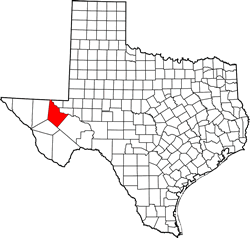
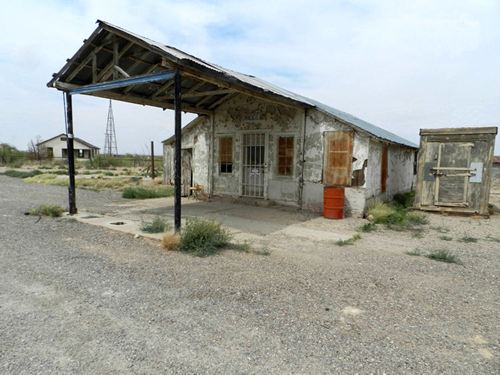
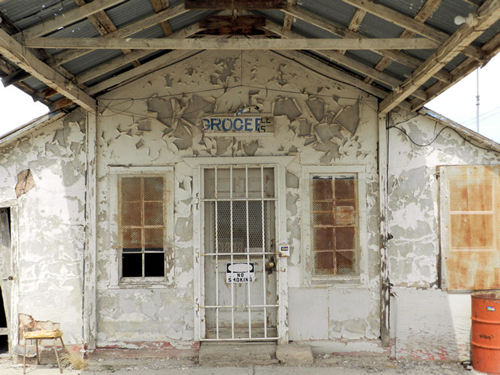
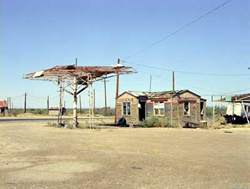
Former Orla
Post Office, TX 79770
Photo
courtesy Barclay
Gibson, May 2012
|
History
in a Pecan Shell
The town was born in 1890 as a section house for the Pecos River Railroad.
Their post office was granted in 1906.
In the 1930s, the population could truly be counted on the fingers
of both hands - that is one still had the full complement of fingers
and thumbs.
Businesses in town doubled during WWII
- to two.
The town continued to swell to 40 and then 60 people.
In the mid-1960s Orla was an established oil supply center and the
population reached its zenith of 250 Orlanites.
The population decreased to slightly under 200 from 1970 through 1990.
(See Reader's Forum below)
It remains an equipment shipping point.
Orla, Texas Update
"I regret to inform you that everything pictured here has been
leveled in favor of modern development." - Oldcar Trader, October
26, 2019 |
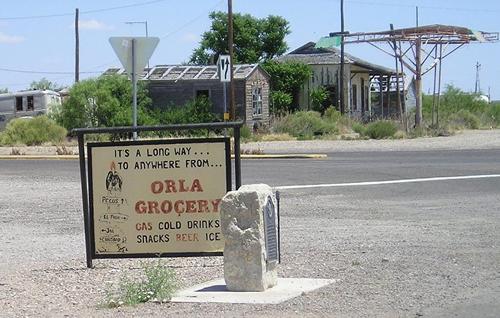
It's
a long way to anywhere from...
Photo courtesy Sarah
Reveley, 2007 |
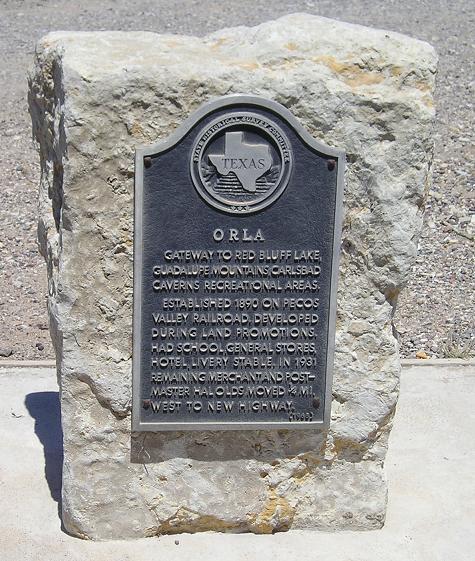
Orla Historical
Marker
ORLA
Gateway to Red
Bluff Lake, Guadalupe Mountains, Carlsbad Caverns recreational areas.
Established 1890 on Pecos Valley Railroad. Developed during land promotions.
Had school, general stores, hotel, livery stable. In 1931 remaining
merchant and postmaster Hal Old moved 1/4 miles west to new highway.
|
Orla historical
marker on US 285
Photo courtesy Sarah
Reveley, 2007 |
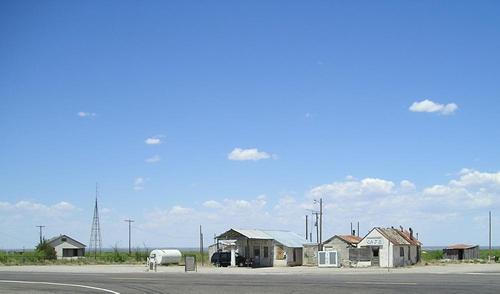
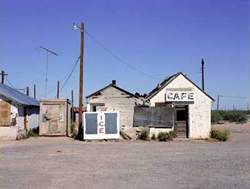
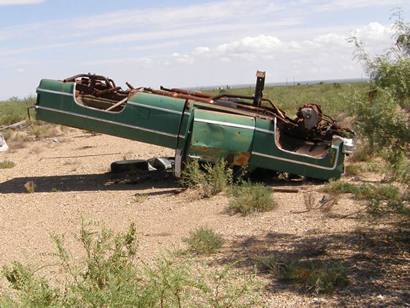
Cafe in Orla
Photo courtesy Rob Hann, 2003 |
 |
 |
Orla, Texas
Forum:
Subject:
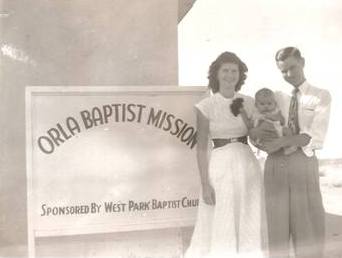
Orla Baptist Mission
James Hughes was pastor of this church in 1953 – pic is of James,
Sallie & Janet Hughes. We would drive out from Pecos
on Sunday morning, and quite often were invited to someone’s home
for lunch and the afternoon instead of driving back to Pecos
and back out for the evening service. We were there when Hall Olds
had the only service station and café. We now live in Conroe, TX
and I retired from Alsay Inc (industrial water well drilling co)
after 20 plus years as comptroller there. I was born and raised
in Pecos – graduating from
Pecos Hi in 1949. - Sallie Hughes, September 12, 2007
Orla Remembrance
and History
I lived in two of the Pasotex Pipeline Oil camps near Orla, Texas
from birth to age 6. The first camp was referred to as the Guadalupe
camp and the other we called the Orla camp. The camp houses were
extremely well built having screened in porches and hardwood floors.
Our yards were outlined by pitted flat rocks. Gentle rolling hills
once covered by an ocean surrounded the camps. Guadalupe Peak could
be seen in the distance, more visible in the evenings.
Some of the families in our community included Jim and Esther Powers,
Lucky and Pauline Cooley (children: Monte, Tishe, & 2 more sisters),
the Dennis family (children: Mike and Jalrea), Bill and Doty Price
(children: Butch and Priscilla), and my parents, Charlie and Mildred
Phillips (children: Sandy & the twins, Chuck & Wally). There were
many more, but I was too young to remember. Many of these individuals
are no longer with us. We lost Monte Cooley to Vietnam around 1967.
He was such a treasure...I've often wondered where he would be today
had that not happened. We used to play marbles together in the sand
and rocks.
There was a little Baptist church in Orla just off the Jal highway
that we attended whenever a preacher was available. My mother played
the piano there. A recent visit found the roof leaking, the double
entry doors standing ajar, old scripture material scattered about,
and a fox living in the back.
As of September 2006, there is a little grocery store sitting back
of the historical marker off Hwy 285 that is currently open and
operated by Bessie Mitchell. I admire her spirit and keeping the
flame for travelers in need. Oil derricks outlined in lights stand
like Christmas trees across the desert from Orla to Kermit.
A controlled burn is being conducted along the nearby Pecos
River as a pilot project to clear the salt cedar. The rationale,
I am told, is to prevent water uptake by the cedar and the clogging
of the river by the trees/plants. The last burn was five years ago.
Although located in a remote, isolated part of Texas,
the area is rich in history. This land near the Pecos
River was traveled by American Indians (later tribes being Apaches
and Comanches), Spanish explorers, and gold-seekers bound for California.
On March 8, 1854 during a survey expedition in search of the best
railroad route to the Pacific, Captain John Pope forded the Pecos
River at the least threatening point. It is situated on the
Loving-Reeves county line one mile south of the Texas-New Mexico
boundary. The crossing, which was eighty feet wide and 2 ˝ feet
deep (Kermit, 1984), became known as Pope’s Crossing. Stages traveling
the Butterfield Overland Mail route used this passage. Later in
1936 when Red Bluff Dam and Reservoir was created on the southern
edge of New Mexico and five miles north of Orla, Texas, the crossing
was inundated. Another piece of history linked to the area was the
Goodnight-Loving cattle trail which extended across the region near
the Pecos River.
Orla sunsets and sunrises are beautiful. Together with my memories
of the desert smell of greasewood and dust, I return periodically
for balance and harmony. - Sandy Phillips Countryman, September
30, 2006
Orla, Texas
Bubba's Bus Route and the Day the Water Tank Fell
I Iived in Orla Texas from 1961 through 1968 until I graduated from
Pecos High School. Life in Orla was made to say the least. Our memories
were good for the time we lived there. At that time, there was much
activity in the area with oil and gas, and later about 1967, a sulphur
boom came along with several exploration companies coming in to
the area. .. more
- Michael E. Beckham, September 16, 2005
|
*Orla,
Texas
I'm one of those internet Yankees who bought some acres of land
in West Texas, located
somewhere just outside of Orla.
My wife and I took a driving vacation, in April, to see if we could
locate a few of my impulse buys, including that one around Orla.
Well, you'd think you could find 87 acres of land but, in West
Texas, t'ain't all that easy. In fact, we never did.
We did stop by the Orla Post Office, which was closed for the day,
and by Miss Bessie's general store. According to a handwritten "Orla's
population today" sign hanging in the post office, Miss Bessie is
half of the town's population. I've never known everybody in a town
before, so we're looking forward to meeting the other fifty percent
of Orla, Texas -- maybe on our next visit. - Alan Koss, August 06,
2005
PS The reason I wrote this is 'cause you guys still carry
Orla's population as it was in 1990, at around 200... Not any more...
It is, to all intents and purposes, getting ready to join your roster
of Texas ghost towns.
My Father worked
for Pasotex Pipeline very near Mentone,
Texas. I went to the school in Mentone. The year I started to
school there were about 4-5 seniors that graduated from there. I
went to the first, second and part of the third grade there. Then,
we had to go to Pecos, Texas
for the rest of my school. I graduated from Pecos,
Texas in 1959. So, I know the school closed long before the
1970's. From Mentone,
Texas, we moved down the road to Orla, Texas. We lived at the
Standard Oil Pump Station called, Orla Station.
Orla had a grocery with a post office in it and a cafe next door.
There was a "motel" but people lived there. There was also a church.
My Father helped get a school bus started from Pecos
for all the Oil company children and ranchers children. When we
first started there were my sister and myself and two other girls
that were sisters. Their Father also worked for an oil company.
When I graduated, there was the biggest bus that they made. I don't
remember how many children were on the bus but it was full. - Rita
Ann (Lee) Wagner, August 28, 2004
|
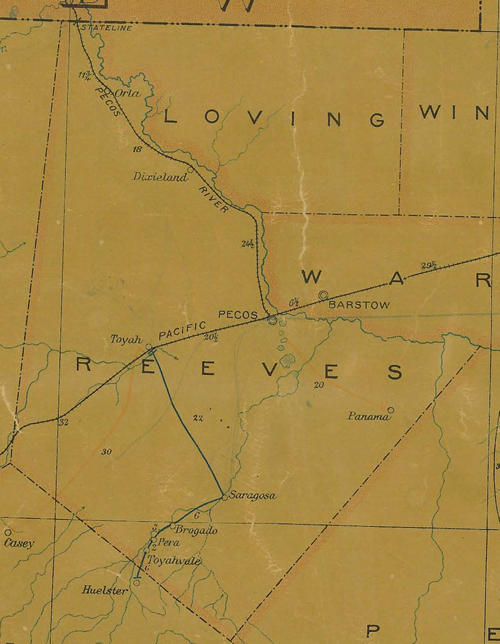 |
The 1907 Reeves
County postal route map showing the relative location of Orla
and ghost town Dixieland
From Texas state map #2090
Courtesy
Texas General Land Office |
| Texas
Escapes, in its purpose to preserve historic, endangered and vanishing
Texas, asks that anyone wishing to share their local history, stories,
landmarks and recent or vintage photos, please contact
us. |
|
|
 HOME
HOME