|
Did
you eat blackeyed peas for good luck on New Year's Day? Did you
do so because it's a 'great ante-bellum Southern tradition?' If
so, congratulations. You have been scammed by one of the most likeable
con-artists in Texas history.
Blackeyed peas have been a Southern staple for centuries, it's true-but
they were a staple food for 'po' folks' and animals. Traveler might
have eaten blackeyed peas in his stall on New Year's Day, but you
can bet they didn't grace the table of Marse Bob and family on that
date. It was not, in fact, until World
War I that blackeyed peas moved out of the sharecropper's shanty
and into the landowner's house. They're a good source of protein,
and what with things like 'Meatless Tuesdays' during the First
World War, they were used primarily as a meat substitute.
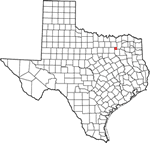
In 1947 a feller named Elmore Torn, Sr. was hired as the flack for
the Henderson County
Chamber of Commerce. You probably won't remember Elmore Sr., but
you might have heard of his son, Elmore Jr. He's an actor better
known as 'Rip'
Torn.
At the time Elmore Sr. was hired on, there wasn't much to promote
in Henderson County.
There was farming-and oil-and farming-and oil-and that was pretty
close to it. There was a pottery manufacturing business, and there
was a cannery. The cannery canned, among other things, blackeyed
peas.
If you open a can of blackeyed peas these days, you've got a reasonably
good product. It's not as good as shelling the peas themselves and
cooking them up with hamhocks and spices in your own kitchen, but
it ain't bad. The same could not be said for canned blackeyed peas
in 1947. When you opened a can what you saw was something that looked
like lumpy, grayish-brown library paste with dark brown spots scattered
in it. What you tasted was, in essence, salty tin. The canning process
picked up the taste of the metal the cans were lined with. In other
words, that stuff was downright awful and it's a miracle anyone
ate it at all.
Elmore Torn, Sr. was tasked with the job of creating a market for
this all-but-inedible mess. He came up with an idea that caught
on so thoroughly people now believe eating blackeyed peas on New
Year's Day for good luck is a long-standing tradition dating to
the ante-bellum South.
Blackeyed
peas, Elmore wrote in a tract he had the Chamber publish, were a
long-standing Southern culinary delight that graced the tables of
high and low society all across the ante-bellum South, particularly
on New Year's Day, when no proper Southern table would be without
them. Eating blackeyed peas on New Year's Day brought good luck.
Yankees, in the hated Reconstruction period, suppressed this fine
old Southern tradition, and it was in danger of being lost. Even
General Lee and President Davis ate blackeyed peas on New Year's
for good luck, and because of that the Yankees tried to stamp out
all memory of this time-honored Southern tradition. It was time
this tradition was revived all across the South. And, of course,
how better to revive it than to serve conveniently-packaged canned
blackeyed peas from Henderson
County, Texas?
Elmore had the Chamber print up several hundred of these fliers.
Then he went to the cannery and had an equal number of 2-ounce cans
of blackeyed peas made up. He sent the scam-and a 2-ounce can of
blackeyed peas from Henderson
County, Texas-to the food editors of every major daily newspaper
in the South. The peas-and the story-hit the food editors' desks
right after Thanksgiving.
At the time, there really wasn't a 'traditional' meal for New Year's.
Thanksgiving-and sometimes Christmas-was turkey, and of course Easter
was ham, the 4th of July and Labor Day were either hot dogs or burgers
cooked outside, but beyond that there weren't any really 'traditional'
holiday foods in the South. Exactly how many food editors bit Elmore's
hook we don't know, but he continued mailing copies of his scam
and the 2-ounce cans of blackeyed peas to food editors across the
south for several more years. Each year more and more food editors
got on the bandwagon. Elmore started the 'tradition,' not of eating
blackeyed peas per se, but the specific 'tradition' of eating blackeyed
peas for good luck on New Year's Day-a 'tradition' which had never
existed before 1947.
He
eventually retired and moved to Williamson
County, where he became known as 'The Sage of Circleville.'
Circleville,
incidentally, is-or was, when I was a youngster chasing cattle on
a little place about 30 miles west of it--a mostly-ghost town at
the intersection of Texas 29 and Texas 95, between Taylor
and Granger. At
the time it had a dancehall frequented by girls from Taylor-not
those girls, the other ones-and Granger,
and an abandoned cotton gin, and that was about all there was to
Circleville.
Elmore was known for insisting that Circleville
was a far more cosmopolitan place than New York City. After all,
almost no one in New York had ever heard of Circleville,
Texas-but might near everyone in Circleville
had heard of New York City at least once.
Elmore's been gone a good many years now, but his 'tradition' continues.
He's where all the good flacks end up, and no doubt he's having
a good laugh over all the 'sophisticated' big-city-newspaper food
editors he conned with that yarn and those 2-ounce cans of blackeyed
peas. And, yep-I'll have blackeyed peas on my table come New Year's
Day. Not because I think they'll bring good luck in the New Year,
but to honor Elmore Torn, Sr.-the guy who parlayed 2-ounce cans
of blackeyed peas and a tale cut from whole cloth into a 'time-honored
Southern tradition.' Besides, I like 'em.
© C.
F. Eckhardt
"Charley Eckhardt's Texas"
January 1, 2007 column
More on Food
Related Topics: People
| Columns | Texas
|
 HOME
HOME