|
MUENSTER:
OLD EUROPE IN FRONTIER TEXAS
by John Hellman
Professor of History, McGill University, Montreal, Canada |
| "[T]here
is no substitute for trying to learn your family's history firsthand,
rather than from books, while the witnesses are still in this world."
|
"Texas: …A place
I surely love
Wide open spaces 'round me
The moon and stars above."
"Blue Yodel #1" Jimmy Rodgers 1
(1897-1933), "the singing brakeman" was the father of American country
music and his blues songs were staples on plains homesteads.
"You boys always remember: you come from hard-working, kind-hearted,
God-fearing people."
Former Marine officer’s parting injunction to
the young cousins “from up North” after a family reunion (Muenster,
Texas) 2
|
* * * * *
Preface
In the 1960s, I discovered an European historian who made me think
about my childhood times with family in Muenster,
Texas. Medievalist Christopher Dawson, an historian of Christian
Culture teaching at Harvard, questioned the common assumption that
history was progressing. 3
A prolific writer, Dawson wrote more than twenty books and numerous
articles on the nature of Christian culture. He considered it his
vocation to explore the cultural role of religion, the relationship
between Christianity and world cultures, and the specific history
and institutions of the Christian religion. As a result of this vast
research, he emphasized the need to recover the spiritual tradition
at the root of the Western European history: "It is the religious
impulse which supplies the cohesive force which unifies a society
and a culture... A society which has lost its religion becomes sooner
or later a society which has lost its culture." Dawson challenged
commonly held assumptions about culture and history, and what he saw
as the Western "religion of progress". This anti-modern medievalist,
a shy and nostalgic Victorian country scholar considered something
of a Catholic apologist, demonstrated a romantic celebration of his
heritage while adamantly rejecting the very notion of Progress.
Although they were hardly conscious of it, there was something peculiarly
medieval about pockets of European culture in America like those scattered
German parish communities who arrived in Texas
(my grandparents as small children) in the late nineteen century,
and eventually prospered on the rolling lands which ran down to the
Red River valley and the Oklahoma border of east
Texas. This European flavour was even more pronounced in my great-grandparents’
original homesteader parishes Lee county, Iowa.
The hard-working God-fearing people of Muenster
Texas in the 1960s did not, for the most part, derive their basic
attitudes toward personal identity, community, love and death, from
reading books. 4
They were not compelled to go off to university to trace the history
of the origins of the modern sense of self in the great texts of Erasmus,
Luther, Calvin, Descartes, Pascal, Voltaire, Rousseau - the "shapers
of the modern mind" 5
. Their own senses of self came from their family backgrounds.
But they did have senses of self which were shaped, at least unconsciously
by a few of the "Great Minds of the Western canon". For many years
the pastor of Muenster's
Sacred Heart Parish was a monk trained at the Swiss-founded Benedictine
monastery of Subiaco, Arkansas, so if the Rule of St. Benedict is
part of mainstream western thinking it figured – at least to some
degree – in their cultural baggage. The monastery in Subiaco, Arkansas
played an important part in the history of Muenster.
Subiaco Abbey, originally called St. Benedict Priory, is a member
of the Swiss-American Congregation (group of monasteries) of the world-wide
Benedictine Confederation. Subiaco was founded by three monks of St.
Meinrad Abbey in Indiana: Fr. Wolfgang Schlumpf, Br. Kaspar Hildesheim
and Br. Hilarin Benetz, and soon "adopted" by the motherhouse of St.
Meinrad, the ancient Abbey of Maria Einsiedeln in Switzerland. In
November, 1877, an offer of land for a new Benedictine foundation
in Arkansas was made to Abbot Martin Marty of St. Meinrad Abbey by
the Little Rock-Fort Smith Railroad Company. The monks of this new
foundation were to minister to the German-Catholic settlers coming
to the western Arkansas River Valley. On March 15, 1878, the three
founding monks arrived in Logan County to begin the new Benedictine
enterprise. Gradually the little community at Subiaco grew as new
members, largely from Switzerland and later from the U.S. came to
help in the work.
When I was a boy, there was something monastic about the attitude
of Muenster people to their silent
spaces, and their obligation to work hard, every day. They would find
it difficult to understand that Voltaire dismissed the great mass
of medieval Europeans as ignorant primitives because, in fact, much
of their mentality remained medieval. My grandmother built a "grotto"
of field stones for a statue of St. Francis of Assisi in her (and
other) family backyards and was proudly matter of fact about her special,
quid pro quo, relationship with him. My father recalled observing
as a boy the stern old pastor coming out from town, during the traditional
Rogation Days, and scattering the ashes from the fronds burned after
the Palm Sunday service in the furthest corners of the property to
protect the coming harvests from plague and drought. 6
To protect themselves from the very real threat of Tornadoes and dust
storms my grandparents, as newlyweds, first built and lodged in a
reinforced concrete Tornado shelter. After their home was built, this
thick-walled structure (which still stands decades after their wooden
home was destroyed by fire) served as a garage. |
* * * * *
Texas
prairie wooden homesteads in east Texas were raised up two stories
from that dry, unfriendly ground with the help of family and neighbors.
The wherewithal could be ordered by catalogue and come to that place,
like the people, on the "Katy" - the M.K.T. (Missouri, Kansas and
Texas) railway – and be nailed together with the help of family, community,
and the community's professional carpenter. According to family lore,
the latter had been gotten drunk in Iowa and awoke to find himself
in a cattle car heading west to a new life. Our family’s lonely outpost,
a long bumpy and dusty ride, out and up, far from the village which
had grown outwards from the M.K.T. train station, seemed like an island
afloat on a vast sea of land. There might have been a sign alongside
that road saying: "civilization ends here". Only one distant windmill
intruded on an empty, wide-open spaced, landscape that extended as
far as the eye could see. The land around the farm, with its prairie
dogs, jackrabbits, rattlesnakes, scorpions, chiggers and the occasional
tarantula or wolf, was not particularly welcoming. Hot nights one
was obliged to sleep on a mattress on the grass in the front lawn,
or the small yard adjoining the breezeway to the summer kitchen, and
suffer bites or rashes as a result. There was a grassy lane, with
a few wind-battered trees, which ran down from the barn through the
land to a creek with a few Spring and Fall waterholes but which mostly
dried up during the punishing summer heat. The large, square, green
moss-lined, water trough for the cattle did not invite bathing.
It was a rough, uncomfortable, but oddly secure place. Was that because
there were very few passers-by, and great visibility in all directions?
Decades later, staying in a quiet farmhouse on the snow swept grounds
of a Trappist monastery in Quebec City, that world of a protective
(and sometimes oppressive) silence, with a substratum of security,
in harsh countryside returned. That community of furtive contemplative
nuns, known for their fabrication of dark chocolates, ranged in age
from fairly young to very old. The Trappist chaplain 7
immensely tall, slow-moving, soft-spoken and gentle, was so was so
much taller than most French Canadians that he reminded me of the
very big Texans of my father’s generation. 8
He, too, was a significant, benevolent, patriarchal presence in that
closed community "outside of time and the world" with whom he shared
vast space and silence.
Life on that vast, unfriendly, and not particularly fertile Texas
plain had been hard but if there were any regrets about leaving the
rich black land and bustling community of St. Paul, Lee County, Iowa
(where they had been proud to have been the first settlers) they were
seldom voiced; in the West, "seldom is heard a discouraging word,
and the skies are not cloudy all day". 9
Women who were pregnant did not allude to their condition until they
could no longer perform their daily chores. "Discouraging words" –
complaining during daily tasks was big city or back-east luxury, which
had no place among these tough, burned-necked, in such arduous, bottom
line, survival conditions. Not complaining of the punishing nature
of Texas weather became a survival technique – unknown to the favored
people who, I later observed, regularly regret the day's weather on
the Cote d'Azur, which has one of the most pleasant climates in the
world. Forty years after he left Texas, my father, a loyal son of
Muenster was obstinately using the "dry-farming" techniques developed
for surviving in the Great American Desert in caring for his verdant
lakeside garden in Wisconsin. While some things did not do very well
(I never remember seeing an artichoke) my niece recalls ‘a crazy excess
of Zucchini’ during Wisconsin summers.
Lee County, Iowa, was, though not regretted for the weather, was fondly
remembered as the place where a family member had been born "the first
white child". (The father had arrived from what was then the kingdom
of Hanover in the Spring of 1836.) 10
They were proud to have been among the first settlers of Lee County,
and sufficiently established so as to have joined their neighbors,
ten years after their arrival, in running off the Mormon settlers
who had just set down in Nauvoo, Illinois, just across the river,
and bought some land in Lee county. The Mormons were resented for
their sectarianism, and their suspect ways (not their polygamy, which
was only a rumor at the time) and the family had helped encourage
Brigham Young and his people to undertake their long exodus to Utah.11
Our own family Western trek to the Promised Land of Texas
was undertaken with children and belongings in rattling, drafty, cattle
cars, one of which had a “dead drunk” carpenter in the back who had
not intention of migrating to Texas.
The land offered by the shrewd and German Catholic Flusche brothers
around Muenster, was a bargain, much
cheaper by the acre, than in Iowa, and a significant part of the parish
left uncles, cousins, and the diminishing supply of free land behind.
Analogous expeditions went off to found German Catholic communities
in places like Hanover, Kansas. They might miss some kin folk back
in Iowa, but by the 1970s the original dirt-floored family homestead
back there was serving as a pigsty and would not survive for much
longer as it was on the ledge of a small quarry. When Nauvoo with
its reconstructed Temple became romantic heritage to the prosperous
Mormons of Utah, the Texans were still too close to subsistance farming
to be nostalgic about Iowa. The quaint St. Paul, Iowa, red brick parish
church, with its gravestones inscribed in German, was picturesque
but since the Texans vaguely believed in a family reunion in the Next
World, they husbanded few of the relics of hard times in this one.
The wide-open spaces proved much drier, and four or five times less
fertile per acre, than the black loam of the Iowa corn belt - and
their utility for farm crops would be exhausted after a couple of
generations of cultivation. But a family adage helped explain why
we had left Iowa: "When you can see your neighbor's windmill he is
getting too damn close". They may also have liked to be out of sight
of the Church steeple of that bossy, self-important “Black Benedictine”
pastor who long ruled the roost in Muenster.
At uncle Arthur or great-uncle Cooney's ranches not even one windmill
was to be seen in the distance, and at night there was only the moon
and stars up above, infinitely vast, grandiose as it is on the Western
plains. When, thanks to Divine Providence or dumb luck, they became
rich from the oil wells drilled on their land they "stayed put". My
great uncle "Cooney", hard-working, shrewd and sharp, drove a thirty
year old car on full day's trip to oversee his vast land-holdings
which ran all the way to the Red River and the Oklahoma border. Said
to be "rolling in dough", he gave the oil rights to his lands to that
same order of Sisters based in Mishawaka, Indiana that his daughter
had joined. He wanted to be left in peace with his wife in that two-bedroom
house, with his old car, on that endless space.12
Uncle Bill, spent his life repairing the fences, watching the calving,
on his own arid ranches in Oklahoma and Arkansas, which could only
be overseen from the air. He took off in his Cessna at dawn each morning
to look after the Herefords, just as his uncle Cooney was setting
off down the lane in his old Ford. For vacations, Bill flew to a trailer
house he had deposited on a wilderness mountain side in Colorado for
hunting season use. As the family prospered and many went off to college,
things changed and a cousin in the younger generation who became a
Doctor in Dallas, even built
a retirement home on the island of Nevis.
Aside from becoming a bit "mental", eccentric and anti-social, what
kept those people in their modest houses on those dusty Texas plains
when they could have afforded more civilized and comfortable, well-appointed
and air-conditioned, lodging in the town, or even the various pleasures
of Fort Worth or Dallas?
Moving to Fort Worth
or Dallas was not easy because
of close family and community ties. Courting the young of neighboring,
rival towns like Gainesville or
St. Jo was not easy when
those people would shout "Beat the little Hitlers" at football games.
Young people "courted" in a local culture overseen by Benedictine
priests and nuns, often married their first love by their late teens
or by their early twenties. "Living together", having children outside
of wedlock was (and remains?) unthinkable. There were many children,
and grandchildren by the time people were in their forties and this
could make moving away even more difficult.
Another factor was that land. It seems they could not do without it.
The vast Texas sky changes all day and
impresses at night: it is a shifting, sometimes ominous presence,
like the sea. The presence of land is, in contrast, ruder, smelled
and heard: the ominous rattle of snakes sunning on piles of stone
gathered from the fields, the scurrying of the deadly tarantulas,
the baying of coyotes, wolves and the nervous bounding of jackrabbits;
the smells of mesquite, cattle manure, dust. Tornadoes and dust storms,
not World Wars, haunted family memory. The stars were what commanded
respectful contemplation, even a poetic response, from those people.
The second stanza of the classic about living on the prairie says:
How often at night when the heavens are bright
With the light from the glittering stars
Have I stood there amazed and asked as I gazed
If their glory exceeds that of ours.
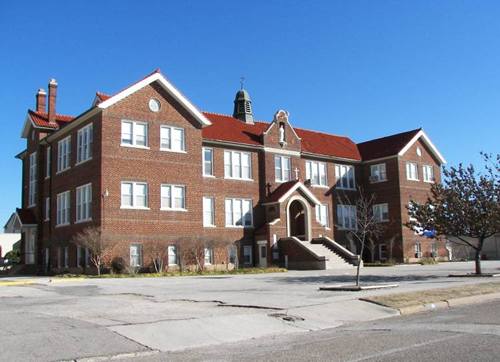
What passed for "our" glory in that village - the Sacred Heart Parish
School and its neighboring cemetery - memory places built (unlike
the clumsily modernized parish church) in imitation of those remembered
from Europe, such as the ancient Swiss abbey of Maria Einsedeln. |
 |
|
Texans were
not given to contemplating their grazing land, except perhaps in
Spring, with the particular satisfaction of relatives back in Iowa
at corn harvest time. But the star-spangled night sky became an
overwhelming canopy over an isolated ranch, as it was to me years
later over a monastery's farmhouse on the edge of a snowbound forest
of rural Quebec. The universe was usually obedient, the stars followed
their courses, and Progress seemed mostly a Big City notion. There
was a capital in Austin,
and another, relatively suspect, one in Washington DC. These Texans
passed on traditions from the old continent which were more important
than those which came from Washington. These came from Switzerland,
but also from the firsthand experience of austerity and connection
to land, the perhaps from the way all of that land isolated them
from the influences of modernity, of so-called Progress. From a
variety of community experiences, more than from Philadephia or
Boston, came inherited notions of right and wrong, good and the
bad. And there were occasional renewing of ties with Europe, far
more than with Yankee New England, often because of the enduring
ties of the orders of monks and nuns with their founding houses
on the old continent.
Sister Theresina, who had come as a young Benedictine nun from the
Swiss alpine village Sankt Johann to teach the sons and daughters
of plains' farmers in the new world, was a respected figure in her
square wimple, and brown and white habit. She was something of an
intellectual and told my grandparents that the brightest Muenster
children, such as my father, should be sent off on the M.K.T. to
the Jesuit boarding school in St. Mary's Kansas. After a half-century
of service the parishioners took up a collection to send her to
see her mountains for a last time. My grandmother went along as
chaperone. Theresina's old brother cried when they met at the Zurich
train station, but on her return to Texas
she claimed to have been disappointed by her homecoming, since the
Swiss had built up too high into those mountain pastures she had
remembered as pure and unsullied when she was a girl. She shared
with her adopted kinsfolk a suspicion of skylines cluttered with
windmills,
much less skyscrapers. She now lies out in flat Sacred Heart Cemetery
alongside her old students with no new constructions blocking her
view.
A Texas homestead could be a stable,
solid, reassuring turf on which to alight. When , as a child, I
was deposited "out there" for a vacation I felt safe, and that I
"came from good people", who worked hard, paid their bills and didn't
need locks on their doors. It had something of a Robinson Crusoe
island to it, with makeshift gadgets of all sorts (“necessity is
the mother of invention”) and vestiges carried out from the mainland.
The upstairs southwest bedroom, however, was locked as it was there
great-aunt Mary had been kept for decades to keep her from running
off into the fields. Mary was there because of a deal which had
been brokered in the early days of my grandmother’s marriage (after
she, at 17, had chosen one of the only two geographically possible
suitors). At their mother's deathbed, my grandmother and her younger
sister promised to take care of Mary, six months with one and then
six months with the other, for the rest of her life. My cousin thinks
a cash payment of $1500 was involved but our grandmother claimed
that they had been promised that, in return for their caregiving,
St. Francis of Assisi would come through for them in hard times.
According to my sharp-eyed grandmother it had been a fair deal,
Francis had always kept his side of the bargain. Mary had been allowed
downstairs for years – until one day, being teased by her nephews,
she ran after them with a kitchen knife. She had also tried to run
away a couple of times but passers-by brought her home.
As Mary liked little boys they would bring her her dinner on a deep-bowled
metal plate, just like that kept for the dog outside the summer
kitchen door. When “Grandpa Gus” , the lanky patriarch, unlocked
the door, she would greet him respectfully ("Good evening Mr. Hellman")
and the visiting child from back East would be left in her bare-floored
room, with its torn wall paper, damaged plaster, chamber pot, odd,
unpleasant smells, and stark metal-frame bed over against the wall.
She was toothless, my grandmother said, because “when a tooth gave
her trouble, she just pulled it out”. Mary told me that the patriarch
was a very good man but that her own "damn shitting” sister was
a lousy cook. In fact when she didn't like the food she would hurled
it across the room, but never in front of me, to whom she would
show her piles of cardboard boxes full of pictures. With her blunted
scissors she would spend the days cutting pictures of handsome young
men, especially those clean-shaven and with cowboy hats, from Life
magazines and stashing them away in cardboard boxes in her closet.
It was probably a better life than it would have been in a Texas
mental institution of those days.
The exact spot on which the farm was built on all that rolling land
was chosen not for view, or for shade or wind cover, but by the
local water diviner with his special gift, and that wavering and
Y shaped-crooked stick which invisible forces pulled down with a
sudden, irresistible jolt. The house was built on that spot but
"square with the world" - i.e. with a compass making certain that
its four walls were facing exactly South, North, East, and West.
These factors would situate and orient my father's hand-built lakeside
cottage in Wisconsin, despite the fact that the “squaring with world”
did not necessarily provide the best picture window vistas for a
particular lakeside setting. This conformity to a law of the universe
was passed on from generation to generation in much the same way
that old churches in Europe were situated so that the first morning
offering of the Holy Sacrifice be offered facing the rising sun.
Our entire Wisconsin house was built completely by hand, in what
was then (a rather benign) wilderness, with the help of my Texan
grandparents who come up to visit in the summer, leaving their farm
in the care of my uncle Arthur. The Wisconsin electric power company
was surprised to be summoned to attach a meter on a handyman's fait
accompli. My father had kept up the family tradition of building
his own house, and he imported parts of Texas to Wisconsin – notably
the obsolete pump organ from the parish church. Once a year my grandmother
would go down to the Muenster M.K.T. Station and send a Christmas
package: pecan powder sugared cookies in metal tins, sacks of pecans
from the along the creek below the farm, and, when I was of age,
some serious M-80 firecrackers (said to be used for training the
military and strictly illegal in Wisconsin), having wrapped the
whole in the rag rugs she had braided.
There was something special about building your own roof over your
head, and never once calling in a professional to fix or help maintain
it. Many years later my father returned from his father’s funeral
with the paint-spattered old claw hammer that had hung outside in
the barn. By then my father had begun to get cranky at the progress
of urbanization around the Wisconsin homestead, and the mansionizing
of some of the old fishing shacks on the lake shore. Texas Hereford
ranchers like my grandfather carried serious carbines alongside
their drivers' seats in their cars (for coyotes or wolves surprised
lurking around sheep or cattle) as well as for self defense. One
night a shot was fired out of the dark at my uncle Arthur's tires
as he was returning from a heated school board meeting, and cousin
Jimmy “blew the head off a damn fool” who was trying to rob his
gas station. My father kept a small “varmint gun” (22) in the Wisconsin
broom closet, and a shotgun for the ducks and geese he eventually
stopped shooting at and began to tame and feed. Muenster was not
like living in a cowboy movie but in the high-sided claw-footed
bathtub, where a Yankee child might have felt safest, one had to
be wary of scorpions scurrying up out of the drain. Still, my father
had great difficulty facing the fact that Wisconsin was, and would
inexorably become, a much more domesticated and tamer place.
Although it hardly seemed so to the naked eye, our isolated Texas
place was part of a closely knit community. When great aunt Mary
died in her seventies, and the death knell was heard out on the
ranches, few of those who picked up the telephone party-line for
the news remembered that girl who been taken to Church as a child
but then lived as an invisible neighbor all those years. As I discovered
when I returned for a visit many years later she is buried with
a conventional grave in the Sacred Heart Church cemetery, a flat
well-cut field, alongside the Church, where stones, much the same
size, are lined up in obedient rows, as in an Iowa cornfield.13
Nearby is a stone for Great Uncle Herman, blown to bits years ago
at 22, when he tripped carrying a box of dynamite clearing stumps
from a pasture; my grandmother and her sisters had gathered his
"beautiful curls" off the field for several yards in all directions.
Mary was near Grandpa Gus who had sheltered her - a bit like poor
Anne De Gaulle alongside her famous General father in the churchyard
at Colombey les deux eglises in France. Sister Theresina was with
the Benedictines, not so far away. On a previous visit, our host,
great Aunt Fritz, was proud to show off her own grave, birth date
already inscribed, alongside that of her bounty hunter husband Joe
who had already passed on to the next life. Often absent on long
trips, he would return to town with a sack full of wolves ears to
be exchanged to the authorities of the State of Texas for hard currency.
A great shot, he "never did a real day's work in his life" but was
much appreciated by kin folk for supplying them with quail when
they were in season. Fritz had supplemented the bounty money to
raise five kids by cooking for weddings and suppers in the parish
church, and – as she showed my wife and I on the tour of the dead
kinfolk - was proud that her tombstone was every bit as nice as
her sister’s, who had had it easier. She asked if we wouldn't send
her a pair of French Eiffel Towers from Montreal for her huge salt
and pepper shaker collection.
What did the pioneer Texas generation pass on to those grandchildren
and great-grandchildren, who seem, at least at first glance, pretty
much like other small town people in the southwestern United States?
Now things are easier as Muenster
is visibly prosperous (in contrast to Protestant neighbors Gainesville
or St. Jo) and even
the John Deeres are air-conditioned. For better, or for worse, the
pioneers' senses of self and community seemed, in certain important
life events, to have remained quite different from those usually
described as "modern", or as those of the great authors of the canon,
(names not always household words in Texas).
The autocratic Benedictine pastors are gone, but after spending
long years working in oil fields on the other end of the earth,
sons of Muenster come home to die
and then lie among kinfolk in the Sacred Heart cemetery where their
stories can be told to visitors. The sense of self of the pioneers'
descendants, wherever they have lived and whatever their religious
or political ideas, seemed indelibly marked by the memories of “their
people” … at least as much as by the values of the so-called American
"melting pot".
When I studied in graduate school with the most celebrated of American
historians, I discovered they knew little, of anything, about the
history of the people I came from and were devoid of curiosity about
them. I took my grandmother to visit the precious antique dormitories
which had housed the Puritan seminarians in the Harvard Yard but
she was unimpressed, finding them rather dour: “Why did they make
all the windows the same size?” She would have preferred to visit
a working farm in the Berkshires rather than the sacred memory places
at Faneuil Hall, Bunker Hill, Lexington or Concord. Since then we
have been gifted with the novels and essays of people like Muenster's
neighbor Larry McMurtry, who have helped give a richer and broader
view of Texas, and of the United States,
to a wider world. But there is no substitute for trying to learn
your family's history firsthand, rather than from books, while the
witnesses are still in this world.
© John Hellman
March
3, 2011 guest column
|
* * * * *
Footnotes:
1 Jimmy Rodger (1897-1933) "His is the music of America. He sang
the songs of the people he loved, of a young nation growing strong.
His was an America of glistening rails, thundering boxcars, and rain-swept
night, of lonesome prairies, great mountains and a high blue sky.
He sang of the bayous and the cornfields, the wheated plains, of the
little towns, the cities, and of the winding rivers of America."
-inscription on the Jimmy Rodgers' statue in his birthplace, Meridian,
Mississippi.
Rodgers represented the music of America to isolated people like my
grandparents who knew little of Jazz, George Gershwin, or much of
the other music which New Yorkers remember as "the music of America"
of that time.
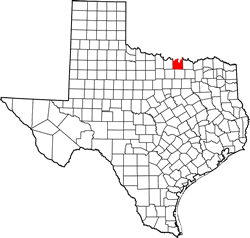
2 Muenster, "Sausage Capital of North Texas", is a village
of 1,556, in Cooke County, East Texas. "Where Texas customs and German
hospitality meet. Home to three major sausage makers, and a celebrated
cheese plant founded by my family. “Known for good food and small
town atmosphere, Muenster hosts German fest, the annual celebration
of spring. It is also home to the Red River Motorcycle Park, boasting
more than 2,500 acres of riding trails." The Muenster Museum is established
in the heritage home of Ben Hellman, first Burgermeister and
elected mayor of the city.” (Cf. State of Texas Department of Agriculture
website).
3 Christopher Henry Dawson (1889-1970), British sociologist
and historian of culture, has been called “the greatest English-speaking
Catholic historian of the twentieth century” and was named the first
Stillman Professor of Catholic Studies at Harvard. Despite this, most
of his books have been out of print for decades, and younger historians
today are ignorant of his work. My first article "Christopher Dawson
and Eastern Europe", The Ukrainian Quarterly, XX, 3, Autumn, 1964,
described his distinct world-historical perspective, as does "Christopher
Dawson, the New Theology, and Harvard in the 1960s", The Christopher
Dawson Newsletter, Summer, 1999, 1-6
4 See, for example, Charles Taylor, Sources of the self
: the making of the modern identity (Cambridge, Mass. : Harvard
University Press, 1989). Charles Taylor's personal sense of self,
when he wrote this book, was distinctively Western and Christian.
5 See Crane Brinton's The Shaping of the Modern Mind (New
York: Prentice Hall, 1950) which was sold in paper back for 50 cents
in drugstores across North America at a time when books by Harvard
History professors were sold in such places. It was the second half
of his Ideas and Men and an important text for courses in European
Intellectual History which flourished in American universities at
the time. It helped establish the idea that there was a canon of great
books which were important in the origins and evolution of Western
Civilization. Brinton implied that Voltaire, his hero, was the epitome
of Enlightenment, and hence of Western Civilization itself. He disdained
what he called "mysticisms" and "irrationalisms" in their varous forms,
particularly religious. He seemed to be reassured by the prospect
that “religion” would disappear in his life time. Those trained by
him, or by Marxists, were not prepared for the various religious revivals
which succeeded the 1960s
6 Rogation Days were days set aside, before the reforms of
the Second Vatican Council, to observe a change in the seasons, tied
to the spring planting. There are four Rogation Days: the Major Rogation,
which falls on April 25, and three Minor Rogations, which are held
on the Monday, Tuesday, and Wednesday immediately before Ascension
Thursday. According to the Catholic Encyclopedia , Rogation Days are
"Days of prayer, and formerly also of fasting, instituted by the Church
to appease God's anger at man's transgressions, to ask protection
in calamities, and to obtain a good and bountiful harvest."
7 Benedict Vanier, OCSO, son of the former Canadian Governor
General General George Vanier. Considered a living saint, Benedict
has served as spiritual advisor to the succession of Canadian Prime
Ministers, most of whom, since and like Pierre Trudeau, have been
serious practicing Catholics (Joe Clark, John Turner, Jean Chretien,
Paul Martin).
8 Now very, very big men are urged to push and elbow one another
on the basketball courts, and for some peculiar reason, particularly
by American Jesuit universities.
9 From the lyrics of the old staple cowboy song, often sung
in family gatherings. Like other western songs, there is a mystical,
Christian element to it, which was taken seriously.
"Oh, give me a home where the buffalo roam
Where the deer and the antelope play
Where seldom is heard a discouraging word
And the skies are not cloudy all day
Home, home on the range
Where the deer and the antelope play
Where seldom is heard a discouraging word
And the skies are not cloudy all day
How often at night when the heavens are bright
With the light from the glittering stars
Have I stood there amazed and asked as I gazed
If their glory exceeds that of ours"
10 According to old Iowa newspapers which have been put online,
Bennett Hellman, son of G.H. Hellman, arrived from Hannover in 1836
and claimed to have fathered the first white child in the county.
For some reason my own grandfather was also named G.H.Hellman, but
never seemed to know the reason why. When asked about the dearth of
family documents, they would always reply that several houses with
family papers had burned down. In any case, these people were illiterate
until my grandparents generation. My grandmother remembered her own
father "able to calculate the number and prices of farm animals being
sold at an auction faster than anyone else" but was obliged to sign
his name with an X". Illiteracy was never confused with stupidity
in their world.
11 Brigham Young, who gained control of Nauvoo after the departure
of Joseph Smith and a succession crisis, established what were
known as "whittling and whistling brigades." These vigilantes were
made up of Mormon men and boys who "whistled" while "whittling" with
large knives that they held close to any non-Mormons who dared enter
Nauvoo. According to one witness:
"The process of whittling out an officer was as follows: A great tall
man by the name of [Hosea] Stout was the captain of the Whittling
society, and he had about a dozen assistants. They all had great bowie
knives and would get a long piece of pine board and get up close to
the officer and pretend to be cutting the pine board, but would cut
over it and cut near the officer. In the meantime, small boys would
get tin pans, old bells and all sorts of things to make a noise with
and surround the officer. No one would touch or say a word to him,
but the noise drowned all that he would say".[10]
By the end of 1845 it became clear that no peace was possible, and
Mormon leaders negotiated a truce so that the Latter Day Saints could
prepare to abandon the city. The winter of 1845-46 saw the enormous
preparations for the Mormon Exodus across the Great Plains.
In early 1846, the majority of the Latter Day Saints emptied the city.
After the departure of the Mormons, their great temple stood empty
until destroyed by arsonists on November 19, 1848. More recently,
the Latter Day Saints have erected a museum and memorial in Nauvoo.
Members of my own family, when we visited in the 1970s, was using
the dirt-floored family homestead as a pigsty and it was on the ledge
of a quarry. Nauvoo was romantic heritage to the wealthy Mormons of
Utah, but my relatives were still too close to substance farming to
be romantic about it. They were proud, however, of the lovely red
brick Church in St. Paul, Iowa, with its gravestones inscribed in
German. Since they firmly believed in a family reunion in the Next
World, they did not see the point in husbanding the relics of hard
times in this.
12 A mysterious, apparently well off, family named the Medders
moved just outside the village “out of the blue” when that oil was
discovered, claiming to be of German Catholic background looking for
a rooted community of their like. These “toe-kissing Catholics" built
a palatial mansion, and soon fortune of the sisters of charity of
Indiana had disappeared. They left town but their grandiose white
ranch-mansion just outside of town was said to have served as the
set for episodes of the famous JR Television series.
13 When we were given another tour, years later, by cousin
Carole Ann, she gave us tiny flags to plant at each grave we visited.
It was like the Jewish custom of leaving a pebble on a visited tombstone. |
| Texas
Escapes, in its purpose to preserve historic, endangered and vanishing
Texas, asks that anyone wishing to share their local history, stories,
landmarks and recent or vintage photos, please contact
us. |
|
|
 HOME
HOME