|
|
 |
Old Moulton:
The Queen of the Prairies
by Murray
Montgomery
In his book, The History of Lavaca County, well-known local
historian Paul C. Boethel has several pages describing some of the
towns in the county,
including a location known for years as Old Moulton.
Boethel wrote that Moulton was founded before 1860 and probably sometime
during the late 1850s. He also indicated that the origin of the town’s
name was in doubt, with most of the early pioneers saying that the
place was named for an old town in the States possibly located in
Kentucky or Alabama; the latter being the most likely because it still
had a town by that name.
Evidently the mystery as to how the town came to be called Moulton
was never really solved. In the old days there were differing opinions
on the name selection. Some folks said it was named for E.L. Moulton,
a pioneer settler in the area, and there were those who said it was
named by a visitor who said the live oak motts were so prevalent in
the region that it should be named after them – perhaps the word “mott”
eventually became Moulton, no one knows for sure.
Sometime before 1860, the town acquired the name “The Queen of
the Prairies” because of its location in what was considered a
rich prairie-land section of the county.
In 1855 the Moulton post office opened and a private school operated
out of a log cabin about the same time. In the 1860s school was also
taught in an old Christian church.
Boethel said that the town didn’t make any great progress until 1874
when Professor M.H. Allis located his school there. “The school flourished
under his excellent management and direction and won state-wide recognition
for the settlement,” wrote Boethel. In 1875 the community had a church,
a wagon and blacksmith shop, several stores, and an Odd Fellows Hall.
This was Moulton up until the late 1880s – known today as Old
Moulton.
Then in 1887 the San Antonio and Aransas Pass Railroad was constructed
from Yoakum to Waco
with the rails passing within two miles of the town and school. This
greatly enhanced the economy of the community and when the railroad
built a station, named Topeka, the old town gradually moved
to its present location near the tracks.
Moulton
When most of the citizens left the old town for the new location,
the station inherited the name, post office and business of Old Moulton.
According to “The Handbook of Texas Online,” by the late 1890s the
old site was pretty much abandoned – the community around the railroad
station was now Moulton.
During the 1890s significant numbers of Czechs and Germans settled
in the community, and by 1896 the town had an estimated 550 citizens,
a Catholic church, a public school, a hotel, cotton gins, and gristmills.
By 1900 Moulton reached a population
of 733, and by 1914 the town had both Lutheran and Catholic churches,
a bank, an opera house, telephone service and a weekly newspaper.
Since 1970 the population of Moulton
has remained consistent at around 900. The census of 2000 showed the
number of inhabitants at 944. The largest number of people living
in the city occurred in 1980 when there were 1,009 residents.
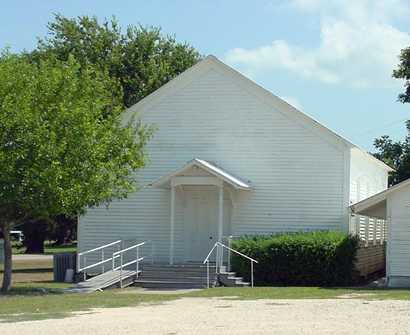
Not much remains of Old Moulton these days. The historic Baptist
church being the predominate structure which has survived the
years of change. Down the road is the old cemetery, with its hallowed
ground containing the remains of early pioneers – some who were involved
in the Texas Revolution.
Founded in the 1850s, the place once known as “The Queen of the Prairies”
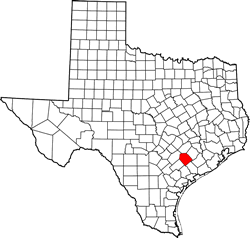
is one of the oldest settlements in Lavaca
County and was a noteworthy contributor to the rich history of
this area.
© Murray
Montgomery
Lone
Star Diary column |
|
|
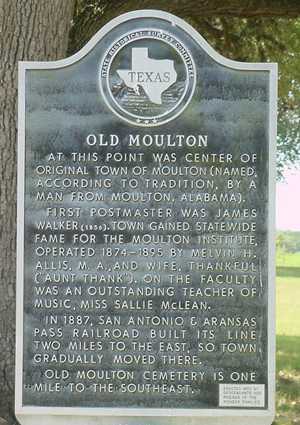
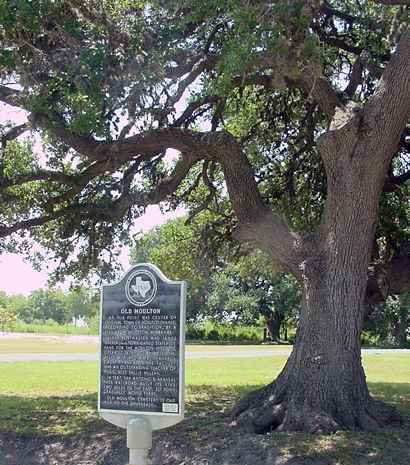
Old
Moulton Historical Marker
TE photo, August 2005 |
Historical Marker:
Old Moulton
At this point was
center of original town of Moulton
(named, according to tradition, by a man from Moulton, Alabama).
First postmaster was James Walker (1856). Town gained statewide fame
for the Moulton Institute operated 1874-1895 by Melvin H. Allis, M.
A., and wife, Thankful ("Aunt Thank"). On the faculty was an outstanding
teacher of music, Miss Sallie McLean.
In 1887, San Antonio and Aransas Pass Railroad built its line two
miles to the east, so town gradually moved there.
Old Moulton Cemetery
is one mile to the southeast. |
Old Moulton Baptist
Church
Recorded Texas Historic Landmark
TE photo, August 2005 |
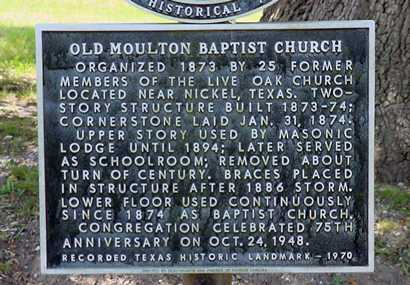
Historical Marker
Old
Moulton Baptist Church
Organized 1873
by 25 former members of the Live Oak Church located near Nickel,
Texas. Two-story structure built 1873-74; cornerstone laid January
31, 1874. Upper story used by Masonic Lodge until 1894; later served
as schoolroom; removed about turn of century. Braces placed in structure
after 1886 storm. Lower floor used continuously since 1874 as Baptist
church. Congregation celebrated 75th anniversary on October 24, 1948.
Recorded Texas Historic Landmark - 1970 |
Old Moulton Baptist
Church Historical Marker
TE photo, August 2005
More Texas Churches |
|
Historical Marker
(On Old Moulton Cemetery Road, 1 mile S of FM 1680)
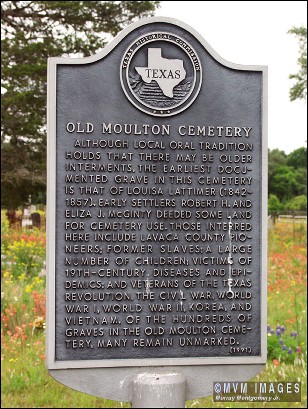
Old
Moulton Cemetery
Although local
oral tradition holds that there may be older interments, the earliest
documented grave in this cemetery is that of Louisa Lattimer (1842-1857).
Early settlers Robert H. and Eliza J. McGinty deeded some land for
cemetery use. Those interred here include Lavaca
County pioneers; former slaves; a large number of children; victims
of 19th-century diseases and epidemics; and veterans of the Texas
Revolution, the Civil War, World
War I, World
War II, Korea, and Vietnam. Of the hundreds of graves in the Old
Moulton Cemetery, many remain unmarked.
1991 |
| Texas
Escapes, in its purpose to preserve historic, endangered and vanishing
Texas, asks that anyone wishing to share their local history, stories,
landmarks and recent or vintage photos, please contact
us. |
|
|
 HOME
HOME

 Texas
Gulf Coast
Texas
Gulf Coast East
Texas
East
Texas Central
Texas North
Central
Texas North Central
Texas South
Central
Texas South Texas
Panhandle
Texas
Panhandle South
Texas
South
Texas Texas
Hill Country
Texas
Hill Country West
Texas
West
Texas Texas
Ghost Towns
Texas
Ghost Towns Texas
Counties
Texas
Counties