|
 |
History in
a Pecan Shell
The town dates
to 1839 when Reese Hughes settled near three mineral-rich springs.
First referred to as Chalybeate Springs, the community that
was to form adopted Mr. Hughes’ name – as did the post office when
it opened in 1847. This initial post office was run by a W.V. Hughes
but only lasted a few years.
In 1876 the East Line and Red River Railroad made Hughes Springs a
stop on its line. The railroad connection allowed people to easily
visit the springs which had gained a word-of-mouth reputation for
curative powers.
In the late 1870s a second post office was established at the slightly
relocated community. By this time the springs had become a popular
health destination for the region.
In the 1850s a furnace for smelting the iron ore was built and during
the Civil War it was made the property of the Confederate government.
After the war, the Federal Government decided that exploiting the
deposits wasn’t worth the cost of transporting coal to fire the furnace.
The lode of iron ore was estimated to be in the hundreds of millions
of tons. In 1912, an offer was made to buy the ore by Bethlehem Steel,
but was turned down by the lease holders.
By the mid 1880s the town had a population of around 300 with most
essential businesses present. It remained at that level (more or less)
for years. The 1920 census reported just over 800 residents and by
the end of that prosperous decade, it had broken the 1,000 mark. After
the stock-market crash, it was reduced to just over 700 by 1933.
The town’s popularity as a resort was diminished but it’s importance
as an agricultural shipping point increased.
During WWII
when iron ore was important to the war effort, the Lone Star Steel
Plant opened ten miles away in neighboring Morris
County. Hughes Springs finally benefited from collateral industries
from the plant, one of which was a plant for producing road-building
material from the steel plant’s byproducts.
In the 1940s, the area population doubled from 767 to over 1,400.
It reached 1,823 by the 1960s census – with jobs still being supplied
by the steel mill. |
 |
Historical Marker
Town of Hughes
Springs
Founded by Reece
Hughes (1811-1893), who settled in Texas, 1839. In 1841 he married
Elizabeth Rose, daughter of patriot Wm. Pinckney Rose. Her dowry enabled
him to start a great plantation. After her death in 1853, he wed her
sister, Mrs. J. w. Scott. In 1847 Reece Hughes founded the town of
Hughes Springs at a famous chalybeate
(iron salt-bearing) spring. It prospered for some years, becoming
the site of a large boarding school and a favored place for church
camp meetings, but later it declined. In 1878, Hughes' descendants
founded present Hughes Springs.
1969 |
Hughes
Springs First Baptist Church
Photo courtesy Gerald
Massey, June 2010 |
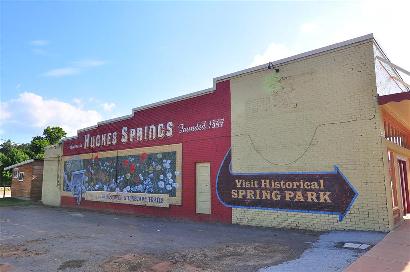
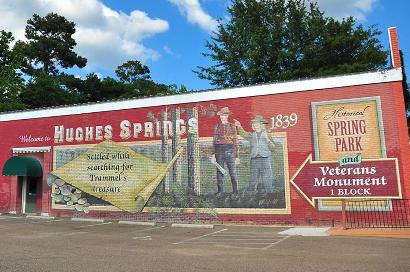
Hughes
Springs Wildflower Trail Mural
Photo courtesy Gerald
Massey, June 2010 |
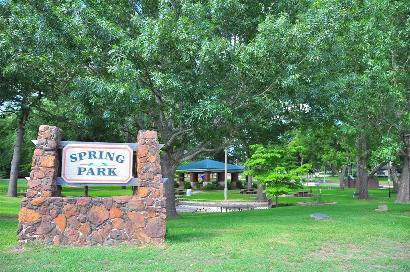
Historical Marker
- Spring Park, 3rd St.
Chalybeate
Springs
(Pronounced "KA
LIB E ATE)
Discovered in 1839 by brothers Reece and Robert Hughes (from Alabama)
while looking for pirate gold. Springs derive name from iron salts
in water. In 1847 Reece Hughes (1811-1893), wealthy planter who later
built iron foundry, started the first town of Hughes Springs here.
1969 |
Historical Marker
- Spring Park, 3rd St.
Trammell's
Trace
Entered Cass
County at Epperson's Ferry. Continued south and west in an arc,
passing through Chalybeate Springs (Hughes Springs). This 1813 pioneer
trail originated in St. Louis and linked the "Southwest Trail" with
the King's
Highway to Mexico.
It was laid out by Nicholas Trammell (1780-1852).
1967 |
 |
by Mike Cox
"Texas
Tales" Column
More than 300 miles inland from the Gulf of Mexico, the community
of Hughes Springs owes its existence to a fanciful pirate story and
one man who believed it.
Born in Tennessee and raised in Alabama, Reece Hughes first
saw Texas in 1829 when he crossed the
Sabine
to hunt buffalo.
The expedition proved short-lived.
“This little band of adventurers was soon driven out of Texas by a
much larger force of hostile Indians,” son Howell Rose Hughes wrote
a century later.
Nine years later after his first visit, Texas having wrested its independence
from Mexico, Reece Hughes returned with his younger brother. They
settled in Red River
County, but an intriguing tale Hughes had heard on his first trip
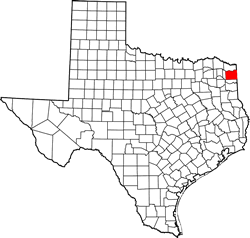
to Texas lured him to what is now Cass
County.
As his son remembered it, “an old sea pirate who bore the name of
Trammel” had buried “a great strong box of gold coins” near an Indian
village on the trail that later bore his name – the Trammell
Trace. Others gilded the legend, claiming Trammel had once been
a member of Jean Laffite’s
not-always-jolly band of saltwater brigands. After Laffite
got run off Galveston Island by the U.S. Navy, the tale continued,
Trammel decamped for St. Louis with his share of the loot. Hounded
by hostile Indians while on the way to Missouri, he buried his treasure
in Northeast Texas.
Hughes and his brother set out to find Trammell’s treasure, following
the trail to an old Indian village along a mineral rich spring-feed
creek in a handsome valley about a mile east of present Hughes Springs.
On March 28, 1839 they pitched a tent and started chopping trees for
a log cabin about a mile from the spring.
“If they ever found the golden treasure for which they were searching
I have no record of it,” Hughes’ son wrote. “But they built their
log cabin, cleared their little farm, and planted a crop of corn and
peas and some garden truck.”
That fall, convinced that in putting down roots in Texas
he had found another kind of treasure, Hughes left his brother in
charge of their farm and rode back to Alabama to bring his father
and other family members to Texas. As
his son later remembered, others “seized with the Texas fever” joined
the party and soon all “began to prosper wonderfully.”
Nicholas Trammell, the reputed pirate who played an unintended
role in the beginning of Hughes Springs... Read
full article
© Mike
Cox |
 |
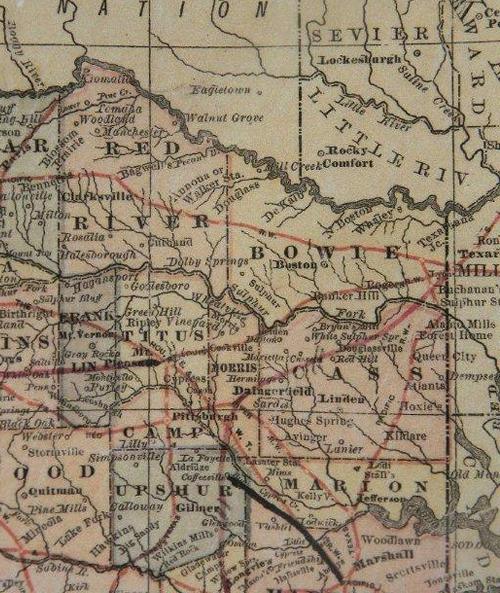
1882 Texas map
showing Hughes Spring in
SW Cass County near
Morris County line
From 1882 Texas state map #2134
Courtesy Texas General Land Office |
| Texas
Escapes, in its purpose to preserve historic, endangered and vanishing
Texas, asks that anyone wishing to share their local history, stories,
landmarks and vintage or recent photos, please contact
us. |
|
|
 HOME
HOME