|
More
than 300 miles inland from the Gulf of Mexico, the community of Hughes
Springs owes its existence to a fanciful pirate story and one
man who believed it.
Born in Tennessee and raised in Alabama, Reece Hughes first
saw Texas in 1829 when he crossed the
Sabine
to hunt buffalo.
The expedition proved short-lived.
“This little band of adventurers was soon driven out of Texas by a
much larger force of hostile Indians,” son Howell Rose Hughes wrote
a century later.
Nine years later after his first visit, Texas having wrested its independence
from Mexico, Reece Hughes returned with his younger brother. They
settled in Red River
County, but an intriguing tale Hughes had heard on his first trip
to Texas lured him to what is now Cass
County.
As his son remembered it, “an old sea pirate who bore the name of
Trammell” had buried “a great stong box of gold coins” near an Indian
village on the trail that later bore his name – the Trammell Trace.
Others gilded the legend, claiming Trammell had once been a member
of Jean Laffite’s not-always-jolly
band of saltwater brigands. After Laffite
got run off Galveston Island by the U.S. Navy, the tale continued,
Trammell decamped for St. Louis with his share of the loot. Hounded
by hostile Indians while on the way to Missouri, he buried his treasure
in Northeast Texas.
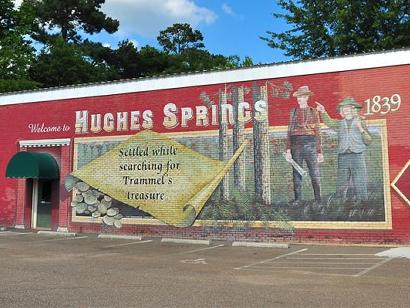
Hughes and his brother set out to find Trammell’s treasure, following
the trail to an old Indian village along a mineral rich spring-feed
creek in a handsome valley about a mile east of present Hughes
Springs. On March 28, 1839 they pitched a tent and started chopping
trees for a log cabin about a mile from the spring. |
 |
“If they ever
found the golden treasure for which they were searching I have no
record of it,” Hughes’ son wrote. “But they built their log cabin,
cleared their little farm, and planted a crop of corn and peas and
some garden truck.”
That fall, convinced that in putting down roots in Texas
he had found another kind of treasure, Hughes left his brother in
charge of their farm and rode back to Alabama to bring his father
and other family members to Texas. As
his son later remembered, others “seized with the Texas fever” joined
the party and soon all “began to prosper wonderfully.”
Nicholas Trammell, the reputed pirate who played an unintended
role in the beginning of Hughes
Springs, certainly would have understood another fellow’s desire
to live prosperously.
A Tennesseean like Hughes, Trammell had migrated westward to Arkansas
as a young man. After working as a French and Indian interpretor for
a time, he settled on the White River and began selling salt. Coming
from a family of traders and trail-blazers, Trammell in 1819 began
cutting a trail from the early-day Texas community of Jonesborough
on the Red River to Nacogdoches.
Soon he relocated to that town in the pine trees along the Camino
Real, the old Spanish road from Louisiana to South
Texas.
While nothing in his still-sketchy biography suggests he ever participated
in piracy on the high seas or buried treasure in East
Texas, Trammell fell a bit short of “Citizen of the Year” status.
As the late artist-historian Jack Jackson pointed out in Trammel’s
“Handbook of Texas” entry, the pathfinder was about as good at finding
trouble as blazing new trails. A fondness for horse racing led to
difficulties over unpaid wagers and Trammell occasionally stood accused
of slave and horse thievery.
After getting caught up in Nacogdoches’
Fredonian
Rebellion in 1826, Trammell thought it expedient to return to
Arkansas. There he operated a tavern and continued as a trader. But,
as Jackson wrote, “His mysterious comings and goings gave rise to
many legends.”
When the Mexican War broke out in 1846, Trammell led 10 companies
of volunteers from Arkansas through Texas to take part in the conflict.
It was about this time that someone referred to him in print as “old
Nick Trammell, notorious highwayman and slave smuggler.”
Jackson theorized that on his way south to Mexico,
Trammell must have passed through the Guadalupe River valley and liked
what he saw. When the war ended and Texas’ status as the 28th U.S.
state had been assured, Trammell moved his family to Gonzales
County and remained until his death in 1856.
About the time Trammell had marched off to war, Hughes – by then a
wealthy planter – founded a town he named after the springs named
for him. Hughes
Springs did well for a time as people came to enjoy the supposed
curative value of the mineral water bubbling up from below, but by
the mid-1870s, its economy wrecked by the Civil War, the pace had
slowed considerably. A new townsite came with the arrival of a rail
line in 1878, but Hughes
Springs has remained just a small, pleasant East
Texas town, a place built on one man’s lust for pirate gold and
another man’s less-than-golden reputation.
© Mike Cox
"Texas Tales"
October
21, 2010 column |
| Books
by Mike Cox - Order Here |
|
|
 HOME
HOME