|
Sabine Town
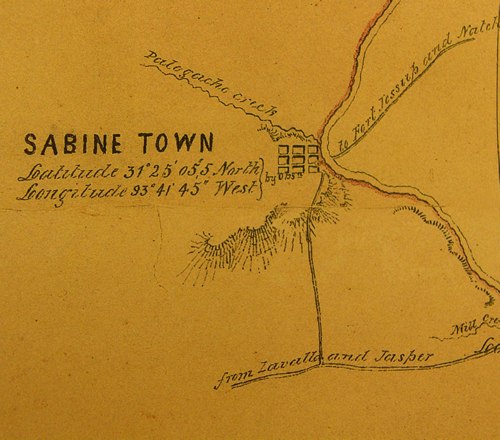
Courtesy Texas General Land Office |
History in
a Pecan Shell
Another once-prosperous
town that depended on river commerce, Sabinetown was located where
Gaucho Creek joined the Sabine
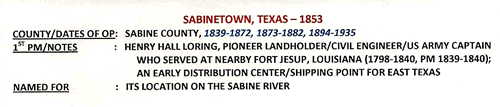
River. The townsite, which had been surveyed in 1839 was built
on land donated by Shadrach Morris.
It soon became a shipping point for cotton
and in addition to primary businesses, Sabinetown had a customs house,
warehouses, a hotel, a clock factory (!) and a trading post for commerce
with the Cherokee Indians.
During the Civil War, Sabinetown was fortified for the inevitable
invasion by the Union Navy, an action that was thwarted by Dick
Dowling and his handful of volunteers at Sabine
Pass.
The town declined with the fall of the Confederacy and the advances
of the railroads
into East Texas slowed
barge traffic considerably. It is said the last paddle-wheeled steamship
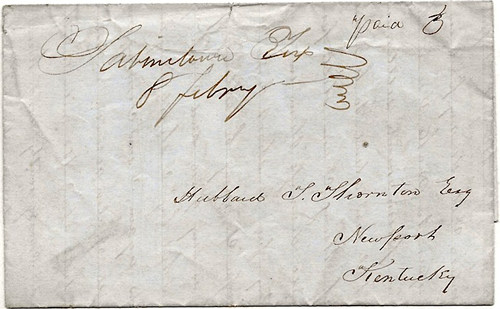
to leave Sabinetown was in the year 1897. Sabinetown’s post office
opened and closed periodically, closing its doors for good during
the Great Depression.
When Toledo
Bend Reservoir was built in the 1960s, nearly all of old Sabinetown
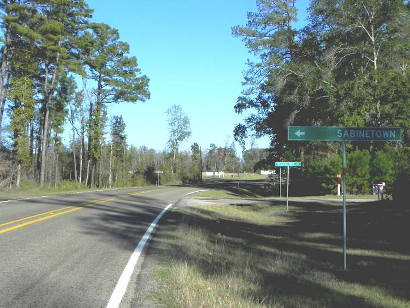
was submerged. Newer communities are found around the older site,
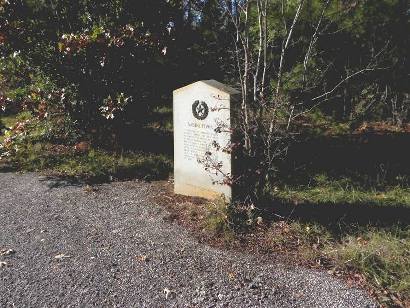
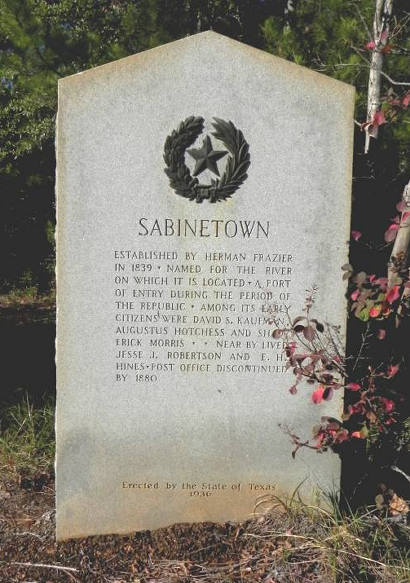
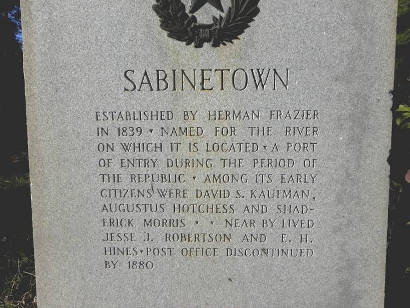
but only the 1936 Centennial
marker stands to serve as a memorial for the historic community.
|
 |
Sabine Town
Cemetery
Historical Marker:
"S. H. Morris sold 200 acres of his land grant in the 1830s for
the establishment of the town of Sabine. Businesses included a post
office, customs house, wagon factory, brick kiln and a tanning yard.
The Sabine Town Cemetery contains 18 known graves; Mary Jane Scott's
is the earliest recorded burial in 1842. The graveyard was in use
until 1907; Harry C. Maunds is the last recorded burial. In 1970 the
James Frederick Gomer Chapter of the Daughters of the Republic of
Texas in Hemphill took over maintenance
of the site.
1997" |
Sabine Town
Chronicles
The
Lady in Blue by Bob Bowman
Mother Maria de Jesus de Agreda, a cloistered abbess who preached
Christianity to the Indians of Mexico and Texas in the 1600s in a
manner known as bi-location....
The last reported appearance of the lady in blue was in the 1840s
when a mysterious young woman wearing a long blue dress came into
the homes of families stricken by a “black tongue” epidemic at old
Sabinetown on
the Sabine River.
She remained in the community for days, brewing a tea from forest
herbs, tending to the ill, weeping over the dead, and never sleeping.
When the epidemic ran its course, she disappeared as mysteriously
as she appeared.
Read full
article |
Sabinetown,
Texas Centennial Marker
|
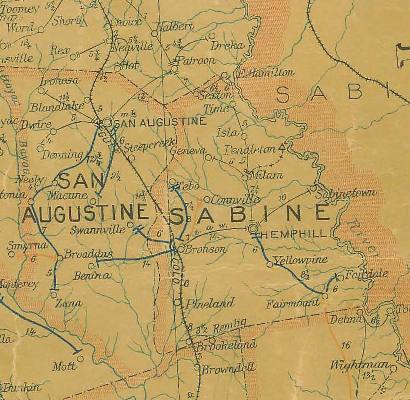
1907 Sabine
County Postal Map showing Sabinetown
(E of Hemphill)
From Texas state map #2090
Courtesy
Texas General Land Office |
| Texas
Escapes, in its purpose to preserve historic, endangered and vanishing
Texas, asks that anyone wishing to share their local history, stories,
landmarks and recent or vintage photos, please contact
us. |
|
|
 HOME
HOME