|
 |
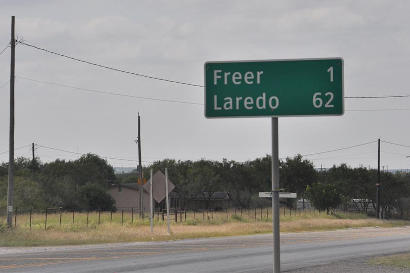
Freer
by Mike
Cox
J. Frank Dobie had an opinion on just about anything.
In 1941, the noted Texas storyteller
and University of Texas faculty member pondered the literature of
two distinctly Texan industries – cattle and oil. “Compared with the
literature and art reflective of cattle,
cowboys, trail driving, horses and other factors of life on the
range,” Dobie wrote in his weekly newspaper column, “the literature
and art reflective of the oil business…are slender.”
For the most part, that’s held up, at least in terms of fiction. The
trail driving era has Larry McMurtry’s Pulitzer Prize-winning “Lonesome
Dove,” but the Texas oil patch has yet
to be the setting for any novel likely to become a classic.
Not that writers have not recognized the romantic in the muddy, greasy,
stinky world of oil production. Three years before Dobie lamented
the literary dry hole of the energy industry, a weekly newspaper in
South Texas was peddling
a little book of oil field verse called “Bell-Bottoms to Boots” by
a sailor-turned-roughneck named Joe “Blackie” Wilson.
Dobie liked poetry, but likely would have dismissed Wilson’s effort
as so much doggerel. Still, the poems have a ring of truth.
In rhyme, Wilson tried to distill life in and around the Duval County
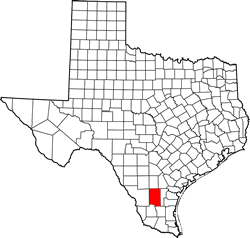
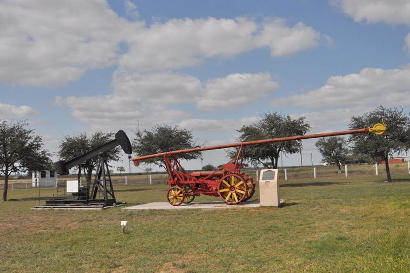
town of Freer, the state’s last truly wild and wooly oil boom town.
The first boom came in the late 1920s, but a second boom that
began in 1932 for all practical purposes suspended the Great
Depression in that part of the state.
C.L. Day started a weekly newspaper, the Freer Enterprise,
as the second boom gathered momentum in 1933. At some point,
“Blackie” Wilson came to the area to work in the fields. Soon he began
submitting poems to the newspaper.
The poems proved to be a popular and Day decided to capitalize on
that.
“Hundreds of subscribers,” he wrote, “have been so well pleased with
‘Rod Tailin’ Blackie’s’ poems that they have preserved them in scrap
books. In order to gratify your desire for a book of poems by your
favorite author, we have gone to considerable trouble and expense
to publish Bell-Bottoms to Boots so that you may be able to
secure your favorite poems bound in a beautiful book, without extra
cost.”
Of course, a person did have to pay $2 for a subscription to the Enterprise
to obtain a “free” copy.
From this distant perspective, it’s hard to imagine that the oil patch
workers spent much time pondering poetry. But they couldn’t work and
raise hell all the time. Nor could the boom that lured them to South
Texas last.
Freer is still on the map, but the boom finally played out. As Wilson
wrote: |
“Well, boys, the boom is over—they’re throwing drunks in jail
“The dealers and the dolls are on the lam.
“If you do any serious drinking be sure to arrange for bail.
“Or you’ll face the morning after in a jam.
“Freer is on her good behavior and will never be the same.
“Remember Borger and Mexia
before the rangers came?
“O somewhere surely there’s another rag town booming
“Where it’s no crime for roughnecks to throw a jag.” |
|
The Freer
Enterprise went out of business in 1972 and these days Wilson’s
book of poetry is as scarce as sissies on a drilling rig.
So what was Wilson’s story? As the title of his book suggests, Wilson
had been a sailor. One of his poems offers strong evidence he was
born and raised around Normangee
in Leon County.
“There is something about an oilfield that always calls you back,
And you can say the same thing of the sea,” he wrote.
“I guess I should be sorry that I listened to their calls,
For the two of them have made a tramp of me.”
The book contains no author’s blurb, but the author hints at further
autobiography in “The Chronic Urge.”
Wilson wrote: “Life gave me a sledge [hammer] when I wanted a pen
And rock when I looked for a rose.
I slaved a while, got drunk on gin
And wrote verses of my woes.”
The booze overrode the muse until, “I begged of Life for a place
in the shade
That I might write.
—And she put me to work with a pick and spade
And gave me a Baptist wife.”
That apparently cured Blackie’s boozing as sure as big-hatted rangers
tamed Freer and the other boom towns.
© Mike Cox
"Texas Tales" -
May 1, 2005 column
|
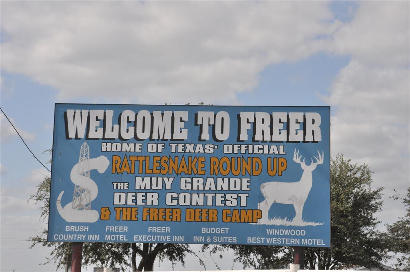
Freer - "Home
of Texas' Official Rattlesnake Round Up"
Photo courtesy Gerald
Massey, 2010 |
Freer, Texas
Forum:
Subject:
Drilling in South Texas
I started working in the oil field in 1972 & did work around Freer.
There used to be a store there that we stopped in after work going
back to Alice.
There were pictures hung on the wall of tents lined up in rows.
After several years of stopping there I asked the owner about the
pictures. His answer was that those pictures were of the oil boom
there In Freer. This reminds me of today, still working in the oil
field around Yorktown,
Kenedy & Three
Rivers. The RV parks & motels are loaded. I once saw a bumper
sticker which said “God give me another boom and I won’t piss it
away”, so I say our prayer has been answered. I hope someone has
kept the pictures from that store, they should be put in a Freer
Museum. Have a good day - Bill Mettlach, September 04, 2014
|
| Texas
Escapes, in its purpose to preserve historic, endangered and vanishing
Texas, asks that anyone wishing to share their local history, stories,
landmarks and recent or vintage photos, please contact
us. |
|
|
 HOME
HOME