|
PLEASANTON,
TEXAS
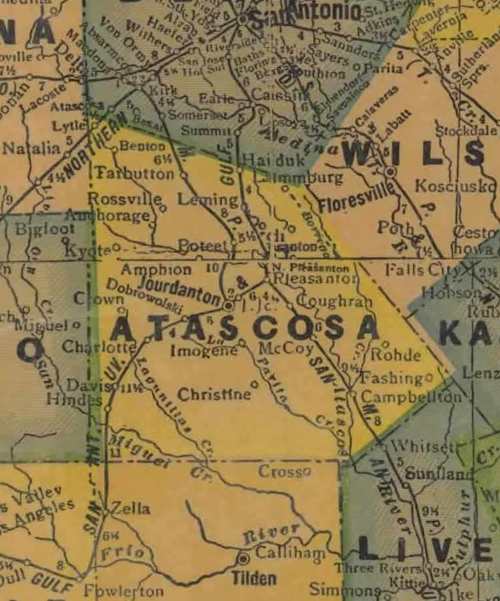
Former Atascosa
County Seat
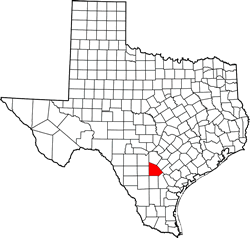
Atascosa County,
South Texas
28°58'1"N 98°29'6"W (28.966953, -98.484937)
US 281, Hwy 97, FMs 476, 5350, and 1334
5 miles E of Jourdanton the county
seat
35 miles S of San Antonio
21 miles SW of Floresville
110 miles SW of Austin
ZIP code 78064
Area code 830
Population: 10,855 Est. (2019)
8,934 (2010) 8,266 (2000) 7,678 (1990)
Book Hotel Here › Pleasanton
Hotels |
 |
History in
a Pecan Shell
Indian troubles
in the late 1850s prompted the establishment of Pleasanton. The town
of Amphion (not 100% confirmed to
have been the Atascosa
county seat) had been formed 9 miles from present-day Pleasanton.
Amphion was bypassed by the railroad
and is today considered to be a ghost
town. John Bowen is credited with naming the community after another
settler named John Pleasant. Bowen generously donated five square
miles of land to form the new town.
In 1861 the population consisted only of a dozen families and the
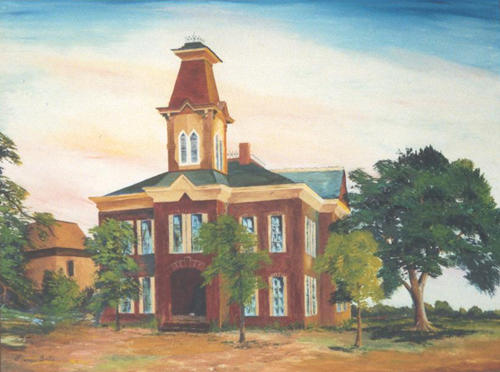
couthouse was a simple log structure. Nine years later a new courthouse
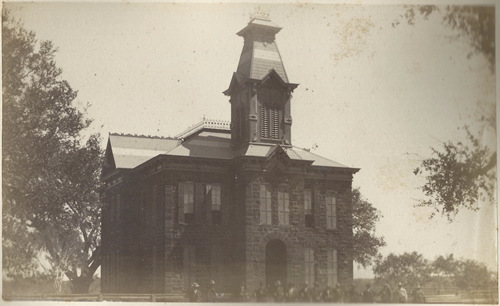
was built and the log courthouse then served as a school. In 1875
the log school was replaced by a stone building. As county seat, Pleasanton
had a bright future. At least it was bright up until 1910 when Jourdanton
became the county seat.
The Missouri Pacific Railroad connected Pleasanton to San
Antonio in 1912 and two years later the town had service to Corpus
Christi.
Pleasanton was thriving with a sizeable population of 1,500 and became
a collection point for cattle herds traveling north to Kansas.
In the mid 1960s the "Cowboy Homecoming" became an annual event
since town promoters considered the city to be "the birthplace of
the cowboy." The festival is held each August.
The population of Pleasanton reached over 6,000 in 1980 and over 8,000
in the mid 1990s.
Book Hotel Here › Pleasanton
Hotels |
 |
|
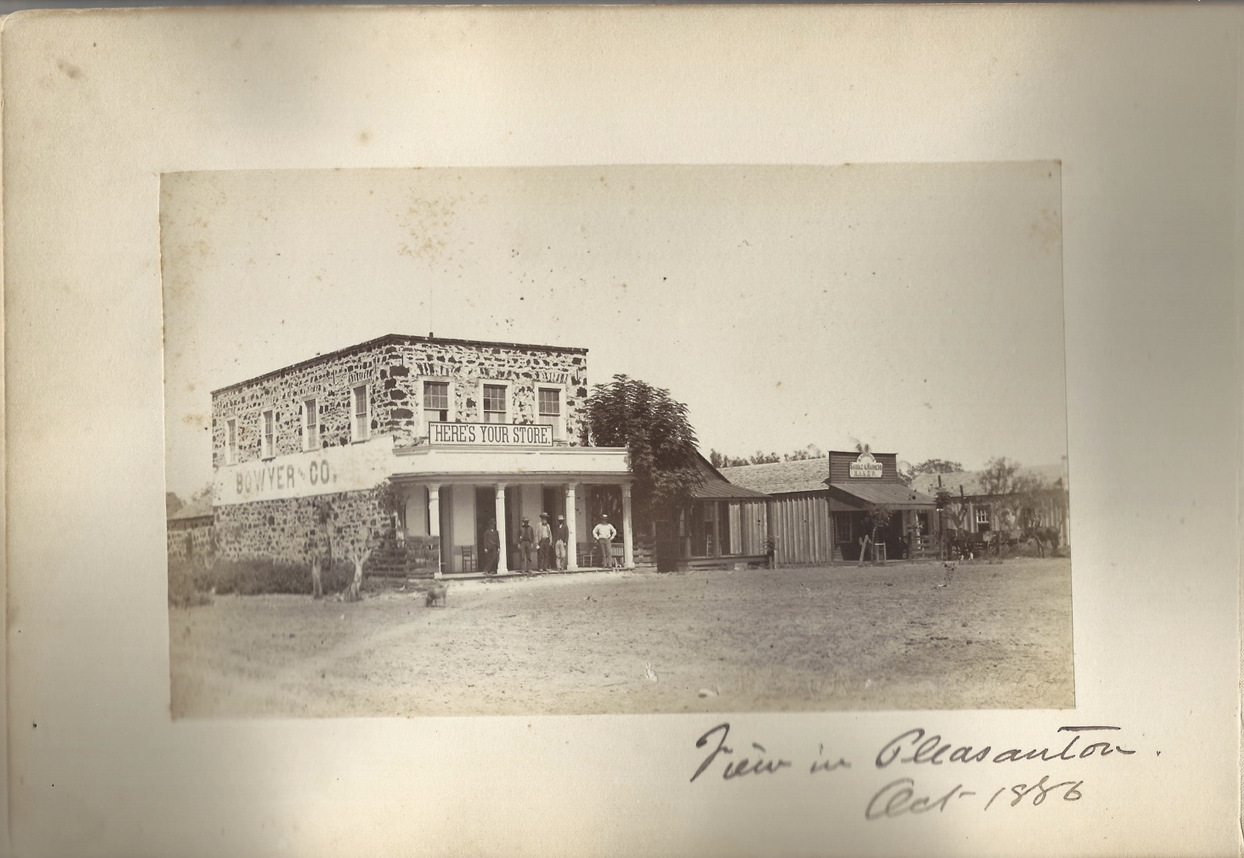
Bowyer &
Co., and H. H. Graham's Saddle & Harness Maker
in Pleasanton
October 1886 photo
Click on photo for large image
Courtesy Malcolm
Jacob Collection
|
 |
Pleasanton,
Texas Chronicles:
Cowboy
Tree by Mike Cox ( "Texas Tales" Column)
Many a Texas town had its hanging tree, an old oak bearing its ugly
legends as well as leaves. But on a more pleasant note, Pleasanton
may be the only place in the state – and the world for that matter
– that had a cowboy tree.
In a way, it’s natural enough that Pleasanton would have such a tree,
unnatural as the combination of the words “cowboy” and “tree” seems
to be. The Atascosa County community south of San Antonio has long
claimed to be the birthplace of the cowboy.
While proving that the very first Texas cowpoke swung into the saddle
in or near Pleasanton would be a bit of a stretch, no one can question
that the cattle business and the men who made it happen played an
important role in Pleasanton’s past.
An historical marker on the city hall square notes that 43,000 head
of Longhorn cattle passed through Pleasanton during the first three
months of 1873.
Located on the old El Camino Real at an easy crossing of the Atascosa
River, Pleasanton had long been a transportation crossroads. When
profit-minded Texans began pushing Longhorns up from the South Texas
brush country to the railhead in Kansas in the early 1870s, Pleasanton
made a convenient stopping place on what became known as the Chisholm
Trail.
The Stock Raiser Association of Western Texas frequently gathered
in Pleasanton for its yearly convention, and the Western Stock Journal
listed Pleasanton as its place of publication. Read
full article › |
 |
| Texas
Escapes, in its purpose to preserve historic, endangered and vanishing
Texas, asks that anyone wishing to share their local history, stories,
landmarks and recent or vintage photos, please contact
us. |
|
|
 HOME
HOME