|
 |
 |
El
Paso Salt War
Although the major events occurred just East of El
Paso at San
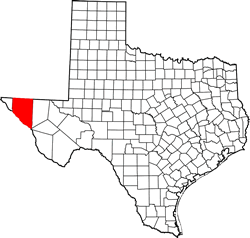
Elizario, the salt lakes here
were the cause of the much written about San Elizario Salt War. It's
an interesting chapter of Texas history and is usually included in
most books written about the Texas Rangers.
You can check the Handbook of Texas Online under "Salt
War of San Elizario" for the details, but in a nutshell it was
a non-family feud that came about when a claim for title was sought
for the flats which was thought by many (including the rival faction)
to be public property.
During its seven-year simmer, the "war" claimed fewer than a dozen
lives, but since it involved factions on both sides of the border
and the Texas Rangers as well as the Army, it demands its place as
a (rather large) footnote to El Pasoan and West Texas History. Because
of the Salt War Fort Bliss was reestablished later the same
year it had been abandoned (1877).
See Salt
Warriors: Insurgency on the Rio Grande by Paul Cool
An award-winning history of the El Paso Salt War |
 |
|
Salt
Flat History in a Pecan Shell
The physical town of Salt Flat can be traced back to a vegetable
farmer who sold produce in Van
Horn. J.W. Hammack was his name and he was employed at nearby
ranches just after the turn of the (19th) century. He raised a family
here and in 1928 his son got wind of a planned highway connecting
El
Paso with Carlsbad, New Mexico. This valuable information was
gotten from the highway surveyors according to T. Lindsey Baker's
Ghost Towns of Texas.
Things were just opening up for the independent driver during this
time as attested to by the opening of the numerous hotels in West
Texas. (See
El Capitan, El
Paisano in our Rooms
with a Past
series.)
A store and gas station were potential gold mines and Hammack had
the location. Almost immediately competition arrived and Salt Flat
soon had 2 stores and 2 gas stations. Both store owners opened cafes
and then "Tourist Courts,"
which were the forerunners of motels.
Flying over the Guadalupe
Mountains was difficult before aircraft cabins were pressurized.
An early passenger airplane crash in 1932 prompted the government
to create an emergency landing field at Salt Flat. FFA personnel
manned the field 24 hours a day until technological advances made
it obsolete in the 1960s.
|
Visits to Salt
Flat, Texas
|
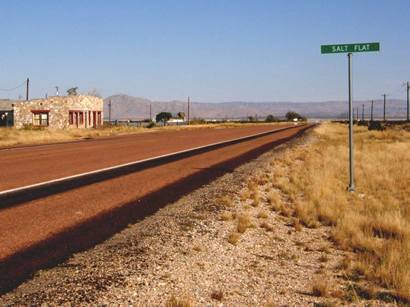
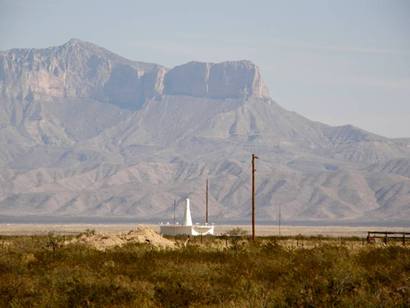
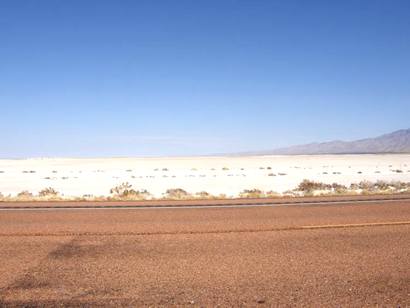
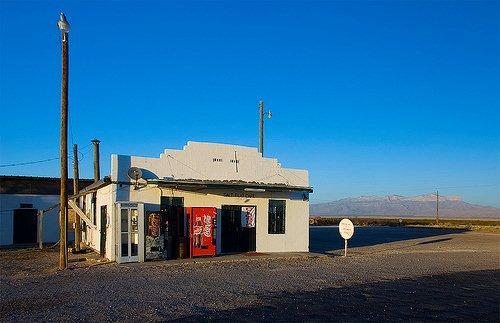
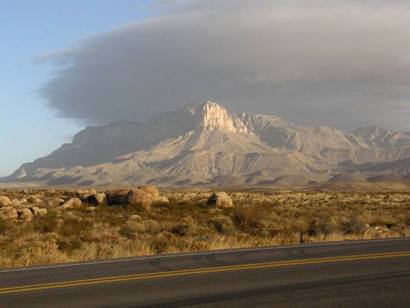
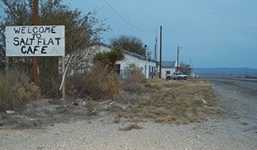
Approaching
Salt Flat from the west
Photo Courtesy Barclay
Gibson, November 2009 |
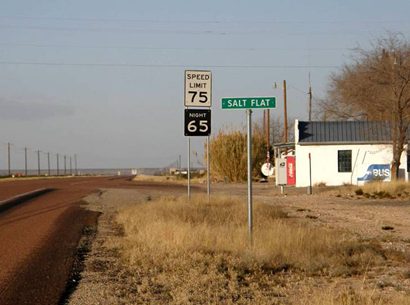
Phoographer's
Note:
"On entering a town it is not uncommon to have a reduced speed
limit sign, 55 mph or even 35 mph, right there with the Road Sign.
At Salt Flat there is the 75 mph sign as if that should be your minimum
speed through the berg." - Barclay
Gibson |
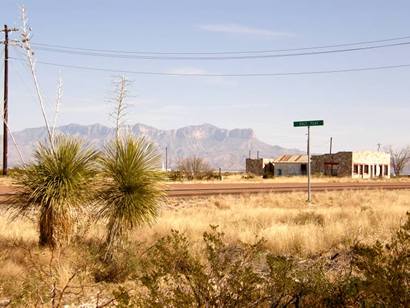
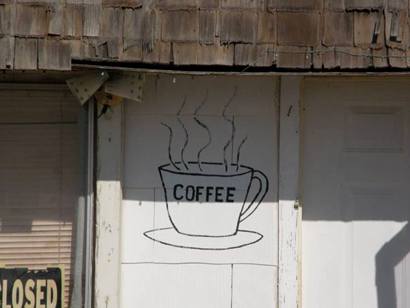
Is
the cup half full or half empty?
Photo Courtesy Barclay
Gibson, November 2009 |
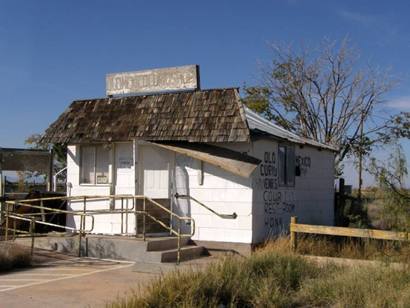
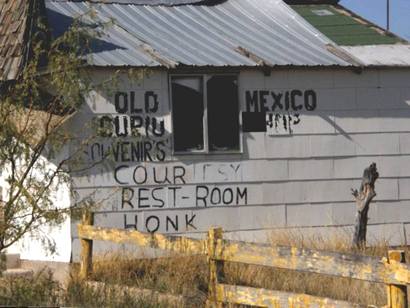
Honk
- Courtesy Rest-Room
Photo Courtesy Barclay
Gibson, November 2009 |
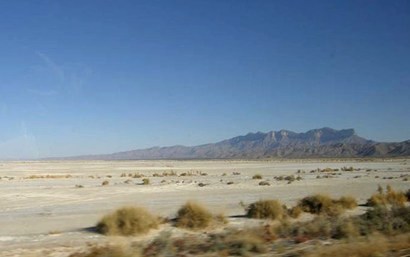
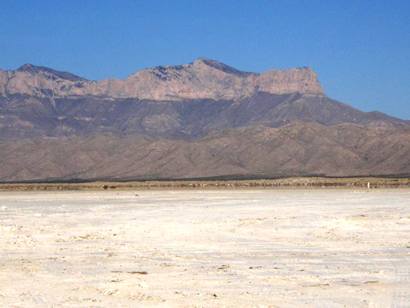
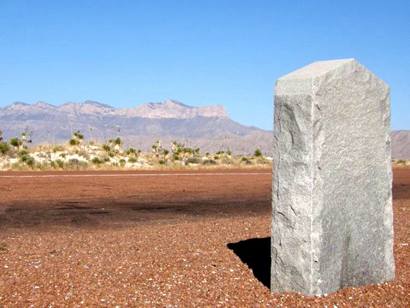
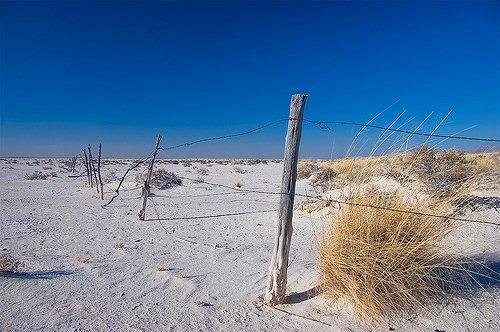
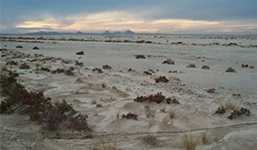
The salt came
from shallow lakes that formed after rains in the Guadalupe Mountains.
It was "mined" for cattle as late as the 1930s, but wells drilled
in Dell City lowered
the water table to where there was less and less salt deposited.
Photographer's Note:
"Don't confuse the salt lake with the 'town', Salt Flat. Two
different and distinct entities, separated by about 5 miles."
- Barclay
Gibson |
Salt Lake,
aka Guadalupe Lake, War
Photographer's
Note:
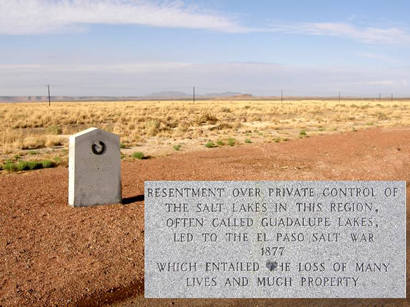
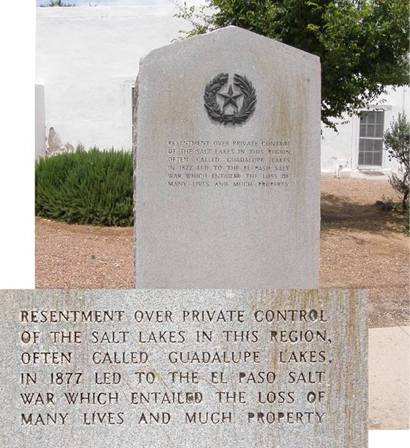
"There is a second marker southeast of El
Paso in San
Elizario. Here are both. Note the similar but not identical wording
on the markers." - Barclay
Gibson |
Salt
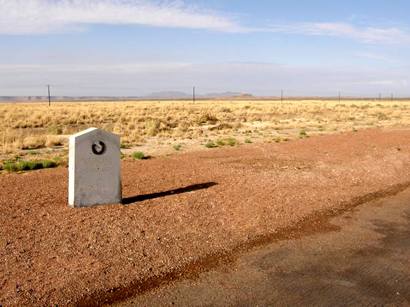
War Centennial Marker
Photo Courtesy Barclay
Gibson, November 2009 |
El
Paso Salt War Centennial Marker Text
Resentment over private control of the salt lakes in this region,
often called Guadalupe Lakes, led to the El Paso Salt War 1877 which
entailed the loss of many lives and much property. |
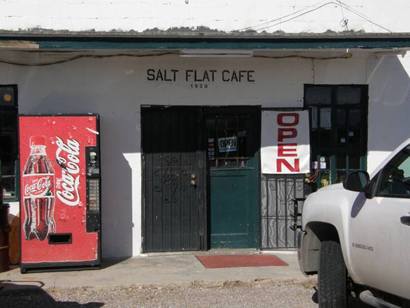
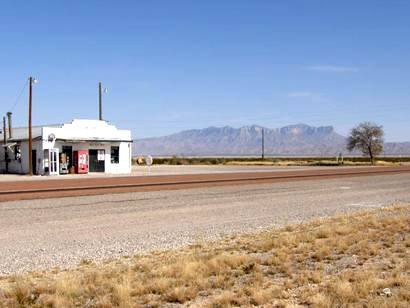
Salt Flat &
Salt Flat Cafe
|
|
Salt
Flat Cafe Turned 75
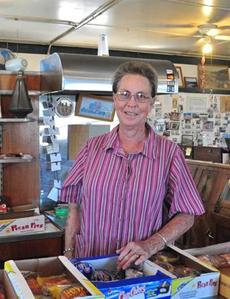
"I just wanted to let you know that after the death of my mother,
Isobel Hammack Gilmore, I have started taking care of the Salt Flat
Cafe. It will be 75 years old on November 20, 2004. I don't plan
a great big celebration but would like people to know that it is
still in operation, we still have bus service and are still cooking
good meals. We still offer the same friendly service that my Grandparents
and Parents offered. Come and see us. I am still working on getting
the many many pictures of the history my family left me. Thanks"
- Shirley J. Gilmore Richardson, June 08, 2004
Salt Flat Area Hotels:
El
Paso Hotels | Van
Horn Hotels
|
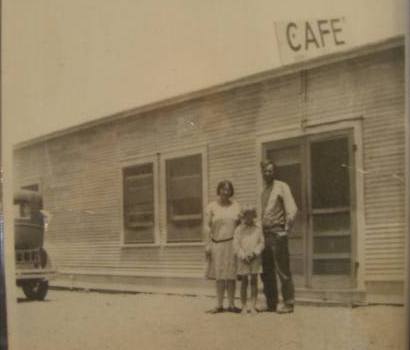
Ona
Hammack, Ed Hammack and Isobel Hammack Gilmore
1929 photo on display in the Salt Flat Cafe
Photo Courtesy Barclay
Gibson, November 2009 |
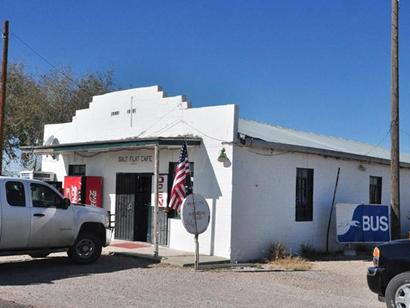
"We still
have bus service"
Photo Courtesy Gerald
Massey, November 2009 |
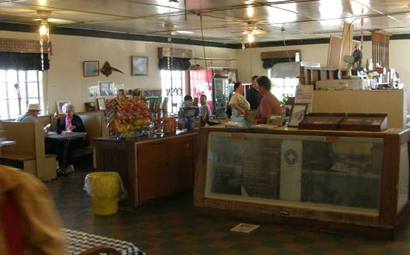
"We are
still cooking good meals"
Photo Courtesy Barclay
Gibson, November 2009 |
"We
still offer the same friendly service that my Grandparents and Parents
offered..."
Photo Courtesy Gerald
Massey, November 2009 |
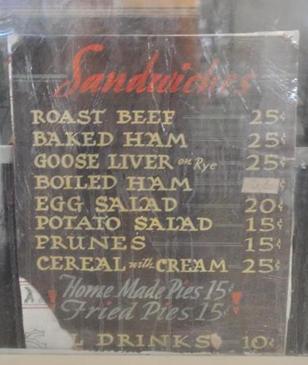
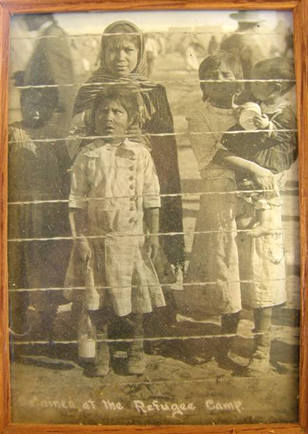
Pancho
Villa Refugees
"The many many pictures of the history my family left me."
Photo Courtesy Barclay
Gibson, November 2009 |
 |
Subject:
The "second" cafe in Salt Flat
I am a near-native of Salt Flat Texas. Though I was born in El Paso,
my mother was from Salt Flat. My grandparents, Clyde and Catherine
Grable, owned the "second" cafe in Salt Flat. I remember it well,
as we lived there for a number of years and spent many vacations
there. It was a wonderful place for a boy to live, full of hot sun,
thunderstorms, horned toads, bats (lived in the garage), snakes
and other desert dwellers. As a teenager spending the summer, walks
across the desert with a 4/10 shotgun in hand was heaven. There
are many adventures that occurred naturally there that now, seems
more adventurous than the urbanized/civilized man I've become. My
parents are both alive, though my grandparents have passed on. Eighteen
years ago I visited Salt Flat, many years after my grandfather sold
it. Nothing remained that I remembered and the only thing remarkable
was the amount of grass visible, nurtured from the sand by a rare
rainy season. Though I would like to hear from others who might
remember my family, I'm not sure any survive. There are many stories,
names and events I know we could hash over. Perhaps, if anyone remains,
we could talk about going to the movie in Dell
City, or "headlighting" jackrabbits on the airstrip or back
highway to Dell
City, or picnics at McKittrick Canyon or visits to Ma and Pa
Glovers at Nickel Creek. I know my mother was glad to leave there,
but I wish it was a place to which I could return.
I would be glad to hear from others concerning Salt Flat. There
is a lot of history, both personal and "Texas-type" that would be
fun to share. My email address is mbmlpcctl@hotmail.com. Please
share this. Thanks for your time, Mike Mitchell, June 03, 2006
|
 |
Clearing
the First Rangeland, and the Salt Flat Cafe
I may be the only person alive today that helped clear the first
rangeland near the location where Dell
City is today.
In 1946 a group of Lynn
county farmers went to Salt Flats to grub out the Mesquite trees
and turn this ranch land into farming land. Thad Smith and his brother
Ores Smith. Thad Smith owned the Hd 14 Alas Chambers Crawler that
the grubbing ploy was mounted on. The two drivers of this rig were
Harley Smith, and JB Williams. Harley and JB were brother in laws,
Vera Harley's wife also lived at the camp or near by, they slept
in their 40 model Ford. Camp was a little shotgun one room house
that most of us slept and eat in, everyone had his army cot and
a change of clothes.
I remember the old Cafe. I think it was sort of a cafeteria style
back then. We had been home for a few days and were returning to
camp and back to our jobs and we would always stop at Salt Flats
and have apple pie and coffee. On this trip JB and his sister Vera
had brought along their (Getair) and Mandolin, and they played on
and on and on, everyone would holler one more time. Pilipino Baby.
To get to the place where we camped we would turn north just east
of the Salt Flat Cafe and down a cow trail road through I think
seven gates, I know I got smarter as I would always try to set in
the middle so I wouldn't have to open those gates, I was just a
boy at the time, my job was burning the brush that my dad and uncle
raked up into big piles. With a big rake they had invented and welded
with our little farm welder and hauled all the way over to Salt
Flat on a bob tail truck.
The first crop that was planted was Alfa, it didn't turn out very
well because they had the land in borders, and were going to use
flood irrigation like they use to do over in the Hondo valley, well
the water wouldn't flow the way it was supposed to and Mr. Stone,
the big boss decided to level it after it had been planted so all
of the Alfa ended up at one end of the field.
The thing I remember most is how that dirt would make my hair stand
straight up and my mom would say I looked like I had been plugged
into a light socket, I was 14 years at the time. I worked through
the summer and up into the fall then had to go back home and go
to school, we were always late getting into school as we would have
to pull cotton to pay for shoes and a coat to wear to school, that
was the good old days.
There was a government trapper working that area back then and he
would stop by our camp every time he was in that area and I would
get to go with him and help him run his trap line. Coyotes and Bob
cats was what he would catch most of the time. When the rabbits
ate up the cotton I'm sure there were folks that would have liked
to have had the Coyotes and Bob cats back.
Dad and I, along with my wife and son and my mother drove over to
Dell City in
1958 just to see the town and to look around some and we felt kind
proud that we had a little part in making that happen, we were the
first ones to acutely start the farms. They pumped the first water
into reservoirs and that was part of my job at times to watch for
Gopher holes in the dams, it would wash out in a short time and
no way you could stop it once it got ahead of you and that shovel.
I have rambled on more than I should have but when I saw your story
and how you had opened the old Cafe up again it brought back lots
of memories, and all the folks that I went out there with are all
gone on but they are the ones that got it all started. Thanks for
listening I would like to do it all over again. - Glen Lowe, Lubbock,
TX, August 08, 2005
That excellent,
definitive style is present again in the Salt Flats article. I cannot
begin to express the extreme enjoyment I received while reading
the story and allow me to also offer "congrats" to Jason Penny for
the excellent photos, which really added to the "being there experience".
- Mike Gerrick
|
 |
 |
The Mayor
of Guadalupe
Pass
I am elated to find your magazine and your article on Guadalupe
Pass. I was once called the Mayor of Guadalupe Pass. This may
seem strange but it's true. I lived two miles South of Guadalupe
Pass for several years. I also lived at Salt Flat, Texas and taught
(other) young men to fly from the Salt Flat Intermediate Landing
Field. I climbed to the top of Guadalupe Pass long before it became
a National Park and I fell in love with the entire area. This was
back in 1948 and it was a once-in-a-lifetime experience for me.
I flew by (and around?) El Capitan for many years en route from
Midland
to El
Paso. My good friend Bertha Glover and her husband owned the
Pine Spings Cafe.... Mrs.Glover received a letter one day from a
lady in Fort Worth,
addressed to "The Mayor at Guadalupe Pass." Mrs. Glover designated
me to be the Official Mayor because she said she had that "authority."
I did answer the letter as I figured a Mayor from Guadalupe Pass
would. I have both of these letters in my files and will try to
send them in when they are found. You are doing a superb service.
There is a lot of lost Texas History and [only] a few of us Ol'
timers still around. I might as well "fess up" - I was 86 years
old in November this year. - Sincerely, David Finnell, Hurst, Texas,
The Former Mayor of Guadalupe Peak, December 8, 2007
El
Paso Hotels > Book Your Hotel Here
|
| Texas
Escapes, in its purpose to preserve historic, endangered and vanishing
Texas, asks that anyone wishing to share their local history, stories,
landmarks and recent or vintage photos, please contact
us. |
|
|
 HOME
HOME