|
|
Texas
| Feature | Texas
Books
Salt Warriors:
Insurgency on the Rio Grande
by Paul Cool
Chapter 10:
“Our county is in open insurrection.”
|
|
Despite
the drought, 1877 was a profitable year for some local merchants.
Charles Ellis expanded his operations in September, buying John Campbell’s
large flouring mill and reportedly “doing a smashing business milling
and merchandizing.” John Atkinson was likewise “doing a good business,”
and so was El
Paso merchant Don Ysmael Ochoa. By no means was the region booming.
Ernst Kohlberg was vehement in his advice to younger brother Moritz
to look elsewhere in America for his fortune, for “conditions here
are not promising at present.” El
Paso before the railroads was no place for a callow newcomer to
elbow out the established merchants.
That year Father Bourgade’s parishioners broke ground on a new church,
the fourth in San
Elizario’s history. Flooding had seriously damaged the third structure,
so the citizens first elevated the ground beneath the new structure’s
foundation with dirt hauled to the site in their reliable carretas.
In 1882, the graceful new chapel was consecrated. It stands today,
a testament to the mound building.
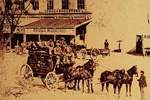
Louis Cardis had big plans. In mid-September he stopped in Mesilla
to complete arrangements for a coach line between that town and Paso
del Norte, Mexico. The stretch represented a gap in direct stagecoach
service between San Diego and San
Antonio that Cardis intended to fill. He also made arrangements
for his customers to be able to purchase tickets as far as St. Louis
“at remarkably low rates.” According to the Independent, “Mr.
Cardis has met and overcome many obstacles in bringing about this
happy result, obstacles that would have dismayed and discouraged a
man of less energy; and he is not only entitled to great credit, but
also deserves a liberal support from the traveling public.” Both his
Texas & California Stage Co. and his El Paso Stage Line boasted four-horse
Concord coaches and “good meals” at fifty cents each. In other good
news, a telegraph construction crew guarded by the Army had brought
the wires down from Mesilla to within twenty-seven miles of El
Paso. |
 |
 |
Saturday,
September 29
Others
might take Cardis’s stagecoach, but not Charles Howard. He stepped
aboard his carriage for the two hundred-mile journey from Franklin
to Fort Davis,
where court business demanded his presence. He had two stops to make.
José María Juárez and Macedonia Gandara had threatened to gather Guadalupe
salt without paying, and Howard was finished with threats. In Ysleta
he picked up Deputy U.S. Marshal Ward Blanchard and Sheriff Kerber.
They continued on to San
Elizario, where they found County Judge Gregorio N. Garcia (not
the captain). Howard swore out an affidavit against Juárez and Gandara,
charging them with intending “to go to the salt lakes . . . and take
salt without the proper permission.” Howard sought a restraining order
with teeth. He asked that the defendants “be put under bond, that
they would not interfere with the Lakes.” Judge Garcia, rumored to
be in Howard’s pocket, issued an arrest warrant for Gandara, Juárez,
Mauro Lujan, and four others. Howard waited for the sheriff’s action.
Later that day, Kerber hauled Gandara and Juarez before the judge.
Faced with fine or incarceration, Gandara testified “that he had no
intention of going to the salt lakes, nor of breaking the law in any
way.” At Howard’s request, the charge against him was dismissed. When
no convincing evidence was introduced against Juarez, Howard laughingly
said, “I reckon we will have to dismiss the case against him too.”
Not understanding English, Juárez “jumped up and said, in a very threatening
and insulting manner to the court,” that he would go to the salt lakes.
He added, “in a vociferous manner that he did not care about the law;
that if others went to the salt lakes, he would go also.” Now really
worked up, Juárez proclaimed that he would go to the lakes whether
or not anyone else went. Garcia ordered the sheriff to arrest Juárez,
pending payment of a two hundred dollar bond. Kerber returned to Ysleta,
presumably with his prisoner in tow.
At about 10 p.m., Judge Garcia was rousted from bed by armed men demanding
a warrant for Howard’s arrest. He told them to file a complaint first.
Grumbling, they left. A few minutes later, Garcia went out to investigate
the clamor in the town plaza. He was stopped by Desidario Apodaca,
who pointed a rifle in his direction. Forty-five years old, Apodaca
was like many in his community: a farmer who answered the call when
danger threatened. He had done so as one of Captain Garcia’s Texas
Rangers. Now, taking aim at Judge Garcia, Apodaca marched him down
to the home of Leon Granillo, where “a great many men fully armed”
gathered. Somewhere else in town, Judge Garcia’s older brother, Justice
of the Peace Porfirio Garcia was being held prisoner. He too had refused
to sign a warrant for Howard’s arrest.
These stillborn attempts to secure a warrant illustrate a practical
notion of Anglo law. Seeking action, Apodaca and the others had been
presented with demands for paperwork, the first and last refuge of
lawyers. As parties, witnesses, and jurors, Paseños had watched pettifogging
Anglo attorneys grind away at one another with little result. Charges
filed, charges quashed; motions made, cases continued; justice delayed,
justice denied. They accepted the desirability of cloaking their actions
in the law, but what they really desired was justice granted.
Holding two reluctant jurists hostage assuaged no one’s anger. It
was now that the junta discussions and decisions of the past summer
bore fruit. The “fully armed” men collecting in town knew what had
to be done. “Soon after Howard passed San
Elizario, the Mexicans began to boast that the party gone ahead
to play jimjam on Howard and would soon have him so.” Meanwhile, his
business completed, Howard had climbed aboard his carriage that evening
and with employee Wesley Owens headed down the road to Fort
Davis. They stopped for the night six miles down the road at Quadrilla,
ignorant that behind them, Howard’s world was collapsing. |
Sunday, September
30
John
McBride, the salt agent’s own agent, had escaped the insurgents’ attention
and, “getting wind of the plot, went full chase to overtake Howard
before he was ambushed.” He reached Howard around midnight. The latter
fumed, “if Cardis don’t let me alone, I’m going to kill him. I’m going
to kill him anyway, for he has been bothering me long enough.” Howard
led his party back up the Rio Grande along the Mexican side before
crossing back to the United States at Ysleta. Early in the morning,
they reached Kerber’s home. From him Howard learned that the two Garcias
had been “roughly treated” and that bands were scouring the county
in search of him. The sheriff and salt agent, along with Owens and
McBride, took to the safety of Kerber’s roof. Meanwhile, word that
Howard was now in Ysleta reached San
Elizario. A contingent of several dozen armed Paseños marched
that evening for the county seat, vowing to bring him back.
The names of the determined men seeking Charles Howard are mostly
unknown. Their leaders were solid citizens, not young firebrands.
Lino (Leon) Granillo was sixty-two years old. His sons Luis (age twenty-five
in 1877) and Pedro (age twenty-three) may have trod beside or behind
their father. Perhaps no Paseño was more resolute that night than
Granillo’s co-leader, fifty-year-old Francisco “Chico” Barela. We
have met Barela before, as a corporal in Lieutenant Montes’s company
of Texas Rangers. His thirty-three acres of Ysleta farmland may have
been modest, but he was well off enough in 1870 to have two domestic
servants. With a wife, several still small children, and a property
stake in the community, Barela had much to consider beyond anger at
Howard. Overturning established legal authority was not something
he could take lightly. The thoughts of all these men as they marched
through the night are not recorded, but they must have felt both the
gravity of their actions and the lifting of a heavy burden that often
accompanies the resolution to put aside talk and do something. It
is likely that the men echoed the jumbled thoughts of their leaders
with grim remarks, encouraging shouts, and grisly jokes rising above
the steady rhythm of their leather soled and bare-footed search for
Howard. |
Monday, October
1
What
happened next is uncertain. According to Howard, Kerber thought it
best to get his wife Julia away from their endangered home. The sheriff
and Mrs. Kerber took off down the road for the safety of a neighbor’s
house. On the way back, Kerber “was surrounded by a band of armed
Mexicans” and held captive. Kerber recalled a more heroic scene. Sometime
after midnight, the contingent from San
Elizario united with Ysleta’s “militia” and marched in the darkness,
some fifty strong, on the sheriff’s house. According to Kerber, he
was there to meet them. If so, he had not changed in the fifteen years
since Glorieta Pass. Acting with the same bull-headed fearlessness
Captain Kerber had displayed in battle, the sheriff attempted to seize
the initiative from the angry throng. Leaving the roof, he stepped
outside and ordered his unwelcome visitors to disperse. The tactic
failed. Kerber was seized, disarmed, and taken a mile out of town
to the insurgents’ local headquarters. As they passed the home of
County Clerk G. W. Wahl, the sheriff called for him to join the parade,
which Wahl did.
Kerber and Wahl were taken by sixty men, “some of them from the other
side of the river,” back to the sheriff’s house. There the growing
insurgent force called for Howard to surrender, promising not to kill
him. After twenty minutes of fruitless dialogue, Barela and Granillo
arrived to take command. Howard asked why they wanted him prisoner.
“The people wish it,” was the simple reply. Howard refused to submit,
claiming the sheriff’s protection. As Kerber described the scene,
“Judge Howard spoke to them mildly, explaining to them the law about
mobs, &c., but they did not care.” Howard put it more bluntly: “They
said . . . they knew no law excepting their guns.”
Barela was finished with negotiation. As Howard later described his
ordeal, “I was seized by two of the men and dragged through the streets
of Ysleta, surrounded by forty armed men, hooting and jeering at me.
Near the plaza they were joined by twenty-five or thirty more and
I was forced on horseback and taken to San
Elizario. The whole mob followed, and yelled, hooted and jeered
the whole way. . . . On reaching San
Elizario, I was taken to the house of Dona Apolonia Lujan. There
I found from 200 to 250 more Mexicans under arms—a more sullen, ferocious
looking body of men, I never saw—I was taken to a room in the house,
and immediately placed under a heavy guard.”
Wahl was immediately set free, but McBride, also herded back to San
Elizario, was tossed into Lujan’s home with Howard and the unhappy
Garcia brothers. For some reason, the Paseños let the sheriff go,
though his attitude toward all “Mexicans” cannot have been a secret
to them. In his report to the treasury secretary, Slade explained,
“In the morning, Sheriff told [his captors] he wished to go get his
breakfast, after which he would return to them; but he came to El
Paso instead.” In his own report to Adjutant General Steele, Kerber
does not mention the breakfast ruse. He simply explained, “Not having
more than four white men in my town, and the Mexicans all in favor
of killing us gringos, I started to El
Paso.” |
Tuesday, October
2
Not
until Tuesday did Cardis learn of the arrests from J. R. Mariani,
who “asked me to go to San
Elizario and use my influence to pacify the excited people, which
I did.” Cardis received a more confrontational visit from Kerber,
who suspected Cardis to be “the instigator of all these troubles.”
Kerber “told him plainly what I would do if Howard was injured.” Cardis
got the message. Promising the Anglo community to secure the release
of all prisoners, he set out for San
Elizario.
There the scene was ugly. When not milling about, many of the hundreds
there paraded through the streets proclaiming “Death to the Gringos!”
and “Long Live Mexico!” Meanwhile, the Paseño leaders were discovering
an age-old truth. Starting a revolution was far easier than realizing
its purpose. Howard remained defiant. “[B]ecoming alarmed at what
they had done” and at what might ensue, several of the leaders, including
Sisto Salcido, the elected “commander” of the September uprising,
Macedonia Gandara, Ambrosio Orgino, and Desidario Apodaca called on
their parish priest. According to Father Bourgade, “the leaders came
to me and wished me to help get them out of trouble.” Admitted to
the makeshift cell, Bourgade spoke with Howard, “who said that the
mob were ignorant men, and that he would not prosecute them for what
they had done to him, but that some of them might be prosecuted for
what they had done to the judges.” Howard’s refusal to cooperate unnerved
some Paseños and fortified others in their resolve. As Bourgade testified,
the leaders “wanted Louis Cardis to come down and get them out of
trouble, as he was more or less the cause of their getting in.” The
crowd outside, however, “intended to kill Howard.”
Kerber, meanwhile, began telegraphing for help, including Judge Blacker
at Fort Davis
and General Steele and George Zimpelman in Austin.
Kerber and Deputy U.S. Marshal Blanchard then went to Ysleta to be
closer to the action. They remained only two hours. Finding the place
too dangerous, they “charged through their lines of sentinels and
got safe to El
Paso on Wednesday.”
Back in Franklin (modern El
Paso, Texas), Rucker had telegraphed the news of civil disorder
to Santa Fe. The situation was serious. The sheriff, said Rucker,
wanted the army “to disperse the mob and preserve the peace; . . .
there are not enough Americans living in the county to form a force
sufficient for the purpose. The Mexicans who are not with the rioters
sympathize with them and cannot be relied upon nor obey his summons
to act as a posse.” Kerber added that “the mob numbers over three
hundred and have sent to El Paso, Mexico for aid.”
When Cardis finally arrived in San
Elizario, he “found the people very much excited against Howard
only.” He and Bourgade held discussions with one of the leaders in
the priest’s home. The man was bent on Howard’s death. According to
Cardis, “I begged for his life with all my might.” Personal business
rescued Cardis from his awkward position around midnight. His coach
station at Eagle
Pass had just been attacked by Indians, the hay cutter killed,
and the mules run off. His drivers were now refusing to carry the
mail without an escort. Cardis remained in talks until “satisfied
that the people had taken my advice to let Howard and all the rest
free.” The legislator left San
Elizario at 3 a.m., removing himself from events he could not
control. Bourgade remained to learn what Cardis missed, or perhaps
already knew. The Paseños had not agreed upon any deal, but continued
to argue among themselves. That night, one of the leaders had “to
push some of the mob away to keep them from killing Howard.” One leader
admitted “it looked very bad.” |
Wednesday,
October 3
The
first reports reaching Austin
were ominous but confusing. General Steele wired Kerber, “Send statement
of mob action. Was it composed of citizens of your county or of Texas
and where and by whom organized[?] Was Howard your prisoner and under
your charge?”
As the sun rose on the third day of his captivity, Howard’s captors
continued to demand that he sign over all rights to the salt lakes
and leave the county immediately, never to return. Though he remained
bound hand and foot, cut off from the world, and “at all times surrounded
by three or four hundred armed pelados, raving and raging like hungry
coyotes,” Howard “refused to subscribe to the conditions required
or in any way treat with the mob.” Cardis, probably the only optimist
around, returned to Franklin at 9 a.m. claiming that “all was settled.”
Two hours later, the sighs of relief abruptly stopped when Sheriff
Kerber received word that Howard would be shot at 3 p.m. Kerber immediately
“tried to summon a posse of white men,” but could not find sufficient
arms for the fifteen men in town. Merchant Joseph Schutz gave a more
compelling reason: “Everybody concluded that this force was not enough,
and did not go.”
At this point, Lieutenant Rucker decided to personally investigate
the barrage of rumors of “riot at San
Elizario.” With Joseph Magoffin at his side to translate, Rucker
reached Ysleta, where some citizens advised him to halt “as the rioters
were greatly excited and had threatened to kill the Americans; that
our arrival there would cause the death of Judge Howard.” Veiled threats
had little effect on this veteran of countless occasions of immediate
danger and imminent death. Anxious that his reports “might be authentic,”
Rucker proceeded under the Ysleta priest’s protection.
Meanwhile, Howard’s resistance was angering the increasingly restive
assembly in San
Elizario. Many Paseños had expected quick results. Now, the more
impatient men just wanted to kill their prisoners, go home, and be
done with it. In Howard’s mind, “The mob was growing ferocious every
moment.” The prisoners, overhearing the feverish talk, were aware
of fractures in the insurgents’ ranks.
Sometime around 6 p.m. an exasperated Kerber dispatched a plea to
Second Lieutenant Simon Vedder, commanding the twenty-man detachment
guarding the telegraph construction party near Mesilla. Kerber was
in turn complaining, genteel, avuncular, desperate and patriotic:
“ . . . be so kind as to send us those men, do not depend too much
on your regulation when the lives of all the white men of this county
are endangered. We are about 25 white men but we cannot fight 300,
excuse my remarks but for the honor of the Old Army help me and help
your countrymen.” Kerber signed the letter and added, “An Old Soldier.”
Vedder forwarded the message to Hatch at Fort Craig.
By Wednesday evening, the Garcia brothers had resigned their judicial
offices. Howard alone remained defiant. Earlier that day, Father Bourgade
was admitted to the prisoner’s “cell” in order to administer the last
rites, should Howard wish it. The priest then joined a meeting of
the popular leaders, who “told me they were going to settle it.” Bourgade
worked with the insurgent captains to hammer out a deal that might
end the crisis without bloodshed. The main provisions addressed their
chief goals. First, Howard would pledge not to prosecute anyone for
imprisoning him. Second, he would declare that he had no right to
the salt lakes. Third, he would leave the county within twenty-four
hours, never to return. Fourth, he would give sizeable bonds to ensure
his compliance. The fifth clause had Howard confessing “that the prosecution
that has been commenced against any of the people is unjust, improper
and without cause and that are the people of the county aforesaid
have had just cause to raise against him.” These details and arrangement
of a twelve thousand dollar bond took up most of the day. Four local
men volunteered as bondsmen: John Atkinson, Jesus Cobos, Charles Ellis,
and Tomas Garcia. Some Paseños wanted a provision that the bondsmen’s
lives “should be forfeited” if Howard returned. The clause was not
added, but the four understood the danger in the bargain they agreed
to seal.
Mauro Lujan prepared the document and handed it to Bourgade. The priest
had his doubts Howard would sign. Salcido warned that the people’s
impatience to disband was not good news for their captive. “Tell Howard
to sign anything, whether it is binding or not,” Salcido advised,
“for the mob [Bourgade’s word] may have trouble among themselves.”
To the priest’s surprise, Howard “was willing to sign anything, because
on the night before, from what he had heard, they intended to kill
him.” Howard also realized there would be no rescue. And so he signed,
as did his bondsmen. With that, he and McBride were released. They
stepped outside to face an edgy crowd. A number of rifles were raised
and aimed at Howard. Proving himself “a hero in canonicals, [Bourgade]
threw his arms around Howard and marched through the mob, telling
them they would have to shoot him too.” Kerber agreed that “only the
presence of the priest saved [Howard’s] life.”
As Howard, Bourgade, and twenty armed insurgents reached the outskirts
of San Elizario,
they were met by Rucker and Magoffin. The officer was still bent on
observing conditions in San
Elizario, but Howard and the pastor strongly advised against it.
Together the party rode to Ysleta and then on to Franklin.
And so the insurgents achieved their goals—on paper. Howard had agreed
to leave forever, taking with him his father-in-law’s claims to their
salt. Howard’s oath to give up the fight was guaranteed by four friends
whose fortunes and lives he was not likely to risk. Howard’s puppet
judges had abandoned their seats on the bench. Though Sheriff Kerber
remained in office, he was powerless to arrest anyone, let alone see
them safely to trial. No one was likely to suffer for their part in
the uprising. All had been achieved without any bloodshed. As Howard’s
party rode away from San
Elizario, they left behind a people who had much to celebrate.
|
Thursday,
October 4
Kerber
escorted Howard and his wife out of the county. Armed men followed
his carriage, but the party reached Mesilla in safety. The sheriff
returned to his home in Ysleta. There was, for the moment, peace in
the valley.
Lieutenant Rucker reported to Hatch that “every American in the county
would have been killed had not their terms in Howard’s case been complied
with.” Though he only saw forty armed Paseños, he had been informed
some 350 were under arms, joined by nearly a hundred Mexican citizens.
“They appear to be well organized, and had been preparing this event
for some time; yet their meetings were so secretly conducted that
the civil authorities did not know anything about their movements.”
Rucker reported “that the presence of troops is necessary here, to
protect life and property, and believe that in case this mob is not
put down by force, the Mexicans will either kill or drive every American
out of the country.”
So far, only one man had been driven from the county. Charles Howard
had escaped death, but he had suffered the shame of his treatment
at the hands of a “mob.” Bertram Wyatt-Brown, an authority on the
role of honor in Southern culture during Howard’s time, explains,
“The chief aim of the notion of honor was to protect the individual,
family, group, or race from the greatest dread that its adherents
could imagine. That fear was not death, for dying with honor would
bring glory. Neither was it the prospect of damnation in the hereafter.
Judgments of that kind were in the hands of God. Rather, the fear
was of public humiliation.”
Over the course of three unforgettable days, armed men had bound and
dragged Charles Howard from Ysleta through Socorro to San
Elizario, yelling, hooting, and jeering at him all the way, thrown
him tied hand and foot into a guarded room, weakened his resolve by
talking over his murder within his earshot, and forced him to sign
away his father-in-law’s property rights and to admit that his own
actions had given the people “just cause” to treat him so foully.
When finally released in front of an angry crowd demanding his head,
Howard had been saved, not by his own courage, but by that of the
priest who shielded him.
As Wyatt Brown and other scholars on the subject of honor among Southerners
and politicians (and Howard was both), have pointed out, “honor is
reputation.” He had certainly lost face among Paseños. However “ignorant
and brutal” he considered them, they were still the majority voting
block, a necessary tool of political power and influence until a white
immigrant tide could ride in on the railroads. Worse, his friends
and rivals in El
Paso knew he had folded. More damaging still, he knew word would
spread. Before long everyone would know, from his family in East
Texas and the comrades he had ridden with in the 8th Texas Cavalry,
to the moneymen and power brokers who held the keys to his future.
Among these was Zimpelman, who had entrusted his venture capital in
West Texas to his son-in-law.
From high to low, they would all know he had been arrested and “jailed”
like a criminal, bound like a slave, and humiliated and intimidated
into what would have been regarded as the cowardly act of signing
his name to save his skin.
Stripped of honor, Howard concentrated on its restoration. If his
intentions were not immediately clear, they soon would be, for, as
Wyatt Brown explains, “Dread of being ashamed is a powerful incentive
for revenge and violence.” As his future statements and actions would
make clear, Charles Howard had been given all the incentive he needed.
|
|
|