|
|
|
A
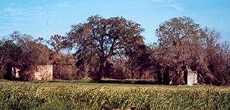
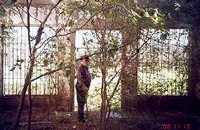
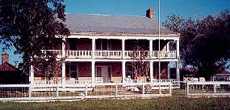
Panoranic View of Old Town Sutherland Springs
TE photo, 2000 |
|
History
in a Pecan Shell
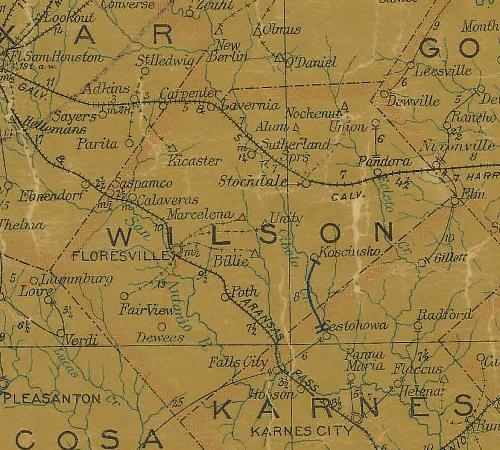
Sutherland Springs was founded by a Dr. John Sutherland
Jr. who set up a post office and stagecoach stop in 1851.
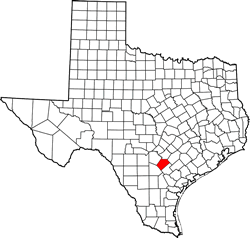
It was officially designated the County Seat of Wilson
County in 1860, but folks were busy during the Civil War and
when it was over, some people preferred Floresville
as county seat and so it was.
When the railroad came in 1877, it became known as the "Saratoga
of the South" for its waters.
You have to look hard to find information on Sutherland Springs
beyond what is found in the Handbook of Texas. To furnish
our readers with more than this we turned to the excellent Taking
the Waters in Texas: Springs, Spas and Fountains of Youth by Janet
Mace Valenza. (University of Texas Press, 2000)
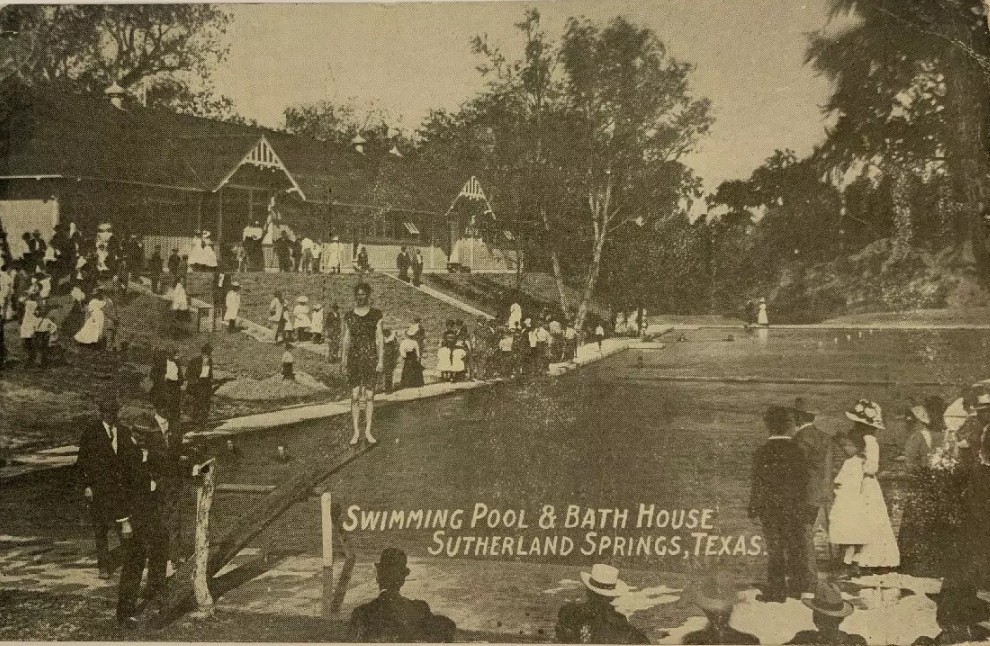
Sutherland Springs was an extremely popular resort and there
was a claim that within a very small area there were over 100 separate
sulphur springs. The main bathing areas were by the river
(Cibolo Creek) and the one with darker water was called "black
springs" and was reserved for men while women used the "white
springs". One legend has it that the waters of the Black Springs
never froze.
Attempts were made to bottle the water from Sutherland Springs and
shares were sold; however no bottling plant ever materialized. The
springs were popular with religious groups for holding revivals
there and after 1917, the US Army contracted to have wounded soldiers
from WWI
recuperate there.
Because of its isolation, trains were about the only way to visit
the springs. During its heyday women and children would take a train
to the springs during the week and then fathers/ husbands would
join them on the weekend.
|
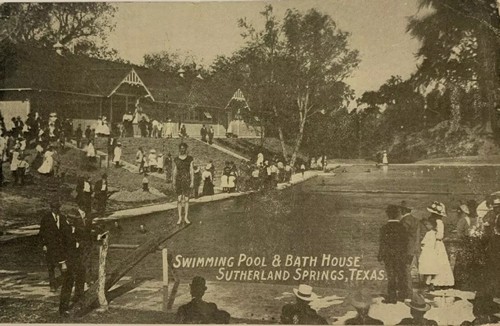 |
Swimming Pool
& Bath House
Sutherland Springs, Texas
Click on image to enlarge
Photo courtesy Danny Whatley |
Sutherland
Springs Landmarks
|
Today
what was Sutherland Springs sits just South and East of the highway.
Two buildings spaced far apart are all that is left of the Old Town,
although there are street signs.
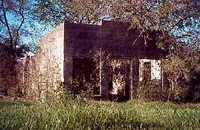
One of the buildings is the former bank. Hackberry trees (and poison
ivy) now grow in the middle of the roofless room and the vault is
still there with its cast iron ornamentation around the door.
Sod farms have become a part of the local economy and the owners of
the old 52 room Hotel Sutherland razed it to have soil to grow more
grass. The building had been closed since 1923.
In 1990
the population is given as 362 (est.), however "old" Sutherland Springs
rounds out at 0.
|
|
|
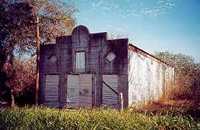
50%
of what's left of downtown Sutherland Springs
TE photo, 2000 |
|
|
The
building that is not the former bank |
|
|
|
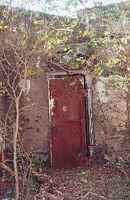
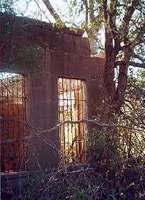
L-
The bank vault
R- Back of bank building |
|
|
The
Joseph Polley House (c. 1850)
still stands on Highway 87 near Sutherland Springs
TE photos,
November 2000 |
Sutherland
Springs Related Stories
Tyrant's
Gold by Mike Cox (Texas Tale Column)
When General Antonio Lopez de Santa Anna came to Texas in 1836 he
left behind death and destruction -- and possibly gold.
|
Sutherland
Springs Forum
Subject:
Sutherland Springs
Dear TE, I just discovered tonight that my great grandparents were
living in Sutherland Springs in 1880.
My great grandmother died in that year. I don’t know where she is
buried. Is there a cemetery in the area? And are there any records
of inhabitants and how long they might have been there?
After her death my great grandfather moved the family to San
Antonio, remaining until his five children were grown and married,
and my mother was born. ( He ended up buried in Seattle but that’s
another story.) Neither she nor my aunt, her older sister, ever
mentioned the Springs. I don’t think they knew about it, or forgot
it, in my aunt’s case. This is all new family history for me and
I am quite excited.
My great grandfather was Harvey Columbus Neal, a Confederate veteran
from SC; his wife was Mary Louise Gee Neal of MS. They had moved
to Texas from Tennessee to “help (Mary’s) father and brother John
with a cattle drive”, and stayed, possibly for the climate - poor
Mary died of TB. I wonder if they settled at Sutherland thinking
that the waters would help her. i believe it was during the 1880’s
that there was a house fire, destroying any family papers and pictures,
so what info I have comes from the 1880 census, courtesy of the
Civil War Trust.
I am a strong supporter of efforts to preserve local history and
so send this in case it is of any value. - Sincerely, Deborah Keeting-Hansen
Sequim WA, January 10, 2015
|
 |
| Texas
Escapes, in its purpose to preserve historic, endangered and vanishing
Texas, asks that anyone wishing to share their local history, stories,
landmarks and vintage/historic photos, please contact
us. |
|
|
 HOME
HOME

 Gulf
Coast
Gulf
Coast East
Texas
East
Texas Central
North
Central
North Central
South
Central
South Panhandle
 South
Texas
South
Texas Hill
Country
Hill
Country West
Texas
West
Texas Ghost
Towns
Ghost
Towns COUNTIES